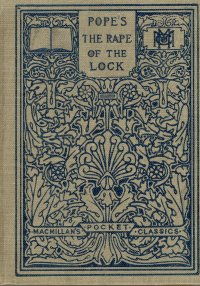
 I thought this was the third of the small century-old textbook editions of Alexander Pope’s that I read this year, the first being a 1901 Riverside Literature Series volume that included “The Rape of the Lock”, “An Essay on Man”, and “Epistle to Dr. Arbuthnot”. I remembered another volume, but it turns out that the Maynard’s English-Classic Series volume including only “An Essay on Man” I found and moved directly to the read shelves and did not count it amongst my reading total because it only contained “An Essay on Man” and not a single other poem that I could have read and thus counted the book (and could have written a book report on that single poem). If only I had read the previous book report before going looking, I would have seen that I explained this all then. But June was a long time ago, man.
At any rate, this century-old textbook is from the MacMillan’s Pocket Classics series and includes:
- “The Rape of the Lock”
- “An Essay on Criticism”
- “An Essay on Man”
- “Epistle to Dr. Arbuthnot”
- “Address to the Goddess of Dullness, From The Dunclad”
- “The Triumph of Dullness, From the Dunclad”
- “Ode for the Music on St. Cecilla’s Day”
- “On Sir William Trumball”
- “To Mr. Gay”
- “On Mr. Gay”
- “Elegy to the Memory of an Unfortunate Lady”
- “Eloisa to Abelard”
- “Messiah”
- “Ode on Solitude”
- “On the Grotto at Twickenham”
- “Universal Prayer”
- “Windsor Forest”
So I did get to read “An Essay on Criticism” which was mentioned prominently in the Great Authors of the Western Literary Tradition audio course, and I thought I was home free–that the other poems would be shorter. For the most part, they were, although “Eloisa to Abelard” and “Windsor Forest” were both several hundred lines of small print long. I bogged down in “Eloisa to Abelard” for a couple of weeks and finished a couple of other books in the interim, but, here is where my larnin’ intersects: In the audio course I am currently listening to, a course on the history of the philosophy of science (or maybe those words transposed somehow), the lecturer talks about Abelard and makes an aside that another of his troubles was Eloisa, and I had this dot to connect it to. Also, the title of the 2004 film The Eternal Sunshine of the Spotless Mind, a film I really enjoyed after seeing in the cinema and at least once since, comes from “Eloisa to Abelard”. Don’t I feel smaht? Sometimes.
At any rate, reading the old, classic literature poets in depth like Keats and Pope here really make me appreciate some more recent poetry more. Much of the poetry they wrote relies on knowing contemporary personages and allusions to contemporary events in addition to the allusions to even more classical (that is, older) works and myths. Blooming heck, even Pindar is this way. And because they were patronized, the poets could and too often did go on at length, leading to the archaisms that I was accused of (and was probably guilty of) pursuing when I was younger (that is, in college). So, okay, I’ve read these guys. But Riley, Longfellow, Millay, and Dunbar? I re-read them.
At any rate, I think I am finally out of these little textbook editions of Pope (although the paperback complete works lurks somewhere in the stacks). But I do have a couple or three of these old green-bound textbooks of Longfellow (not including The Courtship of Miles Standish and Elizabeth which I read in 2024) and not including the really nice sixty-year-old reprint of an older edition of The Song of Hiawatha (which I read in 2018) facing out in the poetry section of ABC Books because Mrs. E. knows I’m a sucker for pretty editions of things I have already read (see also my most recent read of The Book of Five Rings). Hey, wait a minute: The Song of Hiawatha which I read in 2018 is a later reprint of the same book (featuring the illustrations of Frederic Remington). So there’s a slight chance that this edition only differs in the cover. And a slight chance that it’s enough of a difference that I’ll buy it next time I’m at ABC Books anyway.

1 thought on “Book Report: The Rape of the Lock (2) by Alexander Pope (1907)”
Comments are closed.