 After listening to the fifth part of the Great Authors of the Western Literary Tradition lecture series, which included a lecture on Pope, and specifically on “The Rape of the Lock”. And, brother, did that come in handy.
Ah, Pope. The man is more the parts than his sum.
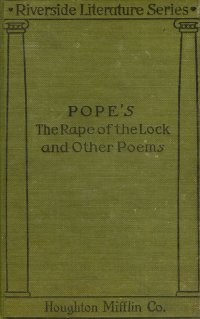
This collection has three poems: “The Rape of the Lock”, which is a poem in five cantos totaling almost 800 lines that depicts an aristocrat who takes a lock of hair from a young woman for his collection, but the poem seems given over to a very detailed description of a card game which is not a game I’m familiar with; “An Essay on Man” which is written to a Henry Bolingbroke (not the Shakespearean Henry Bolingbrokes, though, as Pope was writing in the first part of the 1700s which was 100 years after Shakespeare who himself was writing 200 years after the Henrys in question) and comprises about 1500 lines in four “epistles” which describe man’s nature, nature, and God and the interrelationships and proper places of each, including reason and instinct/passion/what have you; and “Epistle to Dr. Arbuthnot” is a shorter piece, 419 lines, and covers some of the same themes.
Pope writes in couplets, and many of them are eminently quotable. But the individual poems themselves are long, and you might wonder where it’s going–which is why the lecture helped. Pope helps himself by including a summary of the contents of each epistle in “An Essay on Man”, and footnotes by Pope himself and editors of various editions (the original and this edition, presumably) tell us the names of the contemporaneous people Pope is talking about, but that’s not exactly a help or driver into reading large stretches at a time. I exercised some discipline in reading sections, cantos, or epistles completely, much of the time, but this is mostly drawing room poetry to amuse or irritate aristocrats of the time. So while one might want to and actually quote Pope on occasion, it’s not something that many in the 21st century will read for pleasure (see also the complete works of Percy Bysshe Shelley, the second and longer part of The Complete Works of Keats and Shelley, set in a holding pattern behind a stack of literary magazines and Ideals).
At any rate, let’s see what I flagged during my slog.
-
Trough worlds unnumber’d though the God be known,
‘Tis ours to trace him only in our own.
He, who through vast immensity can pierce,
See worlds on worlds compose one universe.From “An Essay On Man”, early in Epistle I. Given all the headlines about UFOs in government files recently, one question is how religion would adopt. In the 18th century, Pope was nonplussed by it. I imagine the Judeo-Christian religions would adapt.
-
Who wickedly is wise, or madly brave,
Is but the more a fool, the more a knave.I think I will put this on my business cards. If I ever order any again. The last batch has lasted almost 17 years, and the box is still half full, which is how a pessimist describes his box of business cards.
-
One from Grubstreet will my fame defend,
And more abusive, calls himself my friend.
This prints my Letters, that expects a bribe,
And others roar aloud, “Subscribe, subscribe!”Shades of the modern Internet culture in penny publishing in the 1700s.
I had a couple other things flagged, but I didn’t remember what I wanted to say about them.
As you can see, the couplets are generally a little epigramatic, flow together, and as I was reading along, I was following; however, at the end of a piece, I was like, “What’s that all about” even though at a high level I knew what and I enjoyed a couple of couplets along the way, the whole did not strike me as greater than the sum of some of the couplets.
Ah, well, I am a product of my times, prefering short, punchy, and pointed poems.
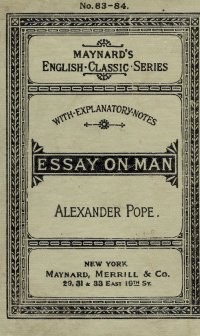 After I read this book, I came upon, shelved just a couple of similar Riverside Literature Series down, “An Essay on Man” in a similar Maynard’s English-Classic Series edition. Unlike the Walter J. Black Classics Club editions, which were marketed to middle class adults, these editions were college textbooks, and it shows. The book I read has faded pencil notes on the front flyleaf, and “Rape of the Lock” has underlining and margin notes. Which, gentle reader, probably means that more than one student used this as I’m pretty sure “dialoging with the text” was not an early 20th century thing. An LLM indicates it was mentioned in an influential 1940 volume called How to Read a Book and became widespread in the 1960s, and this tracks with my experience–editions of classics I have starting in the 1960s start showing this juvenalia marginalia about then. Essay on Man, this other edition, does not indicate such.
I will just move this second book to the read poetry shelves with the one I read, and I’ll put it in by the old and mylar-wrapped complete works of Pope. I have a paperback copy of the complete works of Pope as well around here somewhere, but I won’t be in a real rush to read the rest now.