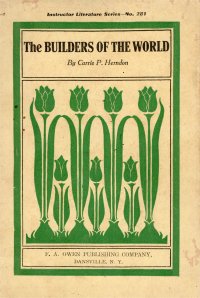
 So I’m a little bogged in my disciplined reading these days–I try to do a section or chapter of The Life of Greece, a couple or twenty things in the giant listicle 1001 Ways to Be Romantic, and a chapter in The Complete Idiot’s Guide to Karate (somehow, trying to clear books from my chairside table has in fact added these last two books to the pile). So I thought I would prowl my stacks for some of the pamphlet-sized single short stories like “The Yellow Wallpaper“, some short fiction that I could use to break up the current stream of nonfiction without committing myself to a full book and which I could count as a “book” for the annual total. But I came across a stack of “Instructor Literature Series” booklets from the early part of the 20th century. And this book was on the top, so I grabbed it.
It’s a 29 page (including a quiz at the end) treatment of geology at the macro scale. The book talks about the then-contemporary understanding of the formation of the earth and its processes. I say then-contemporary because it only mentions igneous and sedimentary rock types, and although it does talk about slate and whatnot, it does not break these rock types into metamorphic rock like we do today. And, the book has, if not overtly Christian, then certainly a Deist perspective as it mentions that God put this all into motion.
I looked a little into the history of this series, and it was a New York (state) guy who made, eventually, 350 of these titles available for school teachers. Inexpensive, compact, and a ready-made lesson (of various difficulty levels). Remember, in the days when these were published, one-room schoolhouses were still common and Horace Mann’s acolytes had not destroyed schooling. I imagine those hard-pressed teachers treasured these little books, and the search engine AI tells me they’re sought after by collectors, but Ebay indicates they’re not that rare.
So I’ll probably work my way through the stack so that I can refresh myself to 1910s-era knowledge as a break from The Story of Greece which is 1940s-era knowledge (although history has not advanced as science might have). As a break from my little early 20th century hardback textbooks like the Riverside Literature Series and MacMillan’s Pocket Classics which I’m also using as a break from other things, although in the case of Alexander Pope’s longer poems, I’m taking a break from them by reading thousand page eighty-year-old history books.
But I assure you that the stack of books on the side table is slowly diminishing. Glacially slowly.
1 thought on “Book Report: The Builders of the World by Carrie P. Herndon (1913)”
Comments are closed.