Police, teens split on need for them
The need for police or the need for teens? Silly reader, the St. Louis Post-Dispatch headline writer is relying on the often overlooked grammatical precept of the implied antecedent, in this case, “curfew.”
To be able to say "Noggle," you first must be able to say "Nah."
Police, teens split on need for them
The need for police or the need for teens? Silly reader, the St. Louis Post-Dispatch headline writer is relying on the often overlooked grammatical precept of the implied antecedent, in this case, “curfew.”
Buy My Books!

Sunset Hills project wants tax break:
The Sansone Group has proposed constructing an office-retail complex to replace the 35-year-old Holiday Inn motel-Viking banquet center on the northwest corner of Lindbergh Boulevard and Watson Road in Sunset Hills.
The developer is seeking $12 million in government assistance for the $48.2 million project. The aid would be via tax increment financing and transportation development and community improvement districts. Each district would levy one-cent sales taxes.
This is already not newsworthy, ainna? As the contracts are written in English, so they come with hands extended for money from the citizens of the “growing” or “revitalizing” area.
Buy My Books!
Story: Alorton police chief grazed in shooting.
Hedge:
Police chief Robert Cummings was grazed in his arm by a bullet apparently fired by another man during a drug stop, Illinois state police said today.
The Post-Dispatch does not completely eliminate the possibility of a self-inflicted wound.
Buy My Books!
It’s a stretch to claim I read this book, since most of its contents are postage-stamp sized (almost) representations of Impressionist and Post-Impressionist art, but it has some introductory text that explains the background of the movement and its exhibitions in Paris in the 1880s. So I gleaned that bit of knowledge as well as determining that my second favorite Impressionist, far behind Renoir but still second, is Mary Cassatt.
So if you’re into Impressionism, it’s a good little book to show some of what’s included in the National Gallery of Art’s collection.
Buy My Books!
In this blog’s very first post, I warned about the provisions in rescue group contracts that you signed to take a pet from them:
When my wife and I wanted to adopt a rescue dog, we had a hound visit our house, mainly to see if it wanted to eat our cats. The rescue volunteer provided a packet of information about dogs and a contract we would have to sign to take possession of the pooch. The contract included house inspections at will of the rescue group. It could also take the dog back at any time if it found our conditions “unsuitable, which includes but not limited to…” a non-exclusive litany. If we lost the dog; we’d pay the rescue group a thousand dollars, even if we “lost” the dog ten years hence when it died and we did not notify the rescue group in 1 (one) week.
Obviously, Ellen DeGeneres is not an avid MfBJNer:
Ellen DeGeneres is in the doghouse with a pet rescue agency after giving a pooch away to her hairdresser because it didn’t get along with her cats.
The talk show hostess and her partner Portia de Rossi adopted Iggy, a Brussels Griffon mix, on Sept. 20. But when things didn’t work out, DeGeneres gave the dog to her hairdresser.
In doing so, DeGeneres violated an agreement with the Mutts and Moms dog rescue agency by not informing them of the handoff.
When the agency called DeGeneres to ask about Iggy, she said she found another home for the dog. The agency sent a representative to the hairdresser’s home Sunday and took the dog away.
The entertainment industry takes note:
DeGeneres went public about the situation Monday while taping an episode of her show to air Tuesday. She admitted she didn’t read all the paperwork involving the adoption.
Ellen DeGeneres does not read her contracts.
Buy My Books!
This is the sixth book in the Chronicles of Counter-Earth series, and if you’ve been reading the blog for the last year, you’ll know that I’ve read the first five somewhat out of order. Also, if you’ve been paying attention, you’ll have noticed that I have read 51 books since the last Gor book I read (Outlaw of Gor, May).
I enjoy these books because Norman puts a rich tapestry into them; I don’t know if he’s keeping the details correct from book to book, but he has layers and layers so that sometimes the books trend into the academic about Gor. But these digressions make the fantasy world a tapestry upon which the action takes place. And, oh, the action. Plots move forward, the pacing keeps one reading one more chapter even after the sane have gone to bed.
In this book, Tarl Cabot becomes a slave while headed to Port Kar where he’s supposed to meet a slaver there who serves the Priest-Kings. The slavery experience causes him to question himself as a Warrior, and he forsakes his honor to become a pirate captain. Then Gorean things happen, slave girls dance, and war occurs.
Really, the books seem to fall into Tarl going somewhere in the guise of another caste so he can view the world differently and Norman can show us different aspects of it. But they seem to work.
This book has some passages that are notably the same as earlier passages; that is, a couple sentences of exposition here and there reappear. Also, the book alludes quite a bit to people and characters from earlier books. Personally, I’m having trouble keeping up, what, with reading a pile between the books; I can’t imagine what it was for someone reading these as they came out some year or so apart.
But I’ll continue reading; I have 4 more to go in the first 10.
Buy My Books!
Hit the kids who are bigger than you from behind with a Six Million Dollar Man lunchbox full of dirt.
A tactic that I employ often to this day.
Buy My Books!
Stunning finding reported in Reader’s Digest:
A February report in the Journal of the American Medical Association found that taking antioxidant vitamins actually increased a person’s risk of dying by up to 16 percent.
. . . . But in 47 randomized trials involving almost 181,000 adults, researchers found that taking vitamins A, beta carotene and E, alone or in combination, actually increased a person’s risk of dying by up to 16 percent.
Personally, I find my odds daunting, but at least they’re not 116% chance of dying.
Buy My Books!
This week, we stopped at only 3 sales because we had prior commitments. However, I found something.
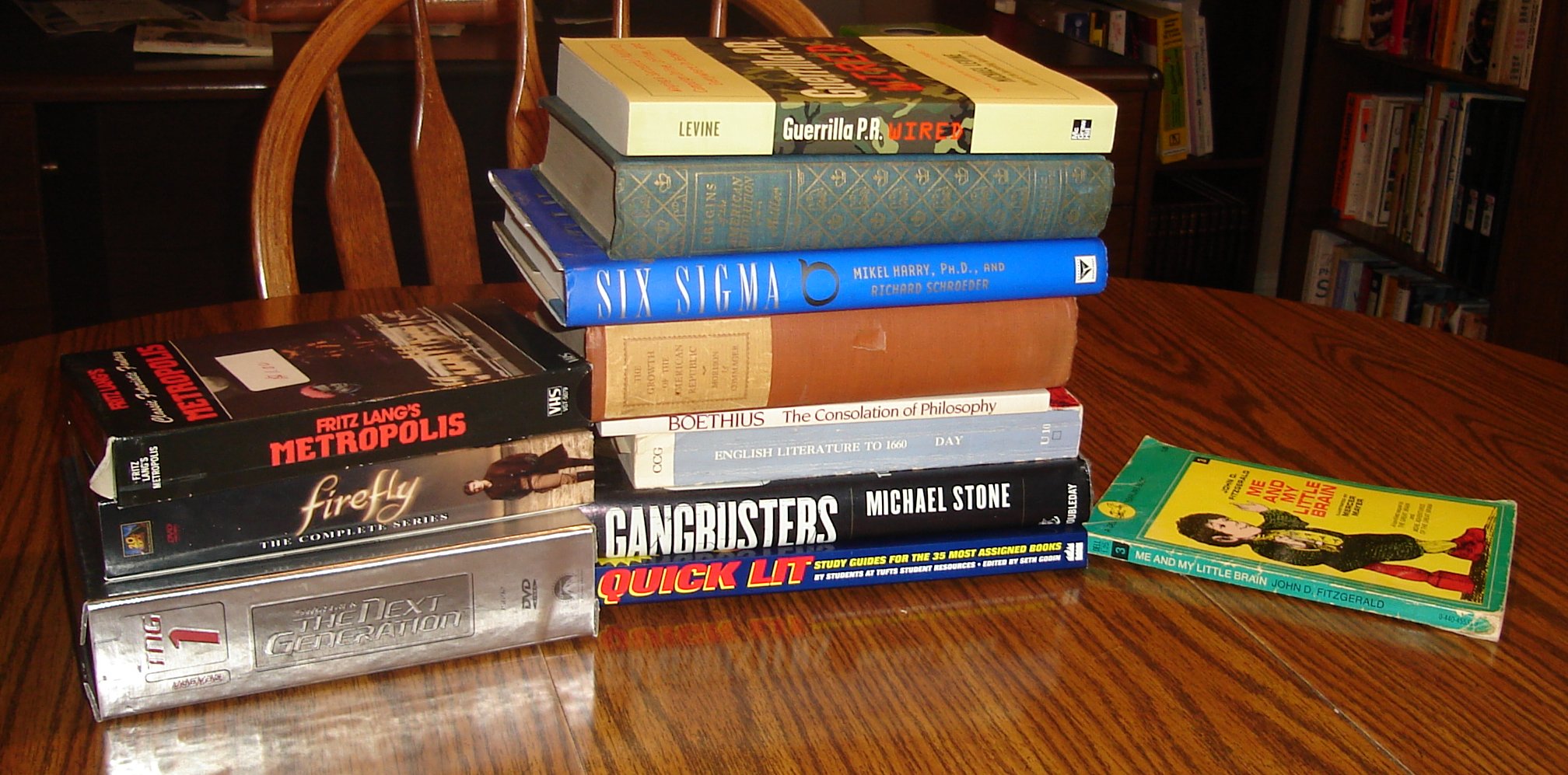
You’ll notice the single John D. Fitzgerald book to the right for the boy. Just like his daddy, he acquired without really knowing what’s on his shelves, and Me and My Little Brain is the only one of the Great Brain series he owns. Now, temporarily, he owns two.
Buy My Books!
Last Saturday, I did not go book hunting per se; I went to my mother’s yard sale and spent all day down there, talking to the little old ladies (and my mother) and whatnot.
However, I did get a handful of material that I bought from others, received as gifts, or reclaimed instead of donating:
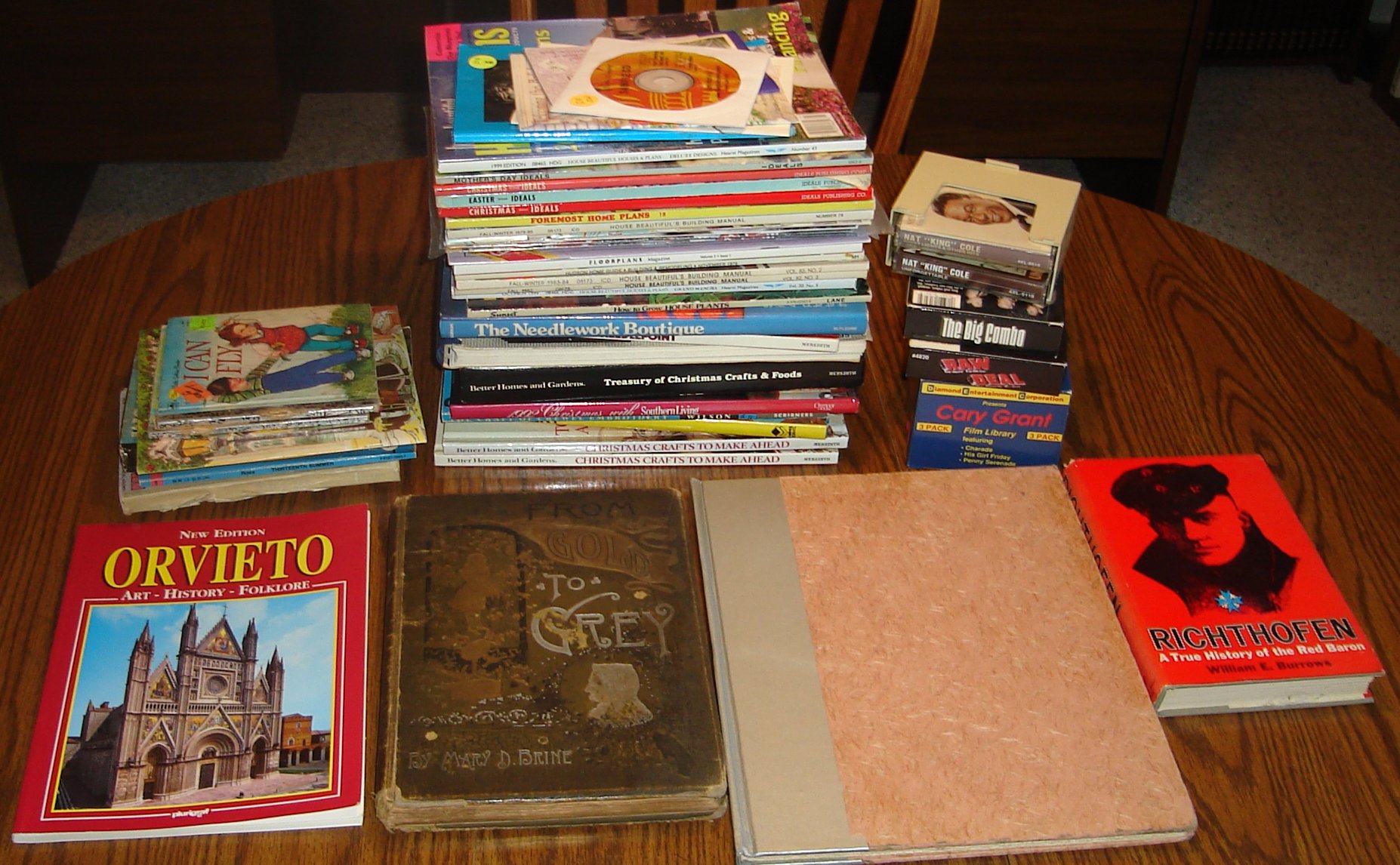
The stack to the left represents some children’s books for the boy; the center stack, which I will not enumerate here, includes the aforementioned magazines, craft books, and home improvement materials I’ve reclaimed. Since they’ve been mine since the early part of the century when I was an eBay seller, I’m not trying to convince you they’re new. They haven’t been in the household for a couple of years, though.
New material includes:
So the weekend wasn’t a total loss as far as acquisitions are concerned.
Buy My Books!
Today’s mail contained 2 Bank of America World Points credit card offers with the same nonprofit group branding:

The only difference is the free gift offered.
The next step, of course, is five credit card offers in a day with no difference whatsoever! Since I’m not interested, perhaps someone who’d steal my identity by stealing my mail or taking advantage of a misdelivery will!
This even beats my last batch of credit card offers.
Buy My Books!
A phish disguising itself as a warning about phishing scams. Brilliant!

Although this phising scam warns the recipients that Citizens Bank Money Manager GPS users have been the target of phishing scams containing misspelled words, it obviously does not note that phishing e-mails often contain weird capitalization or lack punctuation, but then again, valid e-mails often contain these problems.
To be really helpful, it would include a tip about checking your status bar (that bottom line of text in some e-mail clients) or the mouseover text (in some e-mail clients) to make sure that the target of the link is the same as the link text, or it would explain that subdomains with legitimate-looking text are irrelevant if the actual domain, that is, the last thing before the .com, is not what it’s supposed to be (such as vbv75.com).
But that would sort of spoil the phishing exercise, wouldn’t it?
Buy My Books!
Spanish Lake bar sold cocaine, police say
I understand the jukebox was running numbers, too.
Buy My Books!
This is the second Perry Mason book I’ve re-read this year; the first was The Case of the Cautious Coquette in April. This volume is published by Walter J. Black, the same fellow that does the Classics Club and Dickens editions I’ve been collecting; now that I look at it, they use the same binding. No doubt these were inexpensive books sold as part of a Perry Mason book club, and the fact that I see so many of these titles in the wild indicates they were probably early volumes in the series.
In this book, celebrating its 56th anniversary this year, Mason consults with a nurse who wants to prevent the murder of her charge by a husband after her (the charge’s) property. Mason can’t do much for her, but gets roped into defending the nurse when she’s accused of theft. Then the charge actually dies, and Mason must defend the accused–the dead woman’s sister who also consulted with Mason with an incomplete hand-written will.
A quick read and a good mystery. There’s a reason Mason was popular in fiction and on television for fifty years.
Buy My Books!
Corvette goes airborne, lands on a mobile home in Swansea.
Chevys in the 82nd. What will they think of next?
Buy My Books!
Late tax payments rise again in county:
Milwaukee County, including some of its most affluent suburbs, had a double-digit increase in the percentage of property owners unable to pay their tax bills in 2007, a trend that began last year with a 26% surge in the value of tax delinquencies in the county’s suburbs alone.
In all, 17,960 Milwaukee County properties were delinquent as of September on taxes levied for the current year, up 14% from 15,754 as of September 2006. The City of Milwaukee and 14 of its 18 suburbs posted double-digit percentage increases in delinquencies, representing almost $37 million in unpaid taxes this year.
Much of the blame has been levied on the mortgage crisis, in which a proliferation of nontraditional mortgages and predatory lending practices over the last two years have put many buyers – even those in higher income brackets – in over their heads.
But economists and credit counselors point to numerous pressures in a weak economy where minimal wage gains are being eaten away by the rising cost of everything from food and utilities to mortgages and taxes. Since late summer 2006, ground beef prices have risen by 6.7%, chicken breasts by 6.9% and whole milk by 26%, and the federal Energy Information Administration on Tuesday predicted an 11% increase in Midwest winter heating bills.
What else has gone up?
A few dismissed the notion that rising tax bills played a role, though Milwaukee County taxpayers owed at least $35 million more in taxes this year than last, according to the Wisconsin Taxpayers Alliance.
“The tax bill doesn’t go up enough to cause that problem,” said Chris Swartz, village manager in Shorewood, where delinquent property owners owed an average of $6,600 a parcel, second only to River Hills.
Of course not. Given the choice between heat, food, fuel, and property tax bills, where do you think people’s priorities lie?
No doubt the municipal officials are ready to pillory private industry for forcing people to choose to spend their money on non-essentials.
Buy My Books!
Cop who fell on the job sues family of baby who almost drowned:
In January, 1-year-old Joey Cosmillo wandered into the backyard and fell into the family pool. When his mother hauled him out, he wasn’t breathing. Rescuers were able to bring him back to life, but he suffered severe brain damage and cannot walk, talk or even swallow.
Now, his family faces another burden: One of the rescuers, Casselberry police Sgt. Andrea Eichhorn, is suing, alleging the family left a puddle of water on the floor that afternoon, causing her to slip and fall.
Twit.
Buy My Books!
Man, I love the anthropological-style essays about hipsters who move to suburbia and report their shocking findings!
The second morning after I moved into my first officially “owned” home, I woke up to find my somewhat decrepit mailbox bashed in by vandals.
I was rattled. As an Asian, I thought perhaps the bashing was meant as a kind of message to me: You are not wanted here – or something to that effect.
Home ownership was, to me, a strange thing. You’d think it would give you a sense of belonging, of security. But for me it was a foray into territory that as a woman, and half Chinese, seemed off-limits, even though I was born here.
It didn’t help that my new next-door neighbor flew the flag in his front yard well past the Fourth of July and, I would discover, straight into winter.
I live in Santa Cruz, so my initial reading on the mailbox bashing seemed improbable. Still, I was shaken. The neighborhood was suburban style, and filled with a lot of folks of retirement age who had lived in the city since before it had become “progressive” – since before anyone had heard of the word at all.
Later on that day, as I was strolling along my block, I noticed that almost every one of my neighbors also had their mailboxes bashed in – except for those who had taken time to hand paint their mailboxes with flowers or hummingbirds, or who had added accessories to make their mailboxes into caricatures of cats or frogs or sharks or what have you. I mused that at least it was nice of the (I supposed) teenagers with the baseball bat to grant some forbearance for attempts at mailbox aesthetics.
She’s lucky she moved to suburbia in California, because let me tell you, if that half-Chinese woman had moved onto my block, I would probably have not even noticed. Dramatically!
And she could have reported how the people in this tribe walk their children, fly flags with strange foreign emblems (giant green and gold Gs), and refuse to mow their lawns religiously.
Somewhere, somehow, hipsters are all caught by surprise by the revelation that people who live in homes instead of condos, lofts, or urban apartments are people, too!
Buy My Books!
Like the preceding books Webster Park: 1892-1992 and How To Research the History of Your Webster Groves Home, I borrowed this book from the library; unlike those, however, it is still publicly available for purchase at Amazon.com, so I might get a copy.
This book tells the story of North Webster, a small community in the northwestern part of Webster Groves that is mostly black in racial makeup. The book traces its origins as a couple of freedmen’s houses in the middle of the 1800s to its annexation by Webster Groves in the middle 1900s and its integration into the community.
Of course, the best part about this book is the moments and tidbits it provides: Douglass High School became the first black high school in the county, and Carl Sandburg spoke there. The book tells about the young men from the town that joined the 92nd in World War I and their participation in the dedication of the World War I memorial on Big Bend and Lockwood–a war memorial that has since been moved so that the contemporary right-minded folk don’t have to think about the sacrifices and participation in war, but can soothe themselves with a giant sculpture designed to rust.
The book is about 50 pages of text with a large number of names of residents throughout the years (I suspect that much of the narrative comes from family remembrances) combined with eighty pages of photographs from the local residents.
An interesting piece; I’ve added it to my Amazon Wish List, not that you gentle readers are obligated to show me the love you have of this backwater blog with gratuitous gifts.
Buy My Books!
I picked up this book because I liked its cover and its book jacket flap blurbs. Of course, now that I look more closely, the cover is kinda weird:
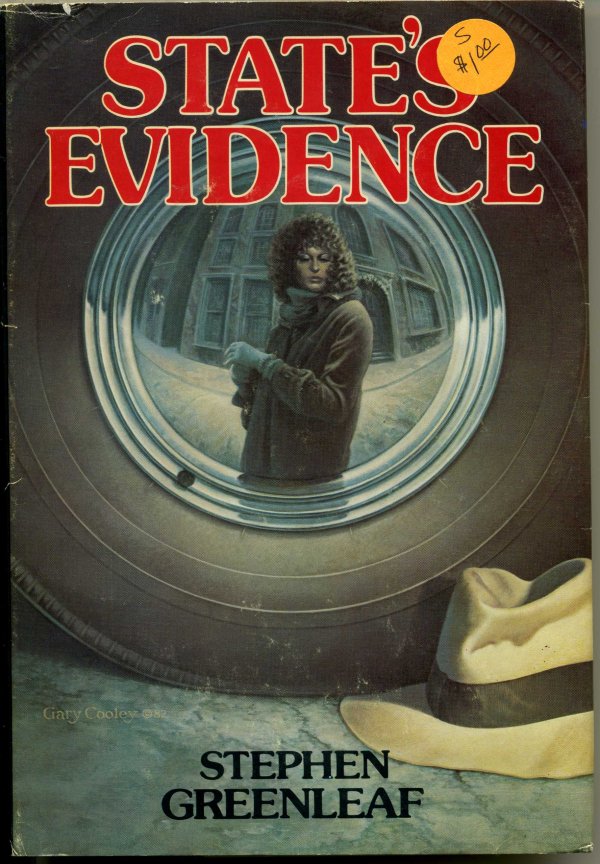
I mean, there’s a tire with a shiny hubcap on the pavement, and there’s the hot chick (ca 1982) witness to a hit and run reflected in it. However, if the perspective of the reflection is to be believed, she’s either a legless panhandler on a little cart or coming out of a manhole in the street. Or the car and the obligatory hard-boiled hat are somehow on a platform three to four feet above the pavement level where the woman is standing.
Okay, so the hard-boiled detective, series character Tanner in this case, is supposed to find a model who witnessed a hit-and-run where the hitter was a local crime boss and the hitee was really a hit. That’s what the flap says. Inside, the Tanner character and his Greenleaf author try to throwback to Chandler and Macdonald (Ross)–the detective even mentions reading those authors at one point. The language is seriously over-the-top riven with metaphors, sometimes two to a sentence or five in a paragraph. It made for some slower reading.
Then, after a bit, the language didn’t jar me, so I thought perhaps this Tanner fellow was hard in the line of the greats. The book, set in El Gordo, California (literally, The Fat Man) uses the California landscape prevalent in the classics, and the book plays in the elements of the idle rich, gangsters, and mixed-up youth.
However, ultimately, it’s not up to the level of the names it tries to invoke. The plot gets just one not too twisted and the resolution is a little too tidy.
I won’t dodge others in this series, but I’m not ordering them all right now. It’s below Robert Crais and Robert B. Parker but not completely unworthwhile.
Buy My Books!