But I have been posting regularly at QAHatesYou.com.
Sometimes You’re The Whopper, Sometimes You’re The Whoppee
Useful information in case you need to whop the product:

Click for full size
Needless to say, given the quality of the documentation, I do want to whop the product since it doesn’t appear to work.
I could have lived my whole life without seeing “u” used as “you” in technical material of any sort and been happy.
Early Adopter
Now that’s a pioneer!
On the other hand, I was one of the first retailers to have a presence on the Web. I’ve been doing it since 1988 or 1989, and I’ve been reinventing. That’s gotten us a head start.
Book Report: New York at Night by Bill Harris (1983, 1985)
I bought this book on September 29, 2007, and as I suspected, it’s better than the other city-themed picture book I’ve read this year, Detroit.
Whereas that book focused on helicopter shots of the buildings in the city, this book covers New York at night. The text is a bit affected with first person sort of you-are-there visitations to New York City in 1983, the photos display a variety of things: people on the job in staged portraiture, buildings, streetscapes, and slice-of-life snapshots.
Of course, everyone is wearing that hair that occurred as the 70s transistioned the the 80s, and most of the buildings have bars on the windows before the renaissance of the 1990s, but it’s an interesting artifact and collection of images.
With no random quotes, unless you count the introductory essays.
Book Report: Tales from the Coral Court by Shellee Graham (2000)
I borrowed this book from the Old Trees library’s local history section, a section that I will probably completely consume by the end of 2008. This book covers, as the title might indicate, the Coral Court motel, a motor court built in 1941/1942 that was not only a mainstay on the Route 66 circuit, but also proved instrumental in founding the municipality of Marlborough, a former speed trap town (that has since disbanded its police force and has slid from the St. Louis County consciousness as a result) and provided St. Louisians with something about which it could giggle behind its hands (the fact that each unit had a garage that opened into the bedroom led itself, led itself from the realm of the modern into the realm of the merely seamy once the Interstate built some miles to the north removed the middle class tourist from the client list).
This book fits more into the In Retrospect mold, as it provides some text about the original owners, the architecture style, and the evolution of motor courts and motels in America, but mostly relies on quotes from random St. Louisians (and some poetry, heaven forfend) about the motel. Still, the author took a number of photos in the period between the closing of the hotel (1993) and its demolition (1995), and the author gathered some other photo material from people who’d heard about her project.
In a couple years, no one will remember the place, since its heydey came in the Greatest Generation years and its ill repute came in the Boomer years, so this book’s novelty will pass but its usefulness as a historical document and collection of photos will live on.
Full disclosure: in that same period before the demolition and the raising of the Oak Knoll subdivision where the motel used to stand, I was dating a photographer and got the opportunity to do a little trespassing for photography purposes myself. So I remember the Coral Court from first hand experience, although not from the authentic Coral Court first hand experience. And that first hand knowledge is what makes this book resonate, so as I said, I suspect it will only be a curiosity in a couple years when that resonance is gone for most people.
Interesting Contrast
Spot the contrast:
St. Louis County Councilwoman Colleen Wasinger, R-Town and Country, plans to scrutinize next year’s county budget to find ways to save enough money to avoid a tax increase.
St. Louis County Executive Charlie Dooley has proposed a county budget of $505.4 million for next year. It includes a property tax increase of 2 cents for each $100 assessed valuation. Dooley estimates that will raise slightly more than $4 million.
Where’s Dooley’s D?
Not So That You Noticed
But Diane Duane, the author of the book I reported on earlier this week, appears in the comments for the post to discuss the book, her library, and writing Star Trek novels.
Book Report: In Retrospect (I) edited by Kathy Condon (1975)
This book, the result of a high school project, came about when Wilda Swift (co-author of Webster Park 1892-1992) started a class to explore local history. Students interviewed a number of residents of the community who could remember life before 1914 and put the book (more of a magazine in a library binding) out.
As such, its quality is what you might expect; it looks as though it was typewritten with some photos pasted in. What a high school class could do 30 years ago before desktop publishing became available, then easy.
The book doesn’t get into narratives; it just drops little sentence or paragraph excerpts from the interviews organized around topics. So it’s more of a quilt than a cloth. Still, interesting enough to get details and a flavor.
Book Report: My Enemy, My Ally by Diane Duane (1984)
Well, I hadn’t been in much mood to read for a number of days, which explains why it’s taken my 10 days to complete another book not written by Tolstoy or Hugo. Instead, to get myself back into the game, I picked up one of the Star Trek novels I bought at some time in the past en masse; the others include the novelizations of the first few movies.
Now, I’m not the Star Trek book guy, so this was my first dose of that part of the canon (the Blish short stories based on the series episodes are a different thing entirely; see also Star Trek 5, Star Trek 6, and Star Trek 10 among others).
The book was written after the first and second series (I count TAS!) had ended, the first two films were released, and appeared about the same time as the third movie; ergo, it’s historical in its canon. Since it’s a book and has no special effects budget, we get a lot of alien races serving on Federation starships and some descriptions of them. We also get insight into the Romulan way (a sequel to this book, I assume, is called that).
But the main thrust of the book is like a television episode with a lot of exposition. The first half of the book details the plot: a Romulan commander, exiled for unpopular views, is set to die in a mission that will foment a Klingon-Federation War. She learns of the existence of a secret Romulan plan to give Romulans the same mentalist abilities that Vulcans have and knows that this will destroy not only the Federation, but the soul of the Romulan empire. She convinces Kirk, on patrol in the Neutral Zone, to act as though she’s taken the Enterprise prisoner so they can go to the research facility and destroy it to save the universe.
I don’t want to ruin it for you, but in the last 80 pages, they do. It reads like a filmography and relies on the normal tricks of the showm pseudo deus ex machina and timely reversals, to climax and then a film-friendly denoument.
I mean, it’s not a bad book, but it’s not high art; one wonders if the authors of these books write these like movies in hopes of getting the extra dough out of having a movie adapted from it or if that’s just the way they imagine the stories. Or maybe I’m generalizing based on a single data point.
I’ll read the rest of what I’ve got and won’t purposefully avoid the series, but jeez, lots of tentacles and an awful lot of characters laughing uproariously at only partially humorous lines don’t compel me to read more right away.
Good Book Hunting: Early November
Well, it has been a while since I told you about what I’ve bought as far as books go, but that’s because we spent Saturday mornings in the latter part of October looking at sport utility vehicles and minivans because although one can sort of fit a single child seat into the back of a Mitsubishi Eclipse with only slight discomfort for the passenger, two child seats would be impossible. So for a span of a couple of weeks, I bought no books.
Fortunately, though, on Sunday, November 4, my mother and I found an estate sale in Lemay. Within a tiny house in one of the older parts of Lemay on a street that ultimately connected to a newer part with larger homes and lawns, some assorted odds and ends remained from a household recently and fairly suddenly emptied. However, in the basement, several boxes of books, mostly paperbacks, lay unpriced. The assortment was rather eclectic; romance novels, 60s detective pulp, philosophy, literature, and some of those paperbacks your grandfather used to keep hidden.
I picked a couple out:

Click for full size
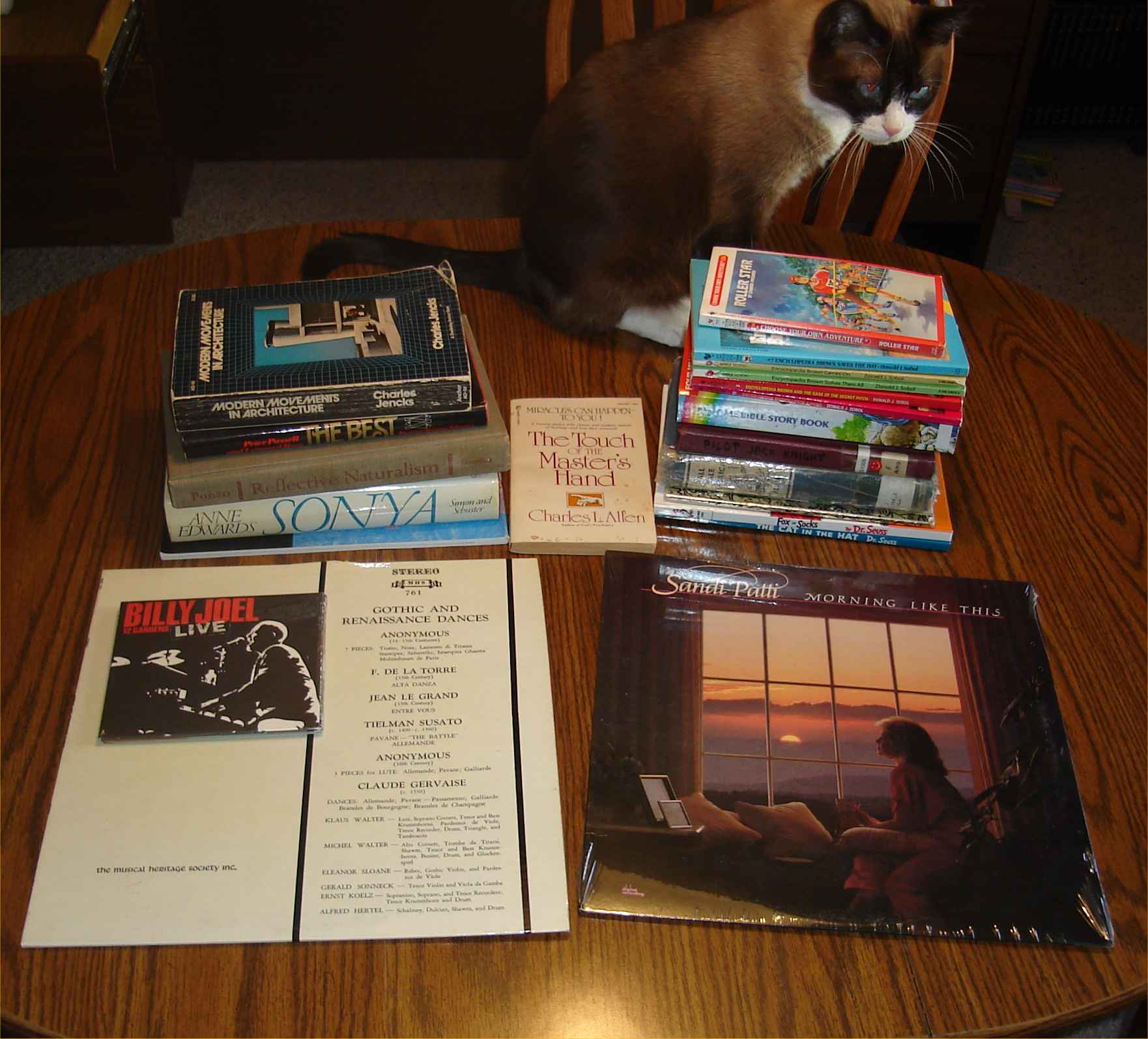
My selection includes a couple of Matt Helm novels (I read one earlier this year and watched the Dean Martin movies in the last two years), the first of the Enforcer novels (I read the third earlier this year), a Richard S. Prather Shell Scott novel (I singlehandedly drove blogger Robert Prather from the Web by commenting every time he guest posted on myriad blogs that I loved the Shell Scott novels), and whatnot.
You want the full list? Click and look. The stack to the right are some theologically-flavored tomes I bought for my beautiful wife.
It was only when I got to the counter, manned by the daughter of the fellow who had to take a book everywhere, that I discovered that paperbacks were a dime and hardbacks were a quarter; it’s a good thing I didn’t know earlier, or I’d have had boxes of smoky and musty pulp to show you.
Then, last weekend, we actually hit some yard sales in our suburb. Global warming is pushing garage sale season into November; now that we have a full SUV, I am driving it up and down the block to help push garage sales in Missouri into January.
At any rate, here’s what we got:

Click for full size
I’m not saying that reading Farnham’s Freehold affected my thinking at all, but I did find my basic skills reference works lacking. So I bought, for $25, a seven volume set called The Science Library, a 27 volume set called The Complete Handyman Do-It-Yourself Encyclopedia, and 11 of 12 volumes of the Popular Mechanics Do-It-Yourself Encyclopedia; oddly enough, of the latter, I lack volume 11. My mother has this set, too, and she’s missing volume 11, too. Hmmm. I wonder if that’s where they put all the neat do-it-yourself nuclear things.
The fellow also threw in the free sample starter pack of the Easy Home Repair binder series. These were sold by packets you could stick into the binders, kind of like those old boxes of recipe cards. I only got the first set, still in its plastic cellophane, and the binder. That’s okay, though; my mother also owns the complete set of these, and I’ll own them all myself far too soon.
Additionally, I bought a book called TV Closeups, a 1974-1975 book produced by Scholastic or some other children’s book publisher that ties into television and a copy of Sinclair Lewis’s Cass Timberlane. And a copy of the 1984 game Ambush, a solitaire war game.
So I’ve added a pile, but not much for my to-read shelf. Regular garage and estate sale stuff has resumed. Thank you, that is all.
Career Advice
Courtesy of Rob Preston of Information Week:
If you long for a Leave It To Beaver world where life is simple and jobs are secure, watch Nick at Nite and take the civil service exam.
Word.
A Very California Solution
Problem: Neighbor downhill from you has a metal roof reflecting its light into your sensitive eyes.
Missouri solution: Sue the fellow, the metal roofing company, the neighborhood association, the township, and Hephaestus, probably followed by fines and potential condemnation by the local government.
The California solution: Put some glass insect sculptures on the roof to make it pretty colors.
Everyone note that the California solution, if applied in Missouri, would meet with the same response; namely, art on your property is cause for lawsuits and legal action.
Because There’s No Defense Like A Good Offense
The Crossbow Project lives:
The world’s most powerful airborne laser capable of shooting down a ballistic missile is being re-assembled by Northrop Grumman and the US Missile Defence [sic] Agency (MDA).
The laser is being integrated onto MDA’s Airborne Laser (ABL). High-power system testing will follow completion.
As they said at Ace of Spades:
If you can burn down an incoming missile, you ought to be able to burn down some miscreant 50 miles away too, right?
And make a lot of popcorn.
Google Maps Shows Moving Day
How many of you can say what you were doing the exact day when Google Maps snapped your house? Well, in my case, I was moving out:

That’s our old house with the moving truck backed into the driveway; the second moving truck sits at the edge of the cul-de-sac, awaiting its turn at carrying away the Noggle library. Heather’s car and my truck are parked out on the main street to make room.
No Word On Left Handed Hunter Accident Rates
The Milwaukee Journal Sentinel finds a truth in statistics:
An estimated 650,000 hunters, many with high-powered rifles, will saturate the fields and forests of Wisconsin when deer-hunting season opens Saturday. They will track game at a time when hunting has never been safer in Wisconsin.
But a Journal Sentinel analysis shows the percentage of accidents caused by hunters 21 and younger in 2006 was the highest since 1999. And in the past five years, those young hunters were more than twice as likely to cause hunting accidents than all other hunters.
Fortunately, judicious use of a calculator has given the paper its needed anti-hunting trope.
Recognizing that One Is No Longer a Part of the Target Demographic
As a matter of fact, I do own a shoe horn.
Book Report: One of Us Is Wrong by Samuel Holt (1986)
I wanted to say that it’s been twenty years since I read the second book in this series, but I’d be misstating my own longevity as well as warping the former Clinton presidency into a longer period than it was. I only read it the book I Know a Trick Worth Two of That probably in 1990 or 1991; I suspect I picked up the copy I had of that at a paperback exchange in Milwaukee the summer before I began college. I don’t know why I remember it that way.
So I recognized the naming scheme/”author” when I found this book probably earlier this year, and the memory was such that I bought the book. And you know what? Worthwhile endeavor.
This book sets the tone for the series: a former policeman/basketball player/television show star Samuel Holt has to deal with his celebrity but also finds himself in a situation where a crime has been committed and where he, the man who played PACKARD, must find out who or what is going on.
It’s a light read from the 1980s featuring Arabic terrorists plotting an attack on American soil. Really, though, that’s secondary to the voice navigating the LA scene suffering from the cancellation of the television series that made him a household name and identifiable celebrity. The Samuel Holt character drives the book, and the missteps, mistakes, and typographical errors are forgiven. After all, Donald Westlake, who wrote this book and the four-book series under the pseudonym of the main character (a la Ellery Queen), churned out a pile in the 1980s.
Friends and readers (and by “Readers,” I mean “Deb, CG, and Gimlet”), I’ll look for the remaining two books in this series. So if you’re into light mysteries, you might want to check these out, quirky as they might be.
Personal Relics: The Good Bookmark
You can tell I’m a serious reader, not one of the rank amateurs who merely picks up the latest mass market paperback for airplane or beach reading or who parrots lines from the latest hot talk show host book club’s recommendation so I can sound smart at card parties. No, it’s not the fact that I carry snapshots of my library instead of my children to show to random coffee shop patrons. My continual enumeration of the books I read each year and my easy answer to questions of what I’ve read lately don’t give me away. The identifier that signals my serious pursuit of letters, which can often include mass market paperbacks and hardback thrillers amid the serious highsnoot stuff, is my good bookmark.
Make no mistake, I own more than my share of the common paper bookmarks that blizzard any book buyer. I have colorful, bag-stuffing scrips of paper with the names of the large chain bookstores and the large Internet bookstores. I have many folded, worn used bookstore bookmarks from shops I have visited in myriad cities across the country. I even have several from used bookstores that I’ve never visited that came with books I bought elsewhere. I have a couple of bookmarks enclosed with unsolicited fundraising appeals; I didn’t send money, but I kept the bookmarks. We even have one or two congratulatory bookmarks given for elementary or middle school achievements floating around here. All get their usage between book covers.
During my reading lifetime, I’ve not been particular about separating the pages where I last imbibed the language with a piece of refined bookmarkery. I’ve used envelopes, receipts, the odd note page, napkins, smaller books, and other varied materiel to let myself know where to resume and to mark for the world exactly how many pages’ worth of wisdom I bore. When one is away from home, one must make do with what nature and its descendent civilization provide. When I am at home, I prefer to use a real bookmark, and for the main book I am reading at any time, I use the good bookmark.
I speak its very name with reverence, as one speaks of the good china. This good bookmark bears my last initial stamped into the top and looks to be brass. The front side shines brightly, and the rear displays a handsome sheen of green paint. Like all good things, it is formal and practical at once.
I received this particular bookmark as a graduation gift when I matriculated from high school. No doubt, my distant aunt bought the bookmark at the bookstore when she was buying my gift certificate and impulsively added the five dollar’s worth of finery to my gift. Regardless, it not only bore my initial, but it became mine.
Almost twenty years later, the memories of most gifts from that era have faded after the utility or quality of the gifts faded or failed. I’m sure I spent the accumulated capital on used books as I bought reading material for the interim summer. I wore the clothes, played the harmonica a couple of times, and I forgot the thoughtful or thought-free presentations of friends and family. But the bookmark lives on.
The bookmark retained some of its mint condition by spending much of the 1990s in a complete collection of Emily Dickinson’s work, somewhere in the middle 700s of her numbered list. A few years ago, during one of the periods when I continued my trek through the wilderness of poor capitalization, I swapped out the good bookmark for a pair of bookmarks—one to tell me where I am, and one to tell me how long I had to go to finish the hundreds of poems Dickinson wrote in 1865.
So while those bookmarks spend the next decade in the Dickinson, I use the good bookmark now for my primary reading material. It lends a certain air of class to my reading, elevates my place marking. Anyone who invests in or continues to use an actual piece of metal to mark a place in a book obviously plans to mark a lot of books with a permanent artifact.
I’ll have to remember again to thank my aunt, long after she has forgotten the gift.
A Headline You Would Not Have Seen In 1960
Hoffa to announce Teamster support for Nixon
Put that in Back to the Future IV and have Marty call it “Heavy.”
That’s News?
Headline: Police officer tasers woman, 82. However, if you’re doing anything but scanning the headlines, you get a slightly different story:
Chicago’s Police Department is investigating an officer’s use of a Taser last month on an 82-year-old woman who was swinging a hammer when police arrived.
You’re forgiven if you thought cops were tasering another 82 year old woman.