Book Report: Treasure Hunting for Fun and Profit by Charles Garrett (1997, 2006)

Book coverLast spring, I lost a part from my rototiller, so I went down to the sporting goods store and bought a metal detector to find it. And since I live on the edge of the Old Wire Road / Trail of Tears, I thought I might become a relic hunter–that’s what the people who use metal detectors call themselves. Or treasure hunters if they look for pure metal. So I ordered this book to get an idea of how to use my metal detector.

The book was written by Charles Garrett, President of the Garrett Metal Detectors company, so the book gives a lot of attention to the innovations in the latest Garrett detectors. It provides a broad overview, from looking for coins on the beach to using metal detectors to prospect for gold in the American West. It has a chapter on how good the hobby is for seniors and children. Ergo, it’s a little broader than I would have hoped.

I guess to get the knowledge I hope for, I’ll have to spend a little more time using the device rather than reading about it. Ain’t that the way?

Books mentioned in this review:

Buy My Books!
Buy John Donnelly's Gold Buy The Courtship of Barbara Holt Buy Coffee House Memories

Scoring Myself Vis-à-Vis The NPR Top 100 Sci Fi Books/Series

Courtesy of Woody, we have the top 100 NPR Science Fiction and Fantasy Books and Series. What? A list of books! Of course we have to measure ourselves against it.

Gentle readers, remember this means I read the book, this means I own the book and haven’t read it yet, and this means I’ve read part of the series. Also, I’ve included a link to those books whose book reports I’ve published on MfBJN.

  • The Lord Of The Rings Trilogy, by J.R.R. Tolkien
  • The Hitchhiker’s Guide To The Galaxy, by Douglas Adams
  • Ender’s Game, by Orson Scott Card
  • The Dune Chronicles, by Frank Herbert (1 / ?)
  • A Song Of Ice And Fire Series, by George R. R. Martin
  • 1984, by George Orwell
  • Fahrenheit 451, by Ray Bradbury
  • The Foundation Trilogy, by Isaac Asimov
  • Brave New World, by Aldous Huxley
  • American Gods, by Neil Gaiman
  • The Princess Bride, by William Goldman
  • The Wheel Of Time Series, by Robert Jordan
  • Animal Farm, by George Orwell
  • Neuromancer, by William Gibson
  • Watchmen, by Alan Moore
  • I, Robot, by Isaac Asimov
  • Stranger In A Strange Land, by Robert Heinlein
  • The Kingkiller Chronicles, by Patrick Rothfuss
  • Slaughterhouse-Five, by Kurt Vonnegut
  • Frankenstein, by Mary Shelley
  • Do Androids Dream Of Electric Sheep?, by Philip K. Dick
  • The Handmaid’s Tale, by Margaret Atwood
  • The Dark Tower Series, by Stephen King (3 / 7)
  • 2001: A Space Odyssey, by Arthur C. Clarke
  • The Stand, by Stephen King
  • Snow Crash, by Neal Stephenson
  • The Martian Chronicles, by Ray Bradbury
  • Cat’s Cradle, by Kurt Vonnegut
  • The Sandman Series, by Neil Gaiman
  • A Clockwork Orange, by Anthony Burgess
  • Starship Troopers, by Robert Heinlein
  • Watership Down, by Richard Adams
  • Dragonflight, by Anne McCaffrey
  • The Moon Is A Harsh Mistress, by Robert Heinlein
  • A Canticle For Leibowitz, by Walter M. Miller
  • The Time Machine, by H.G. Wells
  • 20,000 Leagues Under The Sea, by Jules Verne
  • Flowers For Algernon, by Daniel Keys
  • The War Of The Worlds, by H.G. Wells
  • The Chronicles Of Amber, by Roger Zelazny
  • The Belgariad, by David Eddings
  • The Mists Of Avalon, by Marion Zimmer Bradley
  • The Mistborn Series, by Brandon Sanderson
  • Ringworld, by Larry Niven
  • The Left Hand Of Darkness, by Ursula K. LeGuin
  • The Silmarillion, by J.R.R. Tolkien
  • The Once And Future King, by T.H. White
  • Neverwhere, by Neil Gaiman
  • Childhood’s End, by Arthur C. Clarke
  • Contact, by Carl Sagan
  • The Hyperion Cantos, by Dan Simmons
  • Stardust, by Neil Gaiman
  • Cryptonomicon, by Neal Stephenson
  • World War Z, by Max Brooks
  • The Last Unicorn, by Peter S. Beagle
  • The Forever War, by Joe Haldeman
  • Small Gods, by Terry Pratchett
  • The Chronicles Of Thomas Covenant, The Unbeliever, by Stephen R. Donaldson
  • The Vorkosigan Saga, by Lois McMaster Bujold
  • Going Postal, by Terry Pratchett
  • The Mote In God’s Eye, by Larry Niven & Jerry Pournelle
  • The Sword Of Truth, by Terry Goodkind
  • The Road, by Cormac McCarthy
  • Jonathan Strange & Mr Norrell, by Susanna Clarke
  • I Am Legend, by Richard Matheson
  • The Riftwar Saga, by Raymond E. Feist
  • The Shannara Trilogy, by Terry Brooks
  • The Conan The Barbarian Series, by R.E. Howard
  • The Farseer Trilogy, by Robin Hobb
  • The Time Traveler’s Wife, by Audrey Niffenegger
  • The Way Of Kings, by Brandon Sanderson
  • A Journey To The Center Of The Earth, by Jules Verne
  • The Legend Of Drizzt Series, by R.A. Salvatore (2 / 9 according to this definition of the series) – I know I’ve read some of them
  • Old Man’s War, by John Scalzi
  • The Diamond Age, by Neil Stephenson
  • Rendezvous With Rama, by Arthur C. Clarke
  • The Kushiel’s Legacy Series, by Jacqueline Carey
  • The Dispossessed, by Ursula K. LeGuin
  • Something Wicked This Way Comes, by Ray Bradbury
  • Wicked, by Gregory Maguire
  • The Malazan Book Of The Fallen Series, by Steven Erikson
  • The Eyre Affair, by Jasper Fforde
  • The Culture Series, by Iain M. Banks
  • The Crystal Cave, by Mary Stewart
  • Anathem, by Neal Stephenson
  • The Codex Alera Series, by Jim Butcher
  • The Book Of The New Sun, by Gene Wolfe
  • The Thrawn Trilogy, by Timothy Zahn
  • The Outlander Series, by Diana Gabaldan
  • The Elric Saga, by Michael Moorcock
  • The Illustrated Man, by Ray Bradbury
  • Sunshine, by Robin McKinley
  • A Fire Upon The Deep, by Vernor Vinge
  • The Caves Of Steel, by Isaac Asimov
  • The Mars Trilogy, by Kim Stanley Robinson
  • Lucifer’s Hammer, by Larry Niven & Jerry Pournelle
  • Doomsday Book, by Connie Willis
  • Perdido Street Station, by China Mieville
  • The Xanth Series, by Piers Anthony
  • The Space Trilogy, by C.S. Lewis

It looks like 28 complete novels/series and 3 partials. On the other hand, I have read other books in series whose first book is mentioned (the Rama series, the Ringworld series, 3 of the 4 books in the Elijah Bailey series by Asimov, maybe an extra Foundation book or two beyond the Foundation trilogy, and so on.

Frankly, I’d rather the compiler of these lists include books in series as individual books if they’re going to include them at all, just for consistency sake.

Also, note that to catch up with Woody (who has read 44 of the list, somehow), I should to focus on individual novels on it instead of series, since reading the Lord of the Rings and Dune took me most of the summer, but only counts as one item on this list. Or I could read what I want and just let the list items embolden where they may.

I like the last. Also, when the world comes out with the best 100 best Gold Eagle Books, I’ll…. Well, considering that Gold Eagle has been publishing a large number of books for 30 years, I’d still have a hard time with meeting those list items unless the early Executioner series was overrepresented. Which it very well might be.

Also, I’d like to lament that only one of the authors on this list has said anything nice about my writing. It was Marion Zimmer Bradley after a submission to her eponymous magazine in the 1990s. At least I think it was complimentary: “Much like 200 others, but better written.” Hey, in those days as these, I’ll take what I can get.

Buy My Books!
Buy John Donnelly's Gold Buy The Courtship of Barbara Holt Buy Coffee House Memories

Book Report: Ozark Tales and Superstitions by Phillip W. Steele (1983, 1998)

Book coverThis book is a short collection of tales from Ozarks lore, broken into categories such as “Tales of the Supernatural”, “Indian Tales”, “Treasure Tales”, “Outlaw Stories”, and so on. None of them are well-researched or well-documented, but they do give one interesting stories to tell the children and ideas for little essays and historical bits if one wants to put in the time to conduct real research.

The best bit about this book, though, is this written on the title page:

William Quantrill

As some of you assuredly know, the William Quantrill led a pro-Confederate band of guerrillas in the Civil War. The William Quantrill does not appear in this book, so it’s not a notation of a previous owner. I assume it was the name of the previous owner, perhaps a distant relation of The William Quantrill. So I can boast I own a book once owned by William Quantrill, but given that this is the 1998 reprinting of a book that first appeared in 1983, it’s not The William Quantrill. But those to whom I boast need not know.

Books mentioned in this review:


Buy My Books!
Buy John Donnelly's Gold Buy The Courtship of Barbara Holt Buy Coffee House Memories

Good Book Hunting: August 13, 2011

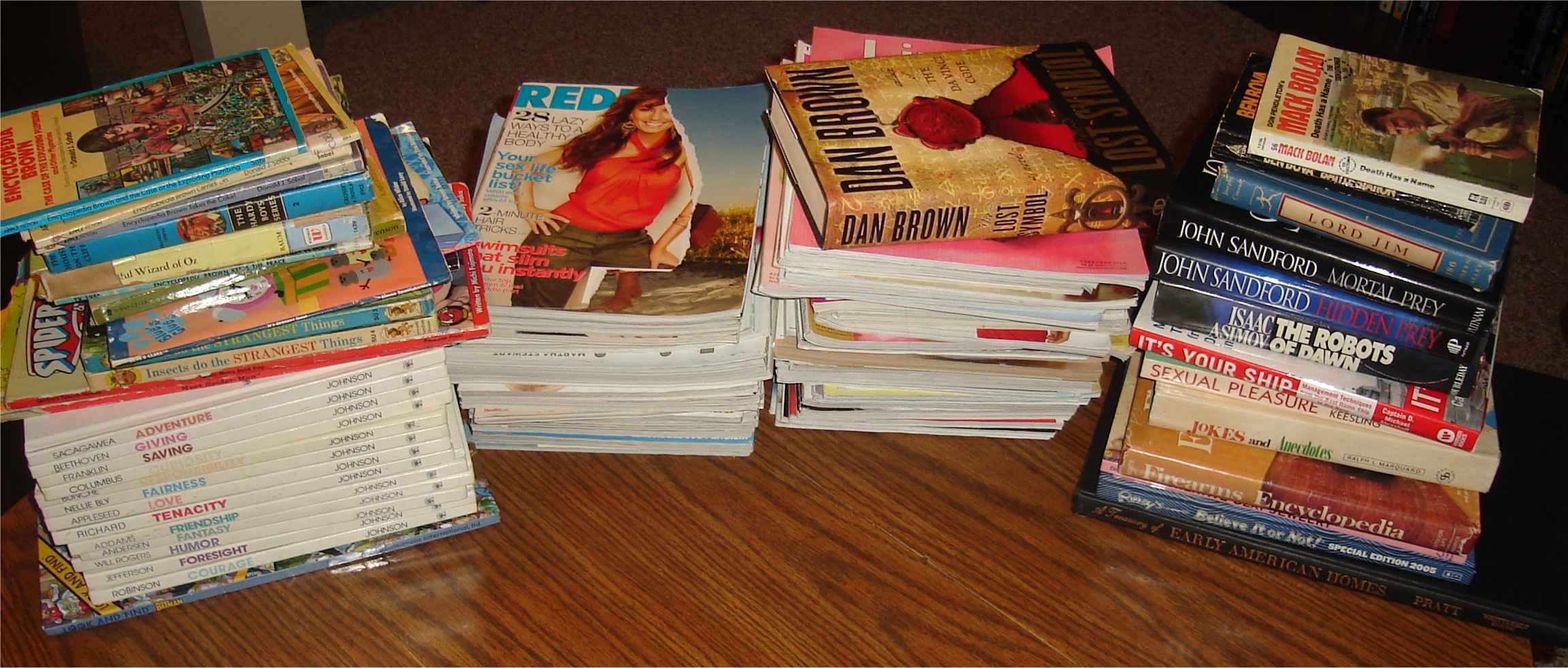
Yesterday, instead of doing something productive, I gathered up the family and headed to two garage sales. When we’d gone to Asbury United Methodist Church last year, they had a whole room of books. This year, there was only a table, but it was heavy on the science fiction as you will see below. Additionally, we managed to reach the SLS 8th Grade Trip Sale about 10 minutes before it was going to close at 11, and, hey, they had books, too.

Here’s what I got:

August 13, 2011 book purchases

Continue reading “Good Book Hunting: August 13, 2011”

Buy My Books!
Buy John Donnelly's Gold Buy The Courtship of Barbara Holt Buy Coffee House Memories

Book Report: Point Blank by Jack Hild (1987)

Book cover This is the next book after Firestorm U.S.A., but it’s far different from the earlier book. We get a lot of allusion to some things in Barrabas’s past, but the book starts him out in Egypt without much to give this reader any bearing on why he’s there and what he’s doing. After a very slow and disengaging first chapter, one discovers that Barrabas has a recurring villain, a former CIA agent who bedevils Barrabas repeatedly. So this book ties into that storyline with which I was familiar.

At any rate, Barrabas goes hunting for this guy; coincidentally, two members of his team are spending some of their “off” time in Africa helping the medically needy there, and they find the super-villain in an abandoned copper mine, weaponizing this new deadly disease AIDS using African natives as incubators. The super-villain frames Barrabas for the attempt on the life of Barrabas’s ex-lover, who then comes to Africa to avenge her brother by killing Barrabas. And other member of Barrabas’s team come looking for him as Barrabas survives a plane crash in the desert.

It comes together at the villain’s lair, of course, and Barrabas’s team wins, of course. Unfortunately, the pacing of the book is kinda slow, and even the jump cuts don’t build suspense because it reminds you how obvious the required coincidence is. So it’s my least favorite in the series, but it does not kill the series for me.

Now, if I could only read something weighty to impress my smart friends.

Books mentioned in this review:

Buy My Books!
Buy John Donnelly's Gold Buy The Courtship of Barbara Holt Buy Coffee House Memories

Book Report: No Shoes, No Shirt….No Problem! by Jeff Foxworthy (1996)

Book coverThis is not the first Foxworthy book I’ve read; I read You Might Be A Redneck If… in 2006 and How to Really Stink at Work: A Guide to Making Yourself Fire-Proof While Having the Most Fun Possible last year. This book proved its worth in merely providing me with the fodder for a blog post ("Wherein My Life Intersects, Again, With The Humor Of Jeff Foxworthy And Larry The Cable Guy") and a tweet/status. Strangely enough, this is my gold standard for books by comedians these days. Also, books by Roman emperors.

This book is better than How To Really Stink At Work anyway. The humor and musings are more aligned with Foxworthy’s humor. Unfortunately, the book does stray into his personal life a bit too much for my taste. I dunno, he talks about his courtship of his wife and whatnot, and I guess I like my humor a little more abstract. When he’s talking about wives and women, I cringe a little to tie this to a specific person. Maybe that’s just me or my taste towards the middle of 2011.

So it’s an amusing enough book, but not pure enough comedy for me.

Books mentioned in this review:

Buy My Books!
Buy John Donnelly's Gold Buy The Courtship of Barbara Holt Buy Coffee House Memories

Since My Blog Empire Is Already So Profitable, Why Not Start Another?

I’ve been kicking around the idea of starting a blog dedicated to the objects I find in books as bookmarks used by the previous owners, where I can muse on what the objects might mean. Some of them will be very curious, as they’ve laid dormant in books for decades.

I’ve started it, sort of. The first post is Kansas City Royals Ticket Stub. It is not as quaint as some of the other things I’ve found, but it’s a start.

Buy My Books!
Buy John Donnelly's Gold Buy The Courtship of Barbara Holt Buy Coffee House Memories

Book Report: The Kentucky Rifle: A True American Heritage in Pictures by The Kentucky Rifle Association (1967)

Book coverI inherited this book from my wife’s uncle, who was something of an expert on period firearms. This book collects images of the Kentucky Rifle, focusing on the craftsmanship in the inlays and etching on the stock.

To someone not that into period rifles, the pictures look a lot the same until you really snap into the lingo and the variation, at which point I could appreciate the differences and the artistic flourishes more.

But it’s definitely a book for enthusiasts more than the casual reader. It took me many football games and baseball games to make it through it.

Books mentioned in this review:


Buy My Books!
Buy John Donnelly's Gold Buy The Courtship of Barbara Holt Buy Coffee House Memories

Book Report: The Bittersweet Ozarks at a Glance by Ellen Gray Massey (2003)

Book coverI borrowed this book at the library this weekend because I was running short of things to read around here. Actually, no, I have this tendency to stop by the local history section at the Republic Branch of the Springfield-Greene County library and check something out in spite of having enough to read. This particular volume is a collection of photographs taken as part of an Ozarks studies class at Lebanon High School from the 1970s to the early part of the 21st century.

That lends the book a certain double effect narration: Some of the photographs are themselves history, as many capture not only the old timer residents of the area wearing their horned rim glasses unironically, but also some of the students are captured in their flared bottom pants, also worn unironically. Sometime in the 1980s, old people stopped looking like these vintage old people, didn’t they? I have some pictures of my great aunts from the late 1980s with the horned rim glasses, and they looked old. In contrast, I have a grandmother and a friend approaching 90 and a mother-in-law approaching, well, maybe I shouldn’t use her as an example since she sometimes reads this blog. But some of the photographs in this book are of people who fall between those ages, and they look older than the aforementioned people who will unfriend me on Facebook for mentioning their ages. Maybe it’s that I’ve gotten older, but it’s not exclusively that, is it?

So I enjoyed looking through this book while watching a Cardinals game. The photographs capture some of the natural beauty of the region as well as some of the residents of the area who were farming it before electricity reached them (in some cases, as late as the 1960s). Although the pictures of the native fauna was less impressive since I’ve snapped most of them myself in my backyard.

A side note: you know, one can easily dodge high school literary works as subpar (come on, they’re just learning). However, one overlooks high school history programs at one’s own risk. This is pretty good stuff, much like Webster Groves High School’s In Retrospect series that started in the middle 1970s, too.

I recommend the book. Of course, instead of going to the library for it, you can order it right off the Internet from the link below. Or, if you’re like me, you can get it from the library and then scoop it up later after you’re sure of it’s worth.

Books mentioned in this review:


Buy My Books!
Buy John Donnelly's Gold Buy The Courtship of Barbara Holt Buy Coffee House Memories

Book Report: Firestorm U.S.A. by Jack Hild (1987)

Book coverThis book is the 16th in the series; I read the 5th of the series, Gulag War, in 2009. Strangely enough, I bought this book, too, for a quarter, although I see it’s not as quite in demand as the earlier books when I search the Internet. I told the kid at Castle Books, a used book store here in Springfield that I’d never heard of (!), that I was excited to get it. He tried to riposte, but could not. I hate it when repartee dysfunction happens to me, too. I’ll keep my eye out for others in this particular series when I’m there. I’ll just have to look in the back cheap books closet again.

Speaking of used book stores, this volume has made the rounds: It has three different used book store stamps from the Kansas City area within it. I guess it was held onto by some serious pulp readers who bought it, read it, and turned it in for store credit elsewhere. Unlike me, who is a serious pulp accumulator.

So this story shares some broad strokes in common with the Chuck Norris film Invasion U.S.A.: A group of terrorists infiltrates Florida and starts wreaking havoc until the Soldiers of Barrabas can stop them by firing their submachineguns from the hip.

The strokes they share are only broad, though. It’s not the Russians behind this, but some group that has a plan to introduce a dictator into the United States as a reaction to the terror. Ah, the olden days, before 1995, when you could posit that a coordinated terrorist attack could topple the government. Before 2011. Before we did actually have terrorists and enemies of our way of life popping up every so often to shoot or otherwise wound innocents. I dunno, the drama loses some relevance since it’s no longer unthinkable, and the stakes are somewhat diminished since what’s at stake is a little more ripped-from-the-headlines-where-the-government-warns-us-not-to-assume-terrorism.

At any rate, a quickly paced read that is more like a text movie than a book, and if you can forgive that and forgive some actually laugh-out-loud funny cinematic moments (no, really, one of the SOBs does bring her MAC-10 up to firing position, her hip, and shoot a terrorist in a crowd three times in the chest, or when two SOBs chasing a bad guy toward his car bomb wait for him to pull his gun before bringing their MAC-10s up to their hips, or any of the points where a soldier with a rifle even with open sights could have ended a dramatic moment really quick), you can enjoy the book.

Books mentioned in this review:


Buy My Books!
Buy John Donnelly's Gold Buy The Courtship of Barbara Holt Buy Coffee House Memories

Book Report: Strangler’s Serenade by William Irish (1952)

Book coverThis is the third novel in the first of the Detective Book Club collections I’ve been working on recently, and it’s the one that has the most American flavor to it, although its setting is an island off the Massachusetts coast that does not have electricity, so everyone’s still lighting oil lamps.

A New York detective, released from the hospital, is sent to a bucolic island for a rest. As he arrives at the boarding house where he will stay, the residents discover a dead man swinging from the rafters in the attic. It looks to be a suicide, but the big city detective proves it a murder. Other residents begin having suspicious accidents, and the detective must lead the sheriff in investigating them. Also, he kinda sorta tries to woo another visitor, a big city resident who comes to the island to paint. He does so clumsily, with the wooing scenes reading a bit like high school, not like what grown people do. Of course, since this book was written in the 50s, the main characters are in their 20s.

As I indicated, the pacing is better and the sensibilities are more modern American, but the book does seem to linger in spots, particularly in the denouement.

If the other two books in the volume had been this good, relatively, I’d almost be eager to jump into another one of the volumes. Many of them feature Perry Mason or Inspector Maigret novels. However, I’ll probably look at something else for a while. And a bit of a note on the binding of these: I don’t know if my body chemistry has changed recently or what, but just holding the book to read it stained the cover a bit, which is unlike other Walter J. Black books I have read. Perhaps it was just a strange circumstance of this volume, but most of the ones I bought, I bought at the same book fair presumably had the same previous owner, so I might need to invest in some reading gloves to keep these relatively pristine.

Books mentioned in this review:


Buy My Books!
Buy John Donnelly's Gold Buy The Courtship of Barbara Holt Buy Coffee House Memories

Book Report: New Orleans Knockout by Don Pendleton (1974)

New Orleans Knockout coverIn this book, Mack Bolan goes to New Orleans to blow the mafia up there during Mardi Gras and finds that his two cohorts from San Diego Seige have been hired by a member of the mob to wire another member of the mafia and were kidnapped when they suspected the job might not be what it was sold as. As such, Bolan has to not only foment the syndicate crossfire among factions of a fraying southern territory, handle out-of-town shooters from St. Louis looking to carve the bayou fiefdom up for themselves, and help the girl, but he has to find his comrades, too.

He does, of course. This book introduces the GMC Warwagon that will become part of the series from here on out. You know, if I’d read this book before Arizona Ambush, I would have found the latter less incredible.

Let’s just say it’s a better read than an Elizabeth Daly doily, but I should probably start again reading more substantive fiction. If all you eat are potato chips, you’ll not find them a treat at every meal.

Books mentioned in this review:

Buy My Books!
Buy John Donnelly's Gold Buy The Courtship of Barbara Holt Buy Coffee House Memories

Book Report: The Book of the Crime by Elizabeth Daly (1951)

Book of the Crime cover This book is one of the last in a series by Elizabeth Daly, whom Wikipedia claims Agatha Christie called her favorite American author or something. Like Dark Bahama, this book appears in a Detective Book Club edition I purchased when I bought a couple dozen of the Walter J. Black hardbacks at some book sale’s box day.

Also like Dark Bahama, this book is a little hard for my modern reader sensibilities to get into. Although this book is set in Manhattan in the 1950s (or just post World War II), it shares more sensibilities with English cottage kinds of mysteries. Ms. Daly was in her late 60s when she wrote this, so she’s more of Clarence Day’s Manhattan than Mickey Spillaine’s New York.

The story focuses on a young wife who escapes from the creepy, closed-in life she gets when she marries a wounded war hero who inherited an income and a townhome from an uncle. She ends up with Gamadge, who is a series character that detects based on knowledge of antiquarian books. Apparently, the woman’s husband found her holding two thin books and locked her in a room, compelling her to flee without even her gloves (yeah, it’s that kind of mystery). Gamadge noses around and discovers a murder and a cover-up, all hinging on the fact that the wife saw (but did not read) a book on the Tichborne case. Uh, spoiler alert.

I’d kinda figured that was where it was going, and I strangely enough knew already about the Tichborne case; I even have it up on my white board as something I should write about. Maybe this book report will be enough to get it erased.

So the first 40 pages were hard to get into, but once it got past that and you figured out who the characters were to care about, it got better. At 104 pages, it’s a fat novella more than a book. But it’s sold more copies than I have, so who am I to criticize?

Books mentioned in this review:

Buy My Books!
Buy John Donnelly's Gold Buy The Courtship of Barbara Holt Buy Coffee House Memories

Book Report: The Seinfeld Universe by Greg Gattuso (1998)

I don’t mean to make you feel old, but Seinfeld has been off the air for 13 years now. I didn’t watch a lot of television in the 1990s, so I missed a lot of the viewing events of my generation, such as E.R. and Seinfeld. Given that it was a thirty minute sitcom, I must have seen a full episode of it sometime, although I cannot remember when or what it would have been. I don’t think I saw a complete episode of E.R., either.

This book, written by a fan newsletter (back in the day when newsletters were mostly mailed) editor, discusses the development of the sitcom, the post Larry David years, the cast, the memorable locations, and so on. It heaps approval on the show, of course, and made me interested in maybe seeing some of the show.

The cast biographies talk about how the individuals playing the roles, scrappy good-hearted souls all of them, are dealing with their success and being on top of the world. Strangely, from here in the future, we can see that after the show ends, Jason Alexander voices a cartoon, Julie Louis-Dreyfus cannot carry a realtime sitcom, Michael Richards gets Corrected for a response to hecklers, and Jerry Seinfeld marries that little girl. The wheel of fortune, she turns in a decade and change.

If nothing else, the book would be an interesting time capsule into the 1990s, although the program did begin in 1989, so it ran contemporaneously with my youthful golden age between high school, college, and almost up to my engagement.

Ah, the 1990s. It seems like American history follows a certain cyclical pattern, doesn’t it? An epic struggle followed by a party. The 1920s followed the War to End All Wars, the 1950s and early 1960s followed the Depression and World War II, the 1990s followed the Cold War…. It’s a facile generalization, sure, but what do you expect in a derivative book report based on a television program about nothing? Regardless, I suppose I should be optimistic about the future after we get through the current troubles, but I know past performance is not indicative of future performance. Nothin’ but the David in me.

Books mentioned in this review:

Buy My Books!
Buy John Donnelly's Gold Buy The Courtship of Barbara Holt Buy Coffee House Memories

Tips on Displaying, Caring For Books

I’m a couple months behind in my Wall Street Journal reading, so I just now got to this article: Books Start Conversation, Stay Dust-Free. New York bookseller Nancy Bass Wyden talks about how to care for books using her own personal collection and home display as a guide.

However, about that personal collection:

Any book lover knows that it can be easy to have your collection overwhelm your décor. Just ask Nancy Bass Wyden, co-owner of the Strand Bookstore in New York City, who has a personal collection that numbers more than 2,000.

More than 2,000? Come on.

Maybe that would be another good tip to keeping your books clean and tidy looking: try to keep the library at 2,000.

Buy My Books!
Buy John Donnelly's Gold Buy The Courtship of Barbara Holt Buy Coffee House Memories

Book Report: Dark Bahama by Peter Cheyney (1950)

Dark Bahama cover

I’m breaking with tradition here a little bit: although I read this book as part of a Detective Book Club volume, I’m breaking it out to review individually (but I don’t count it as a book I’ve read this year until I finish the volume, of course–my accounting rules are as esoteric as GAAP).

This book is part of a series, the “Johnny Vallon” series–although that’s rather strange, as “Johnny Vallon” only makes an appearance at the very beginning as he meets a couple of the characters that do most of the sleuthing and sets them into motion. Maybe he’s like Charlie in Charlie’s Angels throughout the series.

At any rate, the alternate title is I’ll Bring Her Back, and it centers on an old flame of Johnny Vallon who asks for help. She’s promised to retrieve from Dark Bahama the ne’er-do-well daughter of a widow. Vallon can’t go himself, so he sends a man named Isles, kind of a ne’er-do-well gumshoe sort. When Isles gets to the island, he finds a dead body and is suspected in the murder, and as he works to clear himself, he finds that the job entails more than he bargained for. Enter Guelvada, a Belgian/English espionage type who takes over the book and gets some papers from under the nose of the other side.

Well. I mean, it starts out a crime/hard-boiled detective thing and then it turns into an espionage thing, and the main character isn’t the main character halfway through the book. Instead, the guy we’d rooted for falls into a sort of gofer role to the hardened espionage agent. Well.

The style, strangely, is English pulp. I can see where it’s trying to have the paperback sensitivities of American fiction, but the style is very poor for it. I figured it out later: it’s the prepositional phrases that blunt the punch.

For example:

Once again, he had a vague sense of annoyance at the sight of the overturned chair.

and:

In twenty minutes he arrived at the apex of the two roads. Immediately in front of him was the broad State highway. Twenty yards to his right, parked in the middle of the side road, was a State Trooper’s car. By the light of the dashboard Guelvada could see two men seated in the car…nearest to him the driver and on the right in the passenger seat a State Trooper with a submachine-gun on his knees.

Zzzzzzz….. Huh? What? Wrap it up?

It is an interesting artifact if nothing else, but I don’t think I’ll hunt down the rest of the series or the related Quayle series.

Books mentioned in this review:

Buy My Books!
Buy John Donnelly's Gold Buy The Courtship of Barbara Holt Buy Coffee House Memories

Book Report: The Treasury of Clean Jokes by Tal D. Bonham (1981)

I bought a copy of this book at one of the recent friends of some library book sales hoping to blot the karma stain I earned by reading The World’s Best Dirty Jokes way back in 2005.

This book comes from the same era–1981–and contains a number of gags that are dated and really not that funny. Some border on amusing. And, to be honest, I did refactor five of the jokes within into my own tweets and status updates, so the book was worth something. Also, consider that Tal D. Bonham has turned this into an entire series of Treasury of [topic] jokes and that the edition linked below is the second edition of the book published in 1997. Heck’s pecs, the guy has more titles in this series than I’ve sold of my first novel. Someone’s finding these books to be worthwhile.

But I get slightly more laughs from Reader’s Digest and The Saturday Evening Post, both of which are starting to recycle their own jokes. But sometimes I’m slightly humorless, and there are only a couple of talking animal jokes in this book (talking animal jokes very often get me).

I guess this explains why I read joke collections only once every six years or so.

Books mentioned in this review:

Buy My Books!
Buy John Donnelly's Gold Buy The Courtship of Barbara Holt Buy Coffee House Memories

I Am Only A Rat In A Maze, Like You, And Only The Dead Go Free

Speaking of John Sandford, within this Wall Street Journal article entitled The (Really) Long Goodbye (subhead: He’s got a gun, a badge—and rheumatoid arthritis. The iconic detectives of best-selling authors from Michael Connelly to Ruth Rendell are fighting a new foe: old age.), Mr. Sandford makes an appearance:

Best-selling crime writer John Sandford says he planned to end his popular “Prey” series, starring Minnesota investigator Lucas Davenport, by killing the protagonist. His editor, Neil Nyren, warned against it, arguing that Davenport’s death would destroy backlist sales of his earlier books. Mr. Sandford now feels trapped in the series, 21 books in. He’d like to write science fiction or nonfiction, but readers keep demanding more Davenport books.

“There’s enough money on the table that it’s difficult to quit, even though that would be the right thing to do,” Mr. Sandford says. “In a lot of ways, it’s just a successful product. If you’re making Band-Aids, you don’t want to stop making Band-Aids, because they’re selling well.”

Mr. Sandford slowed down time so that Davenport ages just two or three months a year. But after 22 years, Davenport is approaching 50. In his new best-selling novel, “Buried Prey,” Mr. Sanford flashes back to Davenport’s early years as a rookie cop. “It allowed me to put some sex back in the novels,” Mr. Sandford says.

On one hand, I can understand how, after 20 years, a popular series character might be a pair of golden handcuffs. However, I don’t think I can countenance complaining about not being able to write other things, especially given that “John Sandford” is a pseudonym and he could write and try to publish anything he wanted. He could even discontinue the (multiple) series for a while as he branched out.

But the Prey series are bankable for his publishing house and for his agent (if he has one). So the entirety of The System wants him to continue with the series he’s tired of. He doesn’t have a guaranteed publisher, perhaps, for his space operas or histories of the settlement of the northern plains (or whatever).

So if he were to write what he wanted, he might have to work to get it into print, and it might not sell to a level to keep John Sandford earning what he does for the Prey books and it might get him the acclaim that he gets for them. But there’s nothing stopping him from trying. Nothing but himself.

It’s unseemly to complain about one’s success.

And let’s be honest, there’s still sex in the novels. A bit much, really, for my evolving tastes. I’m almost afraid of how much there might be in a book where he’s not restricted to Lucas Davenport’s monogamy.

Buy My Books!
Buy John Donnelly's Gold Buy The Courtship of Barbara Holt Buy Coffee House Memories

Book Report: Storm Prey by John Sandford (2010)

This entry in the Lucas Davenport series details a robbery at the pharmacy of the hospital where Weather, Davenport’s wife, works. The first chapter describes the robbery, including the people within it and their relationships to the people within their criminal circle and to the inside man in the hospital who provides them with the pharmacy key. Weather sees him, of course, and sees one of the bad guys as she comes to the hospital for a rare spectacle of a surgery separating conjoined twins. So she becomes a target when the bad guys bring in a Psycho Killer, and they turn upon themselves in various ways.

I didn’t care for this book for many reasons. Here are some:

  • It’s 400+ pages. I mean, really, it’s almost as long as Dune. Is that really necessary? Maybe, these days, to justify a $25 hardcover price.
  • It spends a lot of those pages on Weather’s surgery. They go on and on about pediatric neurosurgery. That pads it and does not add to it.
  • By introducing the bad guys early and spending a large portion of the story dealing with their dealings with each other, the book becomes something of a collection of intrigues. Who will double-cross whom? How will it end? I came to these things expecting to read about good guys against bad guys, but so much of this book (and the previous, Wicked Prey) deals with subplots among the bad guys. I think part of this might have started with the books where Clara Rinker was the bad guy. Maybe not. But as time goes on, the books have evolved in a direction I don’t like.

It’s not a bad book, especially after page 125 where Lucas Davenport and the cops begin actually investigating, but as this series progresses, note that I’m checking them out from the library. Nevertheless, I have a link where you can order it below. BECAUSE OF THE HYPOCRISY!

Books mentioned in this review:


Buy My Books!
Buy John Donnelly's Gold Buy The Courtship of Barbara Holt Buy Coffee House Memories