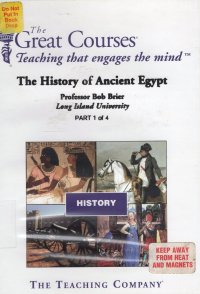
 This has been atop the boxes of audio courses that I have in my office closet since I bought it in 2024 at the Friends of the Christian County Library sale at the Nixa branch (which is this month, come to think of it). I have been a little reluctant to delve into it because it is four binders/48 lectures/24 hours. But a couple months ago, I loaded the DVDs into the main auto and went for it. And I’m glad I did.
The lectures include:
- Introduction
- Prehistoric Egypt
- Ancient Egyptian Thought
- Napoleon and the Beginnings of Egyptology
- The Rosetta Stone, and Much More
- The First Nation in History
- The Rise of the Old Kingdom
- Sneferu, the Pyramid Builder
- The Great Pyramid of Giza
- The End of the Old Kingdom
- The First Intermediate Period
- The Middle Kingdom–Dynasty XI
- The Middle Kingdom–Dynasty XII
- The Second Intermediate Period
- Joseph in Egypt
- The Beginning of the New Kingdom–the Fabulous XVIIIth Dynasty
- Queen Hatshepsut
- Obelisks
- Tuthmosis III-King At Last
- The Fabulous XVIIIth Dynasty Rolls On
- Akhenaten the Heretic Pharoah
- The Discovery of Tutankhamen’s Tomb
- The Murder of Tutankhamen–A Theory
- Medicine–The Necessary Art
- The End of Dynasty XVIII
- Mummification–How We Know What We Know
- What Mummies Tell Us
- Making a Modern Mummy
- Dynasty XIX Begins
- Ramses the Great–The Early Years
- Ramses the Great–The Later Years
- The Exodus–Did It Happen?
- The Decline of Dynasty XIX
- Dynasty XX–The Decline Continues
- Ancient Egyptian Magic
- Dynasty XXI–Egypt Divided
- Dynasty XXII–Egypt United
- Dynasty XXV–The Nubians Have Their Day
- Dynasty XXVI–The Saite Period
- Dynasty XXVII–The Persians
- Dynasties XXVIII to XXXI–The Beginning of the End
- Alexander the Great
- The First Ptolemies
- The Middle Ptolemies–The Decline
- Animal Mummies
- Cleopatra’s Family
- Cleopatra–The Last Ptolemy
- The Grand Finale
The series is, for the most part, chronological but with some topical asides. It is a very high level survey, though, as it deals with 70,000 years (including the prehistory) and 3,000 years of history (written language supplemented by archeological finds), and it boggles the mind: The series ends in the years BC, and as the meme says, the Pyramids were older to Cleopatra (VII, the seventh with that name but the only one who can go without a number to us in the modern world) than Cleopatra is to us (3,000 years versus 2000 years, give or take). Breathtaking.
The professor is definitely a homer/enthusiastic on the topic, and he has this way of repeating words to emphasize or underline his thoughts. It sounds like it would have been annoying, but it was not, actually. And I watched the last two lectures, and I can say that he was better to listen to than to watch. Part of that is that it’s an older series, even older than 2003–not only does the voiceover stock narrator talk about these tapes, but the lecturer himself calls them tapes. And it’s of the cinematography of pretending he’s lecturing to a crowd, which means he’s standing at a lectern and looking at students who are not there, only occasionally looking at the camera. Other ones I’ve seen, including Lost Worlds of South America and a set on watching movies that I’ve not finished because I was watching them–those were made with the DVD viewer in mind. But: I don’t mind because I’m fortunate enough to have an old vehicle which accepts DVDs and will play the audio from them without bothering me with the video. Man, I’m going to miss that when I’m gone.
It reinforced a bit from what I gleaned from Origins of Great Ancient Civilizations and even Our Oriental Heritage (which remaind the only volume of the Story of Civilization which I’ve actually read, although I’m going to revisit the partially read second volume real soon, I hope). Egypt got an early start with its civilization and the benefit of the regular overflowing of the Nile, but that early opulence didn’t help it in the long run when the hungrier groups from less providential environments started showing up. But, man, it did quite blossom in those early days, and Professor Brier is just the man to tell you about it.
Unlike some English literature courses that I’ve listened to, I’m not ready to rush out and buy primary texts or join the societies mentioned in the conclusion lecture. But if I stumble upon them in the wild, I might pick them up. And, briefly, until the knowledge is overwritten by nothing at all, I know some basics and can talk about Hatshepsut, Akhenaten, Nefertiti, Tutankhamen, and Ramses a bit, and I know the differences between who was buried in pyramids and who was buried in the Valley of the Kings, and I can tell the difference between some of the relative dynasties. However, since there’s not going to be a test, I’m afraid that most of this will be forgotten by the time the next trivia night rolls around. Not that history questions come up in trivia nights these days.
It’s funny, or sad, about how quickly these things roll out of my mind. I guess repeated exposure over time will help cement things–such as reading Our Oriental Heritage in 2023 and listening to Origins of Great Ancient Civilizations in 2019 and now this course. And if you linger on LinkedIn as any hustler or underemployed tech person is wont to do, you see lots of messages about continuing to learn, continuing to educate yourself, etc. But it’s always in practical and artificial professional things. Chasing certifications, and so on. I get the sense that being able to kinda talk about the Old Kingdom, Middle Kingdom, and New Kingdom and to talk about the fact that The Valley of Kings has no pyramids in it doesn’t count. Too bad it’s what I find interesting. Too bad for me, perhaps.


2 thoughts on “On The History of Ancient Egypt by Professor Bob Brier (2003)”
Comments are closed.