Book Report: Great Tales of Mystery & Suspense compiled by Bill Pronzini, Barry N. Salzberg, & Martin H. Greenberg (1994)

I can’t believe I read the whole thing.

Sorry to be summoning forth the memory of old Alka Seltzer commercials, but zowie, this is a 601 page book. It’s an Anna Karenina-sized collection of mystery short stories.

It’s a large collection of short stories, to be sure, but it’s a very good collection of short stories, so don’t get me wrong. It took me a couple of weeks to read it, but that’s because even the best book of short stories might be hard to put down, but sometimes they can be hard to pick up again, particularly when they’re 600 page books of short stories and you’re a fellow who likes to read a couple of books a week.

This collection, though, is definitely of higher quality than some of the collections of short stories I’ve picked up in the recent past (even better than The Best from Fantasy and Science Fiction Fourteenth Series). This book runs a gamut, from serious literary writers like Pearl S. Buck and Bernard Malamud to science fiction luminaries like Robert Silverberg (see my review for Three Survived) to my mystery standards (John D. MacDonald, Ed McBain, Ross MacDonald, Erle Stanley Gardner, Mickey Spillaine, and Ellery Queen).

The styles vary, but the quality is definitely high, and it’s worth the buck I paid for it at St. Michael’s book fair this winter. Heck, for the dollar, I got a lot of nights’ reading from it, which is both good (efficient spending for prolonged reading) and bad (prolonged reading means less clearance of the to-read shelf and too little blog fodder).

The link below lists it as low as $.34 currently (plus shipping). Worth all of those pennies and more.

And when you’ve read it, explain the Bernard Malamud story (“My Son The Murderer”) to me, because I didn’t get it. Since it was the last story in the book and the only thing standing between me and logging the book as my 15th trophy of the year, I didn’t mind. But I didn’t get it, either. Blending multiple 1st person points of view across multiple paragraphs? The intro said there was a crime in it, but I didn’t see it.

Books mentioned in this review:


Buy My Books!
Buy John Donnelly's Gold Buy The Courtship of Barbara Holt Buy Coffee House Memories

The Single Greatest Current Mystery From Lost

What do the numbers mean? Why were those guys at the ice station? What’s the deal with Desmond? Why did Locke become paraplegic? Those are all simple, pedestrian mysteries on Lost. No, sir, there’s one mystery that surpasses them all given what we’ve seen or not seen in the last portion of Season 2 and the first half of Season 3:

Who ate the dog Vincent?

Here are the data points:

  • We haven’t seen him since a late episode in Season 2.
  • His two main contacts (protectors) from the survivors (Walt and that chick) are gone.
  • We haven’t seen the survivors hunting boars lately.

The inescapable conclusion is that the either Vincent dog-paddled to Asia or someone has killed and eaten that yellow lab.

Let’s run down the possible suspects:

  • Jin and Sun: Come on, they’re Korean, but that’s too obvious and the writers of the television show would not play to the stereotype. No.
  • Charlie: Sure, in a fit of heroin pitique, perhaps he was jonesing for some meat. Maybe.
  • Hurley: Dude needs some calories, but he’s more the sort to raid the stash from the hatch. Probably not.
  • Desmond: Dude crazy. Maybe.
  • A polar bear: Hey, why not? Walt got attacked by a polar bear; the recurrence of a polar bear would tie back to other appearances by polar bears and could probably amount to nothing. Maybe.
  • An tribe of native Pacific Islanders: Sure, we’ve never seen nor heard from them, but why would that stop them from appearing? Maybe.
  • The ghost of Jack’s father: Well, ghosts don’t eay, but perhaps Jack’s father must consume flesh to reincorporate. Maybe.
  • The shark: Sharks eat things in the ocean. Hasn’t the dog been known to go into the ocean? Maybe.

As you can see, the possibilities are endless. But you can rest assured, I’ll be watching for the clues, such as someone in the background of a shot sucking marrow from dog bones or a character suddenly sporting an Australian rabies tag on a chain around his or her neck. Because I must know.

Buy My Books!
Buy John Donnelly's Gold Buy The Courtship of Barbara Holt Buy Coffee House Memories

That’s No Phish; That’s An Amphibian

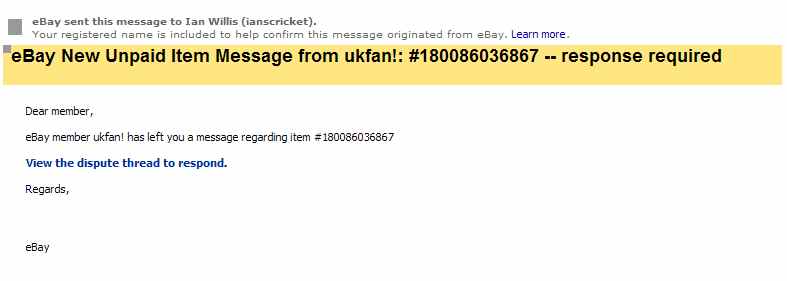
Today, I received this message:


The phish e-mail

Oh, no, I thought like good little phishbait. I didn’t even bid on that.

But instead of clicking through on the e-mail, I go to ebay.com and search for the item.

Well, low and behold, the item number in question was an actual item and it was offered by the seller mentioned in the phish e-mail:


The phish e-mail

Of course, it’s still obviously a phish because:

  1. That’s not the e-mail address tied to my eBay account.
  2. The e-mail lacks most eBay header/footer details.
  3. The message headers indicate it came from somewhere besides eBay.
  4. The auction that I was “delinquent” for hadn’t ended by the time I received an e-mail.

But still, the sophistication of this particular phish is remarkable. It scrapes an actual auction off of the eBay site before or at the time of mailing to make it seem more authentic.

I’m almost afraid enough to vow to never click a link in an e-mail again, but I’d probably get fired.

Buy My Books!
Buy John Donnelly's Gold Buy The Courtship of Barbara Holt Buy Coffee House Memories

New Urbanist Development Not Very New, Not Very Urban

Will city planners and those who’ve mistaken government service for a real-life game of Sim City take note about this development that, after a number of years, lacks the foot-traffic sorts of business it promised?

At first glance, a trip to the New Urbanist community taking shape on Hercules’ bayfront is reminiscent of the neighborhood depicted in the Jim Carrey movie “The Truman Show.” Each Craftsman, Victorian and Italianate home couldn’t be more perfect, glistening in an array of tasteful pastels.

But at least Carrey’s character, trapped in a seemingly idyllic seaside community, could walk to the local cafe for a cup of coffee. Three years after moving into the Promenade section of Hercules’ New Urbanist Waterfront Redevelopment District west of Interstate 80, residents still have to drive or take a long walk for items as mundane as a cup of coffee. The bustling just-walk-to-it village, touted as a model of the New Urbanist movement, has yet to materialize.

One of the tenets of the movement is that residents should be able to access essential services without having to drive to a strip mall on the outskirts of town. The idea is to locate retail hubs within walking distance of neighborhoods, or within easy access to mass transit. Currently, the mixed-use, live-work spaces on Railroad Avenue, which are meant to house these shops and services for Promenade district residents, contain real estate offices, finance firms and, of course, a company that specializes in staging homes for sale.

No, of course not; your community leaders know they’re smarter than those saps in California, and that their misunderstanding of how urban areas grow from central planning instead of organically based on industry/employment won’t make the same mistakes.

Of course, they will. They’ll drive out stinky heavy industry to beam down a Star Cups (an off brand coffee shop, because a profitable corporation knows that light residential areas are risky for sustained business operations). Meanwhile, the affluent types who can live in New Urban areas because they commute to higher paid jobs elsewhere or because they’re on a trust fund/retirement will continue to draw the sorts of businesses they can support–expensive places that can survive when the customers aren’t frequent. Like real estate offices, financial firms, a company that specializes in staging homes for sale, and expensive beauty salons.

Buy My Books!
Buy John Donnelly's Gold Buy The Courtship of Barbara Holt Buy Coffee House Memories

Bill McClennan, Proud His Paper Sucks

Bill McClellan, St. Louis Post-Dispatch proud his paper is hated:

We are not liked. We are a liberal paper, and these are conservative times. What’s more, many of the people who you might think would normally like a liberal newspaper don’t particularly like us.

It bothers the new owners from Lee Enterprises because they have to keep a business afloat. Apparently, it doesn’t bother the actual employees of the Post-Dispatch, though, because they’re on a mission.

Buy My Books!
Buy John Donnelly's Gold Buy The Courtship of Barbara Holt Buy Coffee House Memories

Personal Relics: The Pink Clipboard

I used my translucent pink clipboard the other day. I had an essay I wanted to proofread, so I detached the clipboard from its underused lined pad and clipped the essay onto it. The lined pad, with its years’ old plans and next big thing ideas, I put back into the organizer on my desk. I have things so well organized in that rudiment of civilization that I hate to take them out. But I needed the clipboard, so it came out.

I am reaching the age where every little trinket in my life has an origin in the mists of my time, and the clipboard originates from my college days. Not so much my college days, but the weekends in between my college days. For a brief period, I gamed with a couple of friends in B—’s basement on Sunday nights. Sunday afternoons, I could use my father’s car, so I would round up the gang and we would spend Sunday afternoon and evening in the basement of the townhouse where B— and his mother lived. The basement had the décor of a middle 20th century rec room, with a tile floor, the old couch, and a card table. On the off-hand weeknights, we’d gather to game or to pretend we could play musical instruments together. But on Sunday nights, we’d game.

A couple of late adolescents, dice, pencils, and paper called for something more, but we didn’t know what. Until B— discovered it. One weekend, he presented each of us with a clipboard to make it easier for us to maintain our personal character score sheets. As he produced them from somewhere offstage, he said he’d been to an office supply store and found a sale. Considering that we all earned a minimum wagesque paycheck at the time, his bounty probably represented a not insignificant portion of his disposable income. Much to our chagrin (and, no doubt, to the office supply store manager who eventually put them on sale), the clipboards were pink. No right-minded young man would use a pink clipboard.

But they were free enough at the time, and no right-minded minimum wage earner overlooks the generous excess of a friend. Particularly when that gaudy and potentially effeminate excess can be enjoyed in a basement where overlooked New Year’s parties, games of strategy, and Ghostriders’ band practices occurred. We accepted the plastic clipboards, no doubt edgy statements at a time where clipboards were still made of laminated chipboard, and we used them throughout those Sunday evenings in our youth.

As I proofread whatever it was I wanted to revise, my attention was split to include the history of the device upon which I was working and those nights long ago. I’ve had the clipboard longer than I’ve had my degree, my wife, my career, my Web log, and my son. Whenever I need a place upon which I want to correct my printed scribblings or, for some reason, to attach tablets which already feature their own hard cardboard surfaces, I turn to this single pink, semi-transparent piece of plastic.

Of all the things I’ve mentioned, it will survive. When these words are forgotten, when my marriage and my line have faded into even greater obscurity than from which they have sprung, when my Internet postings have finally emanated into the ether, when the library has given me much pleasure has moldered into fertilizer for future weeds, some archeologist aeons hence will dust off this pink clipboard from the remnants of this homestead or some landfill. With some thought and study, future historians might regard this one possession of mine and will find it reflective of its owner and his civilization.

A plate upon which this primitive dined, no doubt, with a metal clip to hold upon it the wriggling prey.

Buy My Books!
Buy John Donnelly's Gold Buy The Courtship of Barbara Holt Buy Coffee House Memories

Book Report: Too Far by Mike Lupica (2004)

Heather gave me this book for Valentine’s Day, and I’ve already read it. So you know where I stand on Lupica. If you don’t, here’s a refresher course: Wild Pitch; Full Court Press; Bump & Run.

This book, unlike those named above, centers around a crime. A former national sports columnist who retired after the subjective of an investigative story killed himself returns to his hometown on Long Island. A high school student who covers high school basketball games for the local paper comes to the adult sportswriter with a possible clue in the death of the high school basketball manager’s death and its possible relationship to a hazing incident with the team.

So there’s your setup.

What follows is decent prose and a passable story interrupted too often with exposition about school hazing and its barbarity. I mean, brother, sodomy with a broomstick is enough in its description; you don’t have to have two separate characters in a limited omniscient point of view reflect at the page’s length about how brutal it is. I mean, we don’t get that sort of thing in other murder mysteries, unless I’m missing the entire cockfighting murder mystery subgenre (Well, I wouldn’t say I’m missing it, Bob).

The action builds credibly once you get past the editorials against high school hazing and the meticulous recounting of other incidents nationwide (almost requiring end notes). Until we get to the extraordinary double deus ex maquina at the end, where someone else sums up the story and lays it at our investigator’s feet and someone else appears to get the investigators out of the climactic jam at the end. Unsatisfying.

However, I still like Lupica and will gladly accept any and all gifts of his work in the future.

Books mentioned in this review:


Buy My Books!
Buy John Donnelly's Gold Buy The Courtship of Barbara Holt Buy Coffee House Memories

Painted Days and Painted Nights

It’s Mardi Gras time here in St. Louis, which means Soulard is putting on its schizophrenic finery wherein it tries to celebrate in a family-friendly fashion the last minute drive to get in as much debauchery as possible before Lent and repentance came due. But that’s neither here nor there.

Fact of the matter is, I’ve worn face paint twice in my life, and neither time was for a sporting event. The first was, in fact, Mardi Gras 10 years ago. A couple of my friends and I decided to go down the Saturday before Fat Tuesday and take it all in. Familiar with the concept of the New Orleans Mardi Gras and its festivities, I said, “Hey, people paint their faces for Mardi Gras, right?”

“Sure,” my lifelong St. Louis resident friend said.

So I designed a concept for my motif: On one side, the happy drama mask, and on the other side, the unhappy drama mask. Done in black and white. We went to Johnny Brock’s and got some black and white facepaint so we could do the happy side in black on white and the unhappy side in white on black. Johnny Brock’s actually had colored hair spray, too, so I messed the hair up manically on the white side and patted it down flat on the black side. My friend and fellow displaced Wisconsinite Walter, an artist by self-definition, actually did the face painting (and signed his initials under my chin). Dressed in black and white completely and wearing a trenchcoat, my Mardi Gras garb was complete:
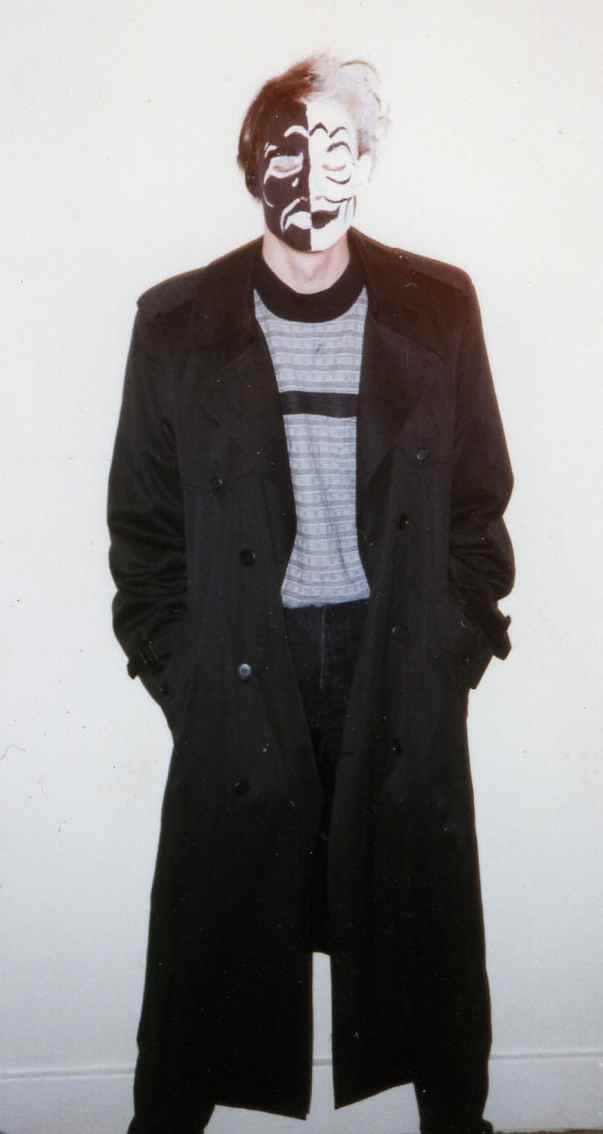
Drama masks; no, really, look closer

So my lifelong St. Louis resident friend put on purple mask, and off we went. Once we got to Soulard, I discovered the “Sure” had an asterisk on it. People paint their faces up for Mardi Gras.*

* In New Orleans and Brazil.

I was one of three people in face paint among the thousands thronging the streets and bars. People thought I was supposed to be The Crow, the Joker, or Ace Frehley. Only one young lady correctly identified it; she was a Webster University student and quite probably in the Theatre Department. Somewhere along the line, my lifelong St. Louis resident friend ditched his mask to better blend in with the “beads are the Mardi Gras costume” crowd.

But it was a good night. We drank liquor until the police chased us out of Soulard and ended up at the Venice Cafe, where a bunch of older (mid 40s) women hit on me and kissed on me to my chagrin. My lifelong St. Louis resident friend explained that, at the tender age of 25, I looked like a middle aged hottie. Needless to say, I haven’t spoken to that friend since before the turn of the century.

Wow, and I still wear that trenchcoat. Maybe it is time to get a new one.

As I mentioned, I’ve painted up twice in my life, and both were in that year: 1997. Perhaps one could read something psychoanalytical into that. But the second time, in the autumn, was at GenCon, the roleplaying game convention. My lifelong St. Louis resident friend from Mardi Gras, my best friend from college, and I drove up to Milwaukee to attend. Even though we all had jester costumes, something on the GenCon sales floor triggered my imagination; I think it was some press on fangs. Suddenly, I wanted to enter the costume contest. As the Weresmurf:
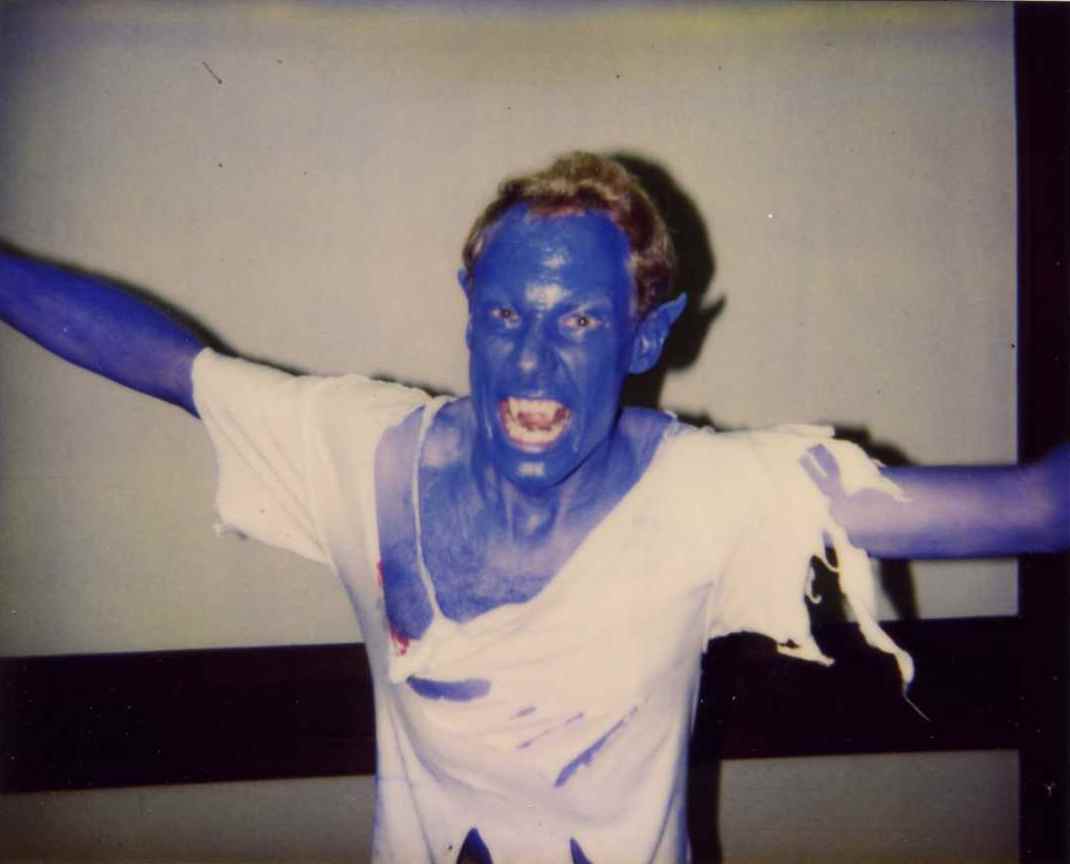
The Weresmurf

I bought some blue face paint and the aforementioned fangs, and my friend sacrificed a t shirt. I plunked down the entry fee and took my shot at fame. The contest featured a bit where you came on stage, and the MC introduced you. You could write your own intro and have the contest leader make special preparations for you. I asked them to lower the microphone and wrote out my introduction.

When my time came, the MC read my beautiful words: “When the moon ripens to fullness, something dark prowls Smurf villiage. It’s the Weresmurf?” Actually, I didn’t pen the rising inflection at the end, but the MC turned it into a question. With that, I leapt from behind the curtain, ran sniffing and hunched from one end of the stage to another, snarled at the MC, and ran up to the microphone, where I preceded to howl out the Smurf theme, finishing with a poignant “root rooooo!” I then leapt from the front of the stage, ignoring the stairs so carefully pointed out by the staff, and ran up the aisle snarling and sniffing until I was out of the spotlights.

At the time, I was a regular on the poetry open mike/slam circuit in St. Louis and had hopes I could get some kind of thing going where I’d give readings at colleges or whatnot (I’d seen the Nuyorican Poets Live that year, too, so it wasn’t out of left field–you know, like painting oneself blue for fun). But the largest crowd I ever performed in front of to that point–and let’s be honest, since–my only vocalization was a Smurf howl.

Adding salt to my pretentious wounds, the only national magazine exposure I’d gotten to that point (and, honestly, up until last month) was in the December 1997 issue of Inquest, which had a photo essay from GenCon:
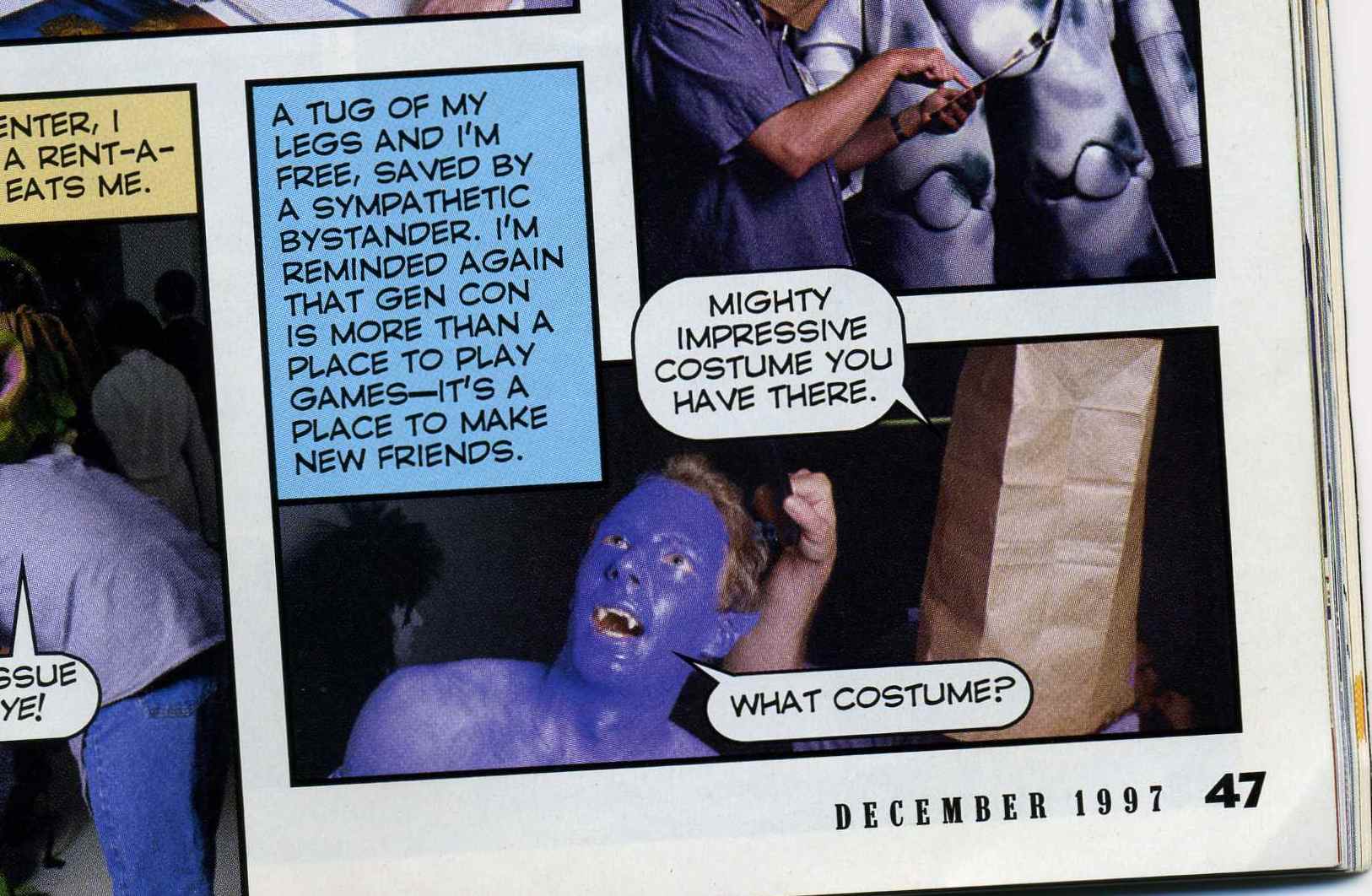
Brian J. Noggle in December 1997 Inquest Magazine

That’s right, it took me 10 years to get my name into a publication with a circulation rivaling that of my appearance in blue paint with a humorous dialogue balloon pointing at my mouth. But wow, blue paint really does bring out my blue eyes.

On the plus side, I did win my category, so I came home with a trophy dish and a pair of commemorative d6. Of course, the category was the equivalent of “everything else” and my only competition was a couple of teenaged girls who put bones in their hair and tried a sitcom skit about feuding vampire sisters. So perhaps my resounding victory isn’t a testament to my genius or proper sense of the absurd and only reflects that I wasn’t as bad as the kids.

But I got the trophy, and I got the Polaroid, and I got the two d6s. I’ve also got a scannerful of photographic memories of that brief moment in my youth where painting my face seemed like the right thing to do at the time. I don’t know that that time will ever come again, but I haven’t been to Lambeau Field, either.
Buy My Books!
Buy John Donnelly's Gold Buy The Courtship of Barbara Holt Buy Coffee House Memories

No Hue and Cry; No Hue Or Cry; Very Little Notice

Wow, has this fallen off the front page already? Moscow May Break Arms-Reduction Treaty, Russian General Says:

A top Russian general said yesterday that Moscow may unilaterally opt out of a Soviet-era arms reduction treaty with the America, Russian news agencies reported.

General Yuri Baluyevsky, the chief of the Russian military’s general staff, was quoted by ITARTass and Interfax as saying that Russia could pull out of the Intermediate-Range Nuclear Forces Treaty, negotiated between Soviet leader Mikhail Gorbachev and President Reagan in 1987.

Can’t anyone muster up some no nuke signs for outside the Russian embassies worldwide?

Buy My Books!
Buy John Donnelly's Gold Buy The Courtship of Barbara Holt Buy Coffee House Memories

What You Need To Be A Struggling Writer

(circa 1993-1994–how precious! – ed.)

Whenever I meet someone, one of the questions that always comes up is “What are you going to college for?”, usually right after I say “Yes, I go to Marquette University”. I usually respond with “Eleven grand a year,” but I am really going to college to get my Writing Intensive Bachelor Degree. I would have been a Writing Intensive Bachelor without the help of Marquette University, but I would not have had so much fun doing it. After I explain to these newly met people that I am a writer, the proceed to give me what they think is encouraging advice.

The advice is always the same, “Hang in there. Don’t give up. Have something to fall back on”. Thank you very much, but that advice is generic for any occupation. When people get specific about it, they always tell me that it takes a long time to break into the writing business. Well, no, I’d like to point out (but I am too polite to) that Tom Clancy and John Grisham “broke” into the biz. The rest of us, or at least I, have to worm our way in. I, on the other hand, am a practicing struggling writer, and I decided that if everyone else is giving advice, I might as well jump on the bandwagon.

To help out with all you struggling writers out there, I have compiled a list of things you’ll need. Strunk and White, ages of English classes, and last month’s Writers’ Digest can give you all the technical details. You’ll need more than words to make it as a struggling writer in today’s competitive market, and here’s what you’ll need.

  1. The Idea You’ll Succeed.
    When I started, I wanted to put down “Talent,” since that is pretty important to make it as a writer, but it’s not actually necessary when you start your jaunt as struggling writer. You can pretty much start with “The Idea You Have Talent” because your writing will get better as you write, so if you think you have talent, you will write more, and it is a self-fulfilling prophesy. Then I thought of some cheap fantasy fiction and pulp detective stories. Some of the stuff I have read has been so bad that I don’t think the writer could have thought they had talent. All they could be running on was self-confidence and the dollar signs they must have been seeing, so to succeed as a writer you just need the idea that it can be done, and not much else, but if you do have talent, so much the better.

  2. Something Written.
    When I told a professor my freshman year of college that I was going to be a writer, he asked me if I had written anything. At that point I had written innumerable bad poems, a few bad short stories, and most of a bad-but-hopefully-salvageable novel. I almost laughed, but you never laugh at a full Jesuit or a full Doctor, so I merely said “Yes, sir”. Since he asked the question, I can only assume he had run across people who were going to be writers who hadn’t written anything, but that’s what they were–people who were going to be writers. You’re not qualified to be an official Struggling Writer unless you’ve written something–and don’t give me that old “Writer’s Block” excuse. That’s like saying you’re on the disabled list without ever having picking up a baseball. So if you haven’t written anything, you might as well not read on.

  3. A Lot of Stamps.
    I mean a lot of stamps. What they say is true, you should receive quite a few of rejections before you get published anywhere. If you don’t, well, I don’t want to talk to you any more. I must have gotten your share of rejections, too. And at four stamps on the envelope to the magazine, four for the SASE (for short stories and articles mailed flat), that works out to $2.32 per submission. It’s more than a lottery ticket, and this should illustrate that you do need the idea you’ll succeed (if you want to get lucky, go to Vegas) and a lot of stamps.

  4. A Stiff Upper Lip.
    And, as you receive a lot of rejections, it might hurt. You might wonder as you stare at your ceiling as the shadows of the tree outside your window dances in the wind because you can’t sleep why you bother going on when all you get are a few compliments from your friends who are probably lying anyway and form letters that were probably written by the same insensitive clod with Rejection Forms Incorporated from every magazine you ever submit to and you might be tempted to give it all up and get into a respectable and lucrative racket like flipping burgers at the local McDonalds, or maybe that’s just me. Keep a stiff upper lip, though. It just takes a while, and once you’re in somewhere, it’ll get easier. Or so they tell me. Keep trying, and if you want a bit of my personal technique, try a dash of arrogance. Remember that that poor overpaid pencil-pushing mousy looking illiterate moron of an editor wouldn’t know a good piece if it was shot through his or her window with a flaming arrow. It’s an immature response beacuse deep down I’d like to project the failure onto the poor editor rather than the quality of my writing. If you can rationalize it, use it. It works for me.

  5. A Paying Job.
    By no means confuse this with a REAL job. I realize that being able to support yourself without writing takes much of the authenticity out of the poverty-stricken living-on-the-streets romantic image of the struggling writer, but if you can almost pay the bills, it’s easier on the stomach lining. Besides, the real world experience you gain will give you ideas for stories and characters, essays and articles, and you will have the expertise to carry it off. The things I have learned as a produce clerk will be invaluable when I start my great novel featuring tomatoes and overripe watermelons as main characters.

  6. A Sense of Humor.
    A sense of humor is helpful in any profession, and it is completely necessary for a writer. Not only will you be able to laugh heartily at lawsuits (“I plagiarized WHAT? I slandered WHOM?”), but you will also look at old things in new ways and give you endless material. Plus, Reader’s Digest pays $300 for short anecdotes, and you don’t have to write them well, and if you’re shifty enough, you don’t even have to live them–just don’t tell them I told you so. A sense of humor keeps me going–I have a collection of my rejection slips that I have kept, and I take pride in showing them off to friends. No, wait, that isn’t a sense of humor, that’s masochism. Maybe I should have added “A Sense of Masochism”.

Well, there you have the official Brian J. Noggle method to becoming a struggling writer. To become a good writer or a published writer is something else entirely, and I’d give you advice on either of the above subjects if I had experience with them. Heck, if you find a good list or magic potion that will give you either of those two powers, give me a copy or mix me up a batch.

Buy My Books!
Buy John Donnelly's Gold Buy The Courtship of Barbara Holt Buy Coffee House Memories

Margin For Error

The common assumption that you’re fairly safe if you’re worth more alive than dead to your peers and family overlooks a slight margin for error available in the equation. The incorrect equation:

Aw > Dw

that we think keeps us from being killed for our insurance benefits pits that value (Dead Worth, or Dw) against potential for future earnings and the future unrealized monetary value of the goods and services rendered as a friend or husband (Live Worth, or Lw) keeps us feeling pretty safe that we won’t get bumped off as long as we remain productive. However, this equation does not capture the slight margin of error represented by the transitional cost. Because we’re actually alive right now, a certain amount of fiscal impact would occur in the transition. That is, we need to add to the Aw a certain expense involved in the actual death, whether it’s $10,000 for a contract killing, a couple dollars for some poison, a couple cents for a bullet, or the trouble of changing the pillowcase after the smothering. Ergo,the correct formula should be:

Aw + CoK > Dw

That is, you can remain comfortably safe if your Dead Worth remains lower than your Alive Worth and the Cost of Killing you.

And that, my friends, is what passes for optimism some days in the mind of Noggle.

Buy My Books!
Buy John Donnelly's Gold Buy The Courtship of Barbara Holt Buy Coffee House Memories

Book Report: The MENSA Genius Quiz Book by Marvin Grosswirth, Dr. Abbie Salny, and the members of MENSA (1981, 1990)

I picked this up at a yard sale or at a book store cheap, much like the MENSA Think Smart Book that I read in 2004.

This book is the same schtick, with chapters on different kinds of puzzles. Unfortunately, this book’s previous owner had penciled in a number of the answers, which really rather spoiled it. I mean, I was trying to prove or disprove those answers instead of answering them myself.

So it’s worth a quick read and a couple pieces of silverage, but for Pete’s sake, open it up and make sure it’s unmarked. Don’t fall prey to the same problem I did. Unfortunately, the next time I pick up one of these books used, I’ll not remember to do that, ultimately proving that I am not MENSA material.

Books mentioned in this review:


Buy My Books!
Buy John Donnelly's Gold Buy The Courtship of Barbara Holt Buy Coffee House Memories

Police Encourage Driving While Distracted

Police: Cell phones a weapon against drunk drivers:

Many drivers in Missouri and Illinois are armed with an important device to combat drunken driving: Cell phones.

With cell phone use on the rise, drivers are being encouraged to report vehicles that show the telltale signs of driving under the influence, such as swerving into the shoulder and crossing the centerline.

For safety’s sake, take your eyes off the road and dial.

Buy My Books!
Buy John Donnelly's Gold Buy The Courtship of Barbara Holt Buy Coffee House Memories

Swapping The Good For The Citizens For Good For The State

Missouri bill would trade casino loss limits for a tax:

A Senate leader proposed a new twist Monday in the long-running debate on loss limits in Missouri casinos.

Senate Majority Leader Charlie Shields, R-St. Joseph, wants to remove the $500 loss limit per two-hour period and impose a 1 percent tax increase on casinos. Money generated from the changes would be directed at a new scholarship program available to all high school graduates attending a public or private Missouri higher education institution.

You see, they placed this artificial cap on spending to make sure that the casino clients had to fritter their savings away on the riverboat “cruises” (that’s what the two hour periods represent, time when the boats would be “cruising” the river; quaintly, riverboat gambling was supposed to take place on boats, not on buildings in an inch of picturesque river backwaters engineered to appease the letter of the law).

But never mind artificial tips to concern for the citizenry; there’s money to be made on it.

Coming soon: decriminalizing murder for hire and replacing it with a licensing fee structure, permit requirements, and an excise tax.

Buy My Books!
Buy John Donnelly's Gold Buy The Courtship of Barbara Holt Buy Coffee House Memories

He’s Already Denied Links To "Hard" Money

McCain denies links to ‘soft money’

His ill-guided support–and passage of–campaign finance reform (aka “make the trained monkeys dance faster when the fundraising organ grinder plays so they can gather smaller peanuts and empower the * Congressional/Senate Committee or Unattributable Issue Advocacy Groups) has ensured I won’t support McCain for president this time around, his attempts to deny candidates access to any money now is misguided.

Or maybe I misread the headline.

Buy My Books!
Buy John Donnelly's Gold Buy The Courtship of Barbara Holt Buy Coffee House Memories

Book Report: High Profile by Robert B. Parker (2007)

Oh, my God, they killed Rush Limbaugh.

Well, maybe it’s not really supposed to be Rush, but a national radio/media figure is strung up in Paradise, Mass, and that means Jesse Stone has to figure out who did it. It’s a decent enough crime fiction piece, but it’s padded out with the Stone/Randall era Parker relationship musings.

Unfortunately, whereas the Susan Silverman/Spenser stories have 30+ years of real novels to work through, where the relationship was often secondary and vividly lived in Spenser’s adventures, in the Stone series the Jesse/Jenn Stone issues are actually co-hosts (and, apparently, the Sunny Randall/Richie issues are special guest stars). Stone, his lovers, his shrink, his co-workers, and pretty much all of the eastern seaboard represented in this book spend an awful lot of time talking about not understanding what’s wrong with Stone and his “love” for his ex-wife.

Which almost ruins a decent crime fiction story.

You know, if it evolved as small portions of the books or if the crises were lived out instead of talked out, I wouldn’t mind so much. But these Stone novels really do amp up the worst portions of the Spenser novels. As though the fans were saying, “More psychobabble, less detection.”

But I still buy all the latest Robert B. Parker books new.

Books mentioned in this review:


Buy My Books!
Buy John Donnelly's Gold Buy The Courtship of Barbara Holt Buy Coffee House Memories

Book Report: Fields of Wonder by Rod McKuen (1971)

Man, no one can make the quest for sex true love seem as banal as Rod McKuen over the course of several books. I had nice things to say about In Someone’s Shadow; I endured Stanyan Street and Other Sorrows. But this book? Blech.

I started reading this to my poor son, but his mother heard the first couple of lines of the first poem:

I began by loving nobody.

Then nobody’s face
became the face of many
as I traveled not to Tiburon or Tuscany
but battled back and forth between the breasts and thighs
of those who fancied for a time
my forelock and my foreskin.

Well, I guess that is a bit graphic. But it’s not sexy; it’s the banal wanderings of a poet narrator beginning the 1970s hangover to the era of free love. Worse, it’s the pseudo-stylings of a longing romantic who seems to be longing for a collection of faceless body parts in his quest for real love or real feeling.

The clever turns of phrase I thought were present in In Someone’s Shadow? Nothing. Sure, these poems are as accessible as regular prose without the line breaks, but I didn’t want to.

Worst of all, I have a couple more of these books left.

Oddly enough, the course of these books makes me more tolerant of Emily Dickinson’s misfires. Over the course of the 1,775 poems collected in the volume I’ve been wading through for over a decade, Dickinson’s pieces run the gamut from simplistic to inscrutable to wow, but her average seems slightly better than McKuen at this point.

Which is why she was taught, almost, in college in the early 1990s, some 130 years after she wrote most of her poems, and Rod McKuen was not, some 20 years after he became an industry unto himself.

Books mentioned in this review:


Buy My Books!
Buy John Donnelly's Gold Buy The Courtship of Barbara Holt Buy Coffee House Memories