Laziness Is The Mother Of Perspective

Laziness is the mother of perspective. I’ve been taking the Wall Street Journal for some months now, receiving the well-rolled and well-wrapped papers in my driveway every morning. I threw them onto the passenger seat of my truck as I began my commute, but I soon forsook the pretense and pretentiousness of carrying the paper under my arm into my office for the cachet. Too frequently, the papers return home unread and accumulate on one end of the love seat. With a paper as expensive as the Wall Street Journal, you don’t throw it into the recycling bin or use it as fireplace kindling when you’re out of twenty-dollar bills without glancing at least at the section headlines.

Some weekends, though, I make a point of, at minimum, paging through the accumulated wisdom, and these blocs of skimming have instilled in me a greater understanding of history, or at least the relative insignificance in history of chatter, speculation, and sports-like spectator-ism that makes up ninety percent of the news coming from Washington and all other government seats.

Every day, I get my share of the chatter; I get headlines and news from the Internet, and I participate in the great diablog that occurs amongst like-minded individuals with Web logs. In the 2004 elections, I followed all of the barnstorming commentary at the speed of broadband. So I participate in the cheerleading and heckling that represents in-depth participation in politics in the 21st century. But October’s Wall Street Journals cured that when I read them in November.

Every night in October of some past year, I hoped to set aside twenty minutes or a half hour each evening to read the paper, knowing full well that I would have seen the storylines play out on The Drudge Report, the blogs, CNN.com, and the local paper’s Web site before I got to the print speculation. Still, I hoped for detailed analysis I didn’t get from the quick scans of headlines when the boss wasn’t looking. But life, chores, and computer games often interrupted my plan. Sometime in late October or early November, I allocated an afternoon to catch up and remove the papers that were beginning to tip the furniture. I had a reverse chronology of the preceding month’s triumphs and follies for America and for the party. But by reading the papers in reverse order, I inadvertently received the perspective of history.

That is, I knew how the early October tribulations resolved before I read the articles outlining the strategies and the pitfalls. In the Internet real-time world, the rhetoric fires up the base and counts individual ticks on the scorecard of history, but the almanacs only carry the name of the winner. So Harriet something-or-other isn’t a Supreme Court justice and some guy with a placid smile is. Ultimately, the individual plays, the calls from the opponents’ cheap seats, and the shouts of the pretty boys and girls through their cones didn’t impact the lives of most Americans.
Sure, nine placid smiles on the Supreme Court will make America one way, as would six placid smiles and three earnest frowns or six earnest frowns and three placid smiles. However, the great events that lead to that court and that change the country occur infrequently enough that one doesn’t have to arrest all normalcy to fight the good fight, or merely the fight (the difference lies in your position on the fight, of course).

Instead, I went about my business throughout October spending my immediacy on the things that directly impacted me (my job, household maintenance, my marriage, and too little exercise). Only when I read the preceding weeks’ papers did I realize the peril to our way of life, but by that time, with the solid knowledge of the continued progress of history, I wasn’t worried. It reminded me of watching a movie I’d seen before.

I once bought a box of Newsweek magazines from 1966-67 at an estate sale; I’d spent two dollars to purchase the year-long subscription in hopes of turning it into eBay wealth. As I searched individual issues for keywords to drive up the bidding, I found similar tropes: Viet Nam, Viet Nam, Lyndon Johnson, the decline of the west, and more Viet Nam. In 1967, it was an ongoing concern, dribbed and drabbed out nightly or weekly as needed by the media of the time to support their corporate habits. By the time I was born, Viet Nam was a conflagration unimagined within those archived magazines. In the thirty-five years before I bought the magazines, the living memory of the year faded to romantic youth for that generation. Within only a matter of decades, that year and its live-or-die will fade to simple line items in history books or full treatises among which historians can dig in libraries.

The politics, too, of our age will fade like this. Remember distinctly the congressional shutdown of 1995? I remember it, although it’s fading to a mere sentence and sense of what it meant. The immediacy and its attendant vehemence for that bastard who caused it—well, I can summon them in name only. So this years’ nominees, secretaries, and Congressional leaders might someday earn themselves trivia questions, but most won’t merit that. Between the now and that then, though, life will go on, regardless of what partisan emergencies erupt and, quite probably, how history’s sweep brushes aside our grave concerns.
Buy My Books!
Buy John Donnelly's Gold Buy The Courtship of Barbara Holt Buy Coffee House Memories

Wallets: A Personal Evolution

Every boy must choose to either embrace the traditions of his father or to throw them off; this dilemma represents the passage to manhood throughout the adolescence that extends into the thirties of American males today. Hence, it’s not uncommon for a man in his thirties, like me, to reflect upon the lessons passed on from the paterfamilias and to determine whether to continue abiding by the wisdom of the predecessors or to strike out in a new direction in search of one’s fortune and moral balance. Thus it was in my thirty-second year that I decided that I would no longer carry a trifold wallet, as my sire had before me; nay, I would embrace the bifold wallet.

My father worked as a carpenter and hunted small game on the city streets of Milwaukee to feed his family for years, and then he stacked food on a pallet in a warehouse to feed his new family. Throughout, carried a worn leather trifold wallet. I don’t remember what sort of wallet my grandfather carried, but I’d bet trifold. The trifold is shaped for the back pocket, for comfortable carrying by men who bend and lift and nail things for a living.

I got my first trifold in high school, a cheap fabric and Velcro piece of swag or garage sale splendor so that I could carry my student ID and the dollar or so I scrounged from my mother for lunch. It nestled the money tightly and comfortably with the extra security of the Velcro strip, its announcement of money spending rarely heard, for I skipped the cafeteria to gather those dollar bills where I could. I carried the wallet until a Christmas gift certificate let me purchase a real leather trifold wallet.

I wore that wallet and its two replacements throughout college and through the first ten years of my working life, when I acted as a retail clerk, as a shipping receiving clerk, and as a printer to pay for student loans and to keep a cheap car mostly running. I even carried them as my career arc accelerated into the information technology field, I got married, and we mortgaged a house.

The trifold signifies a certain protectiveness about the contents, particularly the money within it. The two flaps envelop the contents to guard and protect the funds from the callous outside world and the temptations it offered. Funds were scarce when I was growing up. One’s wallet needed a certain difficulty of access, also, to dissuade one from whipping out gas money or worse, a credit card, to spend frivolously. The trifold represented not only a style of wallet, but a way of life.

However, my life has changed since those hardscrabble days since my life became less hard and more Scrabble; I lucked into a position in the IT industry and became, according to all expectations of my youth, rich. Not only can I pay the student loans, the mortgage, and car maintenance, but I can do it without credit cards. I can get a twenty dollar bill whenever I want, and I can spend it.

The relative affluence combined with a new wardrobe imperative. Instead of worrying about comfort while lifting and toting, I had to worry about the fit of slacks, which meant to avoid an unsightly bulge in trousers. I began carrying my wallet in my front pocket in the world of business casual, and the trifold folded thickly around the security keys, collection of dollar bills, credit cards, insurance cards, and other assorted memorabilia that would somehow not include a picture of my beautiful wife. I wanted something slimmer and thought of the bifold wallet.

Of course, I initially rebelled at the thought, since we have always carried trifold wallets, but the thought returned until I considered it seriously. I liked the idea of a slimmer profile in the wallet, the easier fit into the front pocket of slacks and even jeans. So I found myself looking for just the right wallet in the department store, and in a moment of trepidation and emancipation rebelled against my upbringing and bought the bifold wallet.

The bifold wallet indicates higher class; it’s the top hat of men’s accessories. Barring the cape, monocle, and walking stick, it adds the élan and aplomb that people who stay or dine at the Ritz afford. Instead of guarding money, the bifold flips open easily, like a Star Trek communicator, so its bearer can effectively commune with the natives and so its bearer can access the lubricant of commerce and acquisition easily. I now bear the power and irresponsibility of relative upper middle class, outer-suburb but not over the-river affluence. When my beautiful wife lets me get that extra twenty dollar bill.

Buy My Books!
Buy John Donnelly's Gold Buy The Courtship of Barbara Holt Buy Coffee House Memories

An Arthur C. Brooks Christmas Moment

I’m sure it’s only tangentially related to the Albert C. Brooks-described mindset (Who Really Cares: The Surprising Truth about Compassionate Conservatism), but as I walked relatives out of our house after Christmas dinner, I saw that the house down the block with the “Invade Iran! No” bumper stickers and the “Invest in Peace Instead of War” yard signs had one of the local bus service’s Call a Ride program vehicles out front.
Did someone call a taxpayer-subsidized, bureaucrat-operated van came to take one of the elderly or disabled guests home after Christmas dinner instead of, you know, taking that guest home?

I mean, damn.

Buy My Books!
Buy John Donnelly's Gold Buy The Courtship of Barbara Holt Buy Coffee House Memories

If You Want Me, I’ll Be In My Backyard, Building A Big Boat

According to your various traditions, various deities have destroyed civilization for sins that fall far short of this:

Would Mustang Sally drive a station wagon? Maybe she’ll get the chance.

The next generation of the Ford Mustang could include some previously unthinkable variants including a four-door sedan and a station wagon, according to a report in the magazine AutoWeek.

That does it. Anyone know the name of a good tattoo artist removal cosmetic surgeon?

Buy My Books!
Buy John Donnelly's Gold Buy The Courtship of Barbara Holt Buy Coffee House Memories

Atari Apostasy at the St. Louis Post-Dispatch

Heresy!

I do not remember the day I bought the Atari game, but I am absolutely certain that I did not wait in a line all night to get it. I’m sure because I would never have waited in line all night to obtain any toy — except for the firetruck set at Mr. Beavers’ store which I never got when I was 8, but it’s OK because I’m over it now.

With the Atari attached to our TV, my then-preschool kids and I could shoot at each other from very crude depictions of jet fighters, or shoot at each other from very crude depictions of tanks, or go bowling with an imaginary ball which seemed indistinguishable from the missiles of jet fighters or the shells of tanks.

I bored of it in about an hour. The kids, I think, gave up about 30 minutes after that.

It’s been 20+ years and I’m not bored, as anyone who’s attended our Atari Partys can surmise.

Buy My Books!
Buy John Donnelly's Gold Buy The Courtship of Barbara Holt Buy Coffee House Memories

Election Results!

Preposition 1: Will Brian go to work today?

   Yes 111,110     No: 85,109     Passing

Amendment A: Will Brian take the trash to the curb on Wednesday night, as in past Wednesday night?

   Yes 191,688     No: 4,531     Passing

Proposition B: Will Brian J. read a portion of one or more books as recreation this evening, whose summaries he will report on his blog to the great acclaim of Just D?

   Yes 8     No: 1     Passing

Household Leader: Who will run the household?

Brian (Daddy): 1
Heather (Mommy): 781
Jimmy Ray (Dep.): 2,548,159

In other words, more of the same.

Buy My Books!
Buy John Donnelly's Gold Buy The Courtship of Barbara Holt Buy Coffee House Memories

Altria Takes Note

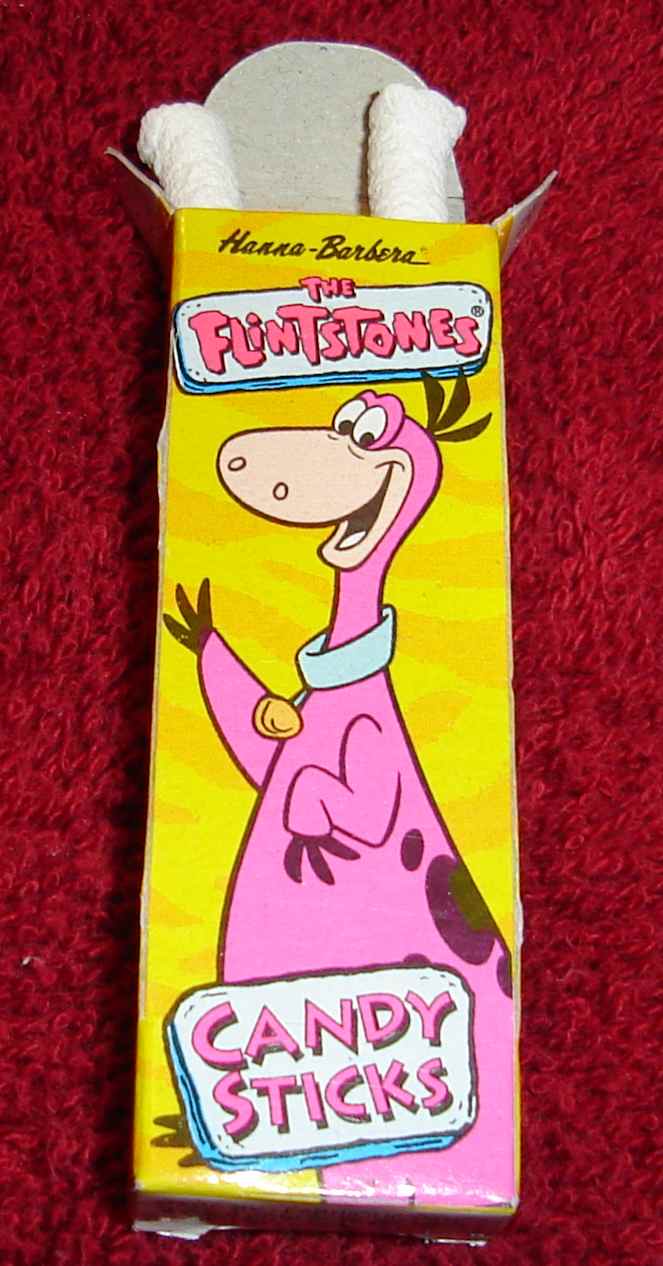
Back when I was a kid, these were called “candy cigarettes”:


Candy Sticks

Of course, back when I was a kid, you could buy dried tobacco products ready-made. But that was before eager taxation proponents passed continual waves of legislation designed to raise money on a socially-unaccepted product. Waves of legislation that had unintended consequences.

Which is why we’ll buy dried tobacco in the produce section someday soon. Because dried tobacco isn’t cigarettes, you see.

Neither are “candy sticks”, but it’s good to see that all the candy cigarette machinery didn’t get rusty.

Buy My Books!
Buy John Donnelly's Gold Buy The Courtship of Barbara Holt Buy Coffee House Memories

How Many Of These Things Are You Old Enough to Remember?

In a sidebar to an article entitled “Whatever Happened To….” by Rose Madeline Mula, the Saturday Evening Post asks that question. Here’s the list, with the ones I remember in bold:

  • Blackjack chewing gum (It and its cousins made a brief comeback in the 1980s.)
  • Wax Coke-shaped bottles with colored sugar water
  • Candy cigarettes
  • Soda-pop machines that dispensed bottles
  • Coffee shops with tableside jukeboxes (Come on, some retro places still have these.)
  • Home milk delivery in glass bottles with cardboard stoppers
  • Party lines (We had them in Jefferson County, Missouri, until 1987 or 1988.)
  • Packards (But I do remember Packard Bells.)
  • P.F. Flyers (But I do remember Radio Flyers. Metal Radio Flyers.)
  • Butch wax
  • Peashooters
  • Howdy Doody
  • S&H Green Stamps (Not Eagle Stamps. See this post from April 2006.)
  • Hi-fi systems
  • Newsreels before the movie
  • 45-RPM records…and 78-RPM records (I still own some 45s.)
  • Telephone numbers with a word prefix (e.g., Olive-6933)
  • Metal ice trays with levers (See this post from March 2006)
  • Mimeograph paper (And the glorious smell of the ink and the warmth of the fresh copies.)
  • Blue flashbulbs
  • Rollerskate keys
  • Cork popguns
  • Drive-in theatres
  • Studebakers
  • Washtub wringers

That makes me 14 of 25, and I am not yet 35. So although this list shouldn’t make me feel old since its items are not older than the 1980s in many cases, I think the ery fact that I have a subscription to the Saturday Evening Post should suffice.

Buy My Books!
Buy John Donnelly's Gold Buy The Courtship of Barbara Holt Buy Coffee House Memories

A Little Inference Never Hurt Nobody

When you’re married, sometimes you let a little inference work for you. It’s not deception, exactly. For example:

    I said: Should I take the leftover Halloween candy to work?
    She inferred: To share with coworkers.
    I really meant: For lunch.

Everyone’s happy. Except maybe my coworkers.

UPDATE: Number of SweeTarts that it takes until you begin to hallucinate: 597.

Buy My Books!
Buy John Donnelly's Gold Buy The Courtship of Barbara Holt Buy Coffee House Memories

The Midwestern Way

In a story in yesterday’s Wall Street Journal (sorry, no link) entitled “‘Honey, I’m Thinking of Having an Affair’: Therapists Advise Confessing Temptation”, we get a sidebar advising how to “Affair-Proofing A Marriage”:

To guard against damage from affairs, experts suggest couples:

  • Acknowledge the risk of an affair occurring
  • Discuss circumstances that might pose a risk
  • Agree to talk about temptations before acting
  • Disclose any affairs promptly
  • Agree not to counterattack if a spouse strays
  • Learn to ask, give and receive forgiveness

These sentiments and the bolding itself might embolden Manhattanites to stray and to talk about it with their therapists and therapist-talking, possibly cheating spouses. However, here in the Midwest, in circumstances where loving your spouse or remaining faithful out of moral obligation don’t hold enough power, the following single tip can help to affair proof the marriage without the mumbo-jumbo:

Remember, your spouse knows where your family keeps the guns, knives, hammers, baseball bats, and other Improvised Blunt Traumatizers (IBTs), and you have to sleep sometime.

Buy My Books!
Buy John Donnelly's Gold Buy The Courtship of Barbara Holt Buy Coffee House Memories

True Urban Legend

In Octobers when the St. Louis Cardinals go deep into the playoffs, not only does the sales of Cardinals apparel spike in the Midwest, but sales of white clothing and underwear also spike as hundreds of thousands of Midwesterners wash their new apparel without bleeding it first.

It’s on the Internet, and you can take it to the bank.

Buy My Books!
Buy John Donnelly's Gold Buy The Courtship of Barbara Holt Buy Coffee House Memories

A Phrase Whose Time Has Gone

Attention all marketers, copywriters, and advertising folk:

Please, from this day forward, stop using the following phrase, because you obviously lack the logical skills required to infer the implication:

Second to None

I heard this phrase on the radio again today, and its earnest presenter assured me that a local grocery store’s pharmacy offered customer service that is second to none.

Oh, really, I thought; so the customer service presented by the cut-rate employees of the discount chain are actually not as good as when the store offers no customer service at all? I mean, that’s what none is; it’s the lack of the very thing offered, and when you say you’re second to none, that doesn’t mean that you’re first; it means that you’re lower than nothing at all.

Oh, I know, you’re going to try to convince me otherwise because you see the inherent logic in the clichés and catchphrases that you parrot in the pursuit of creativity, but really. Trust me, I have a degree in philosophy. You’re just wrong, and you can just as easily parrot some cliché or catchphrase that annoys me slightly less.

Thank you, that is all.

Buy My Books!
Buy John Donnelly's Gold Buy The Courtship of Barbara Holt Buy Coffee House Memories

The Government Organism Learns

About twenty-five years ago, stoplights with crosswalks had two signals specifically for pedestrians. These signals were a red DONT WALK [sic] which displayed solid when the light was read, indicating that the pedestrian should not cross the street and a green WALK that indicated the pedestrian could enter the intersection and probably make it across before the light turned red and cross traffic ground the pedestrian to lunch meat. A third state, akin to the yellow light, involved the DONT WALK symbol flashing, which meant that the light was going to change soon and you probably shouldn’t enter the intersection.

This system, imperfect as though it was, lasted decades. However, some bureaucrat wanted to do something to improve it since people were still dying occasionally in the streets.

So in the 1980s, the conversion from the DONT WALK and WALK paradigm began its shift to the current iconography. The hand replaced DONT WALK and a person walking right to left replaced WALK. This new system would save untold children, the illiterate, and the non-English speaking people who couldn’t understand the DONT WALK and WALK on the signs and who couldn’t puzzle out that crossing with the red light was inherently bad and crossing with the green light was probably safe.

No, our governments enacted expensive changes which required replacement of all crosswalk lights and retraining the young, yet-unnamed Generation X to the new system. To protect the children, the illiterate, and the non-English speaking, you see.

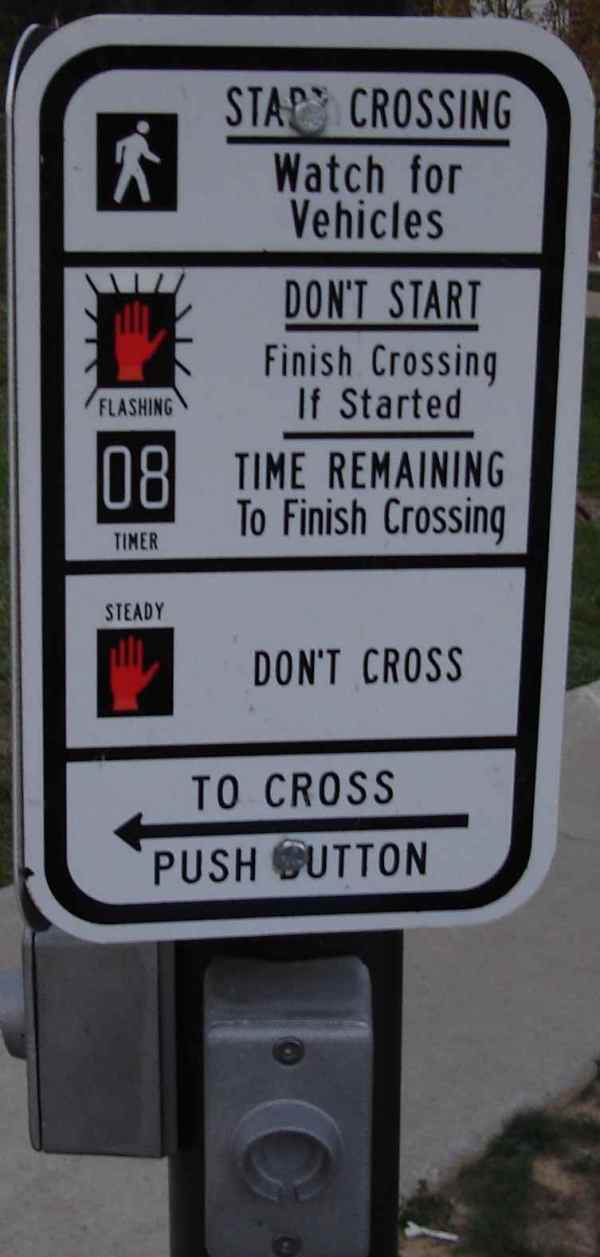
I guess this system isn’t working, either, and that the new iconography doesn’t immediately, universally connect with people and tell them what to do. So now, to protect children, the illiterate, and the non-English speaking who couldn’t handle the old DONT WALK/WALK system–or perhaps adults who can read English but not symbols, the government has come up with this solution:


New crosswalk instructions

After 25 years in which, I assume, pedestrians have continued to occasionally die in crosswalks, the government has added an instruction manual for the new symbols which, apparently, dead pedestrians couldn’t understand. Now the children, illiterate, and non-English speakers get 21 English words explaining the symbols and what they mean. Because the children, illiterate, and non-English speakers couldn’t, apparently, understand 3 English words or 2 symbols without the combination thereof.

It makes me wonder what lesson the governments will learn about pedestrians even after this program does not completely eliminate pedestrian deaths. Perhaps that these instructions are not clear and they need more elaborate details? A manual for understanding the helpful signs at the crosswalks? The sky is the limit, since apparently common sense and budget never will be.

Buy My Books!
Buy John Donnelly's Gold Buy The Courtship of Barbara Holt Buy Coffee House Memories