Subscription Rate for Hipness: $100 / month

He’s Steve Jobs, bitch!

“But we want to make the iPhone even more affordable for even more people this holiday season,” Jobs continued. “So we’re going to do something about that today. We’re not going to sell it for $599 anymore.”

Instead, as a giant screen behind him vaporized first the 4GB version of the device, then the price of the 8GB model, he dropped the bomb. “We are going to price the 8GB iPhone at just $399.”

For being the first people on the block to have one, you’ve paid an additional $200. How do you like them Apples?

Buy My Books!
Buy John Donnelly's Gold Buy The Courtship of Barbara Holt Buy Coffee House Memories

Perhaps It Just Wasn’t A Good Idea

Municipal Wi-Fi – wherein the city pays to have wireless infrastructure installed because the hipsters love it and because city coffers are overflowing and all existing infrastructure is shining and schools are accredited, amen.

But there’s trouble in hipsta paradise in:

  • Houston: EarthLink pays $5 million to delay Houston Wi-Fi buildout:

    A day after EarthLink said it would lay off nearly half its workforce, the company has agreed to pay the city of Houston a $5 million penalty fee for missing its first deadline in building the city’s municipal Wi-Fi network.

    First of many happy returns, I bet.

  • San Francisco: S.F. citywide Wi-Fi plan fizzles as provider backs off:

    Mayor Gavin Newsom’s high-profile effort to blanket San Francisco with a free wireless Internet network died Wednesday when provider EarthLink backed out of a proposed contract with the city.

    The contract, which was three years in the making, had run into snags with the Board of Supervisors, but ultimately it was undone when Atlanta-based EarthLink announced Tuesday that it no longer believed providing citywide Wi-Fi was economically viable for the company.

    Not economically viable? Dammit, the city will do it anyway!

  • St. Louis: Light poles create delay in rollout of city’s Wi-Fi network:

    Still waiting for citywide Wi-Fi in St. Louis?

    It might be awhile.

    Technical delays continue to dog AT&T’s plans to blanket downtown, and eventually the whole city, with a wireless Internet network. Mostly, the problems stem from an unexpected obstacle: the humble city streetlight.

    Hey, where did all those light-up lollipops come from all of a sudden? They weren’t there yesterday!

Behind schedule, over budget, and ill-conceived: the headlong rush to municipal wi-fi whose useful shelf life will probably be less than the time taken to roll it out proves that public/private projects built around the “Wouldn’t It Be Cool” imperative (see also light rail) combine the worst of both spheres. The only thing they do efficiently is to continue to spend taxpayer money at an ever-increasing rate.

Buy My Books!
Buy John Donnelly's Gold Buy The Courtship of Barbara Holt Buy Coffee House Memories

Security of Online Storage and Online Software, Part II

I went on a little rant here about trusting a company and its online business plan as a mechanism for storing your data. As a follow up, we have these two stories:

  • Don’t Trust the Servers: The danger of putting your data at the mercy of a company’s servers was made apparent when Microsoft’s own WGA servers crashed over the weekend.

    The Windows Genuine Advantage plan became a genuine disadvantage over the weekend when the server that verified users went down and began to disable operating systems around the world. At least, it disabled the operating systems of computers that checked into the home base to affirm their legitimacy.

    The WGA server outage hit on Friday evening and was finally repaired on Saturday. It was down for 19 long hours.

  • The Content in Google Apps Belongs to Google:

    An alert reader, SentryWatch, commented per my last blog that the Terms of Service posted on the Google Docs and Spreadsheets site assigns content rights of anything saved on Doc and Spreadsheets to Google. It’s almost too incredible to believe, so here’s the wording from the mighty Google maw itself:

    “… you grant Google a worldwide, non-exclusive, royalty-free license to reproduce, adapt, modify, publish and distribute such Content on Google services for the purpose of displaying, distributing and promoting Google services….”

Although to be fair to Google, kids these days are to young to remember when a similar clause appeared in the Microsoft Office EULA and caused a similar reaction, albeit one not magnified by the ease with which people discuss it on the Internet.

But both stories do highlight the dangers in trusting things in the Internet cloud with core data or core functionality. And it highlights how the “good enough” standard of quality, when multiplied hundreds of times in the number of core users, will leave a large number of users affected by “minor glitches” that will render their services useless to them. Hopefully, before they’re too invested in the online software/data storage vendor.

Buy My Books!
Buy John Donnelly's Gold Buy The Courtship of Barbara Holt Buy Coffee House Memories

The Security of Online Storage

Ever since the first Internet boom, people have been excited about the prospect of storing your photos or other files online using things like I-drive. Me, I’ve never understood why you would trust that third party to keep your stuff safe and available. Never mind that I-drive collapsed in the first boom. The recent decision by Google to end its video thing, including terminating some people’s rights to videos they “bought,” combined with a Yahoo! decision to close one of its photo sharing sites,where your photos will be lost unless you act promptly, reinforce my notion. I mean, Google and Yahoo! are the big guys in the space. If they’re so eager to jettison your data (more likely your access to your data), what of the little guys and companies that come along with the service offering?

Oh, yeah, like I-drive.

Never mind. I am going to continue backing up to 3.5 disks and hoarding old 3.5 disk drives.

Buy My Books!
Buy John Donnelly's Gold Buy The Courtship of Barbara Holt Buy Coffee House Memories

ComputerWorld Magazine: Government Should Force Telecommunications Providers to Lose Money

In the article ISPs to rural America: Live with dial-up, writer Robert Mitchell apparently wants the government to force businesses to lose money so that BOBOs who move to rural areas can have fast Internet access. The problem:

Kim Rossey is one of them. Soon after moving to Gilsum, N.H. (population 811), Rossey learned that he couldn’t get broadband to support his Web programming business, TooCoolWebs. DSL wasn’t available, and the local cable service provider wasn’t interested in extending the cabling for its broadband service the three-tenths of a mile required to reach Rossey’s house — even if he paid the full $7,000 cost.

Funny, the solution is:

Rural areas need broadband. But deregulation has freed carriers from any real obligation to offer it. The market will never provide universal broadband access without regulation or subsidies, but the U.S. lacks both a coherent policy and the political will to address the issue. Even as the telephony infrastructure itself is absorbed into the Internet, some policy-makers still fail to view broadband as the new critical infrastructure.

The U.S. (government) should compel telecommunication providers to lose money on this install. Or perhaps the government should compel taxpayers to run fiber up to rural homes. Who knows? All that’s important is that the policy is coherent, not that it’s economically viable.

Next up: Compelling Chinese places to deliver to Web design businesses in the sticks. Because third world countries, particularly China, have plans in place to get Chinese food to rural areas.

Buy My Books!
Buy John Donnelly's Gold Buy The Courtship of Barbara Holt Buy Coffee House Memories

Commodore 128 as Nature Intended It

Fellow Milwaukeean (and the only current Milwaukeean between the two of us) Triticale knows I collect old computers, and when he recently changed abodes, he told me I could have his old Commodore 128 that had been in his garage forever. Well, I talked to my brother in Milwaukee about picking it up for me, and he did, and on my most recent trip to Wisconsin I retrieved said machine.

When I first tried to boot it, it failed. So I planned to make it a teach-yourself-electronics project to resuscitate it, but all it took was a new fuse in the power supply. So I didn’t really learn much at all, but it works beautifully.

And darn the luck, the only television with an RF switch attached to it was in the living room. So behold:
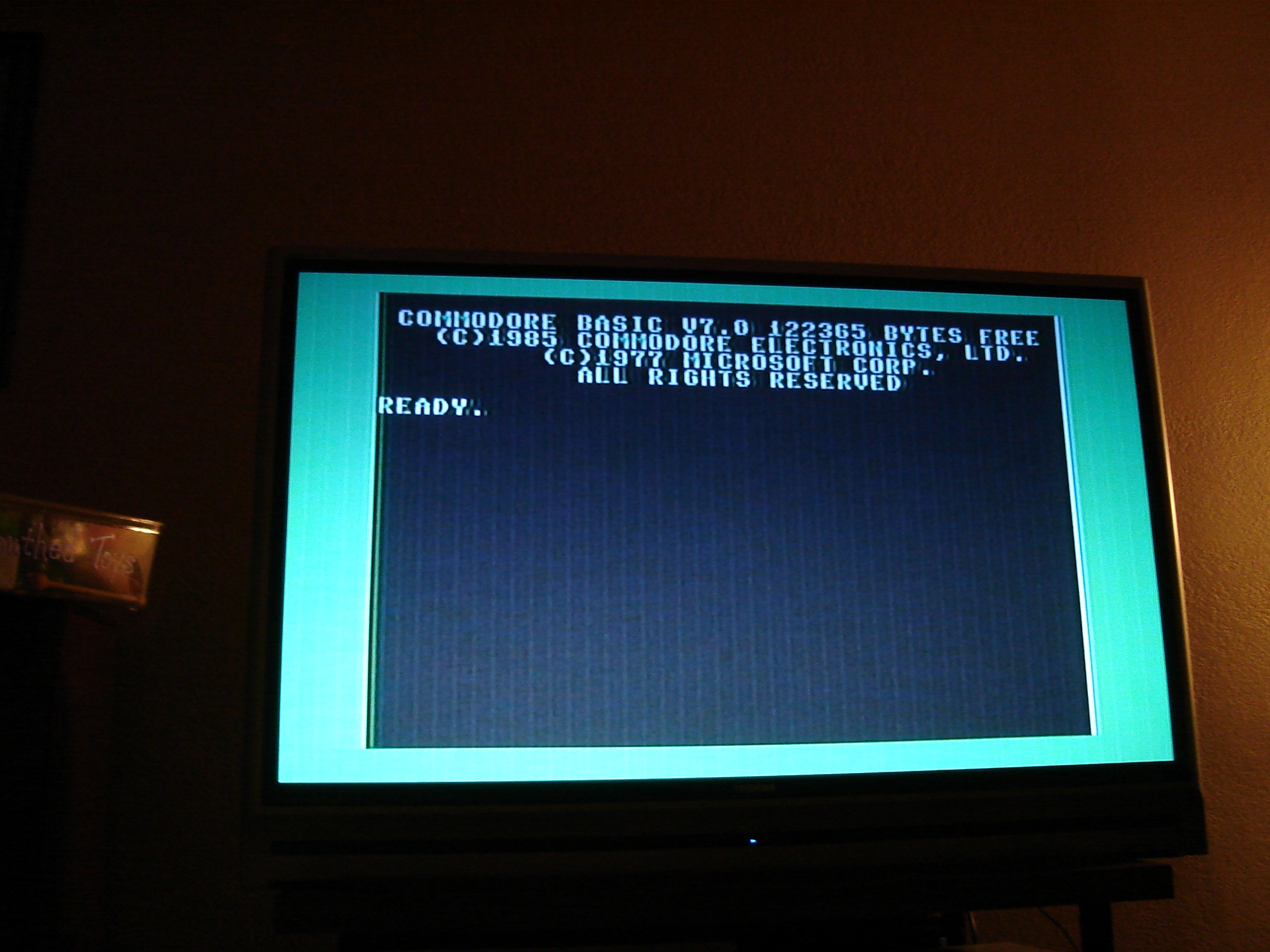
Commodore 128 startup
Click for larger

Oh, my. I was so excited, I hooked the Commodore 1571 disk drive up and I’ll be durned if it didn’t work right out of the box. So I dug through my archives of my old disks and found some of the programs I had written in the first Bush presidency. As you might know, the Commodore 128 was my first computer, so Basic 7.0 was my first language. And I wrote a number of programs.

Including Adventurers’ Guild, a program designed to keep track of my D&D group’s equipment and character list. It wasn’t truly data-driven, but it did use the Commodore 128’s graphics to their ability. I mean, high res graphics, brother:

Adventurers' Guild startup
Click for larger

The main program was just a routing piece that called a subprogram allowing the user to look at the various and sundry keeps, characters, or stockpiled equipment:
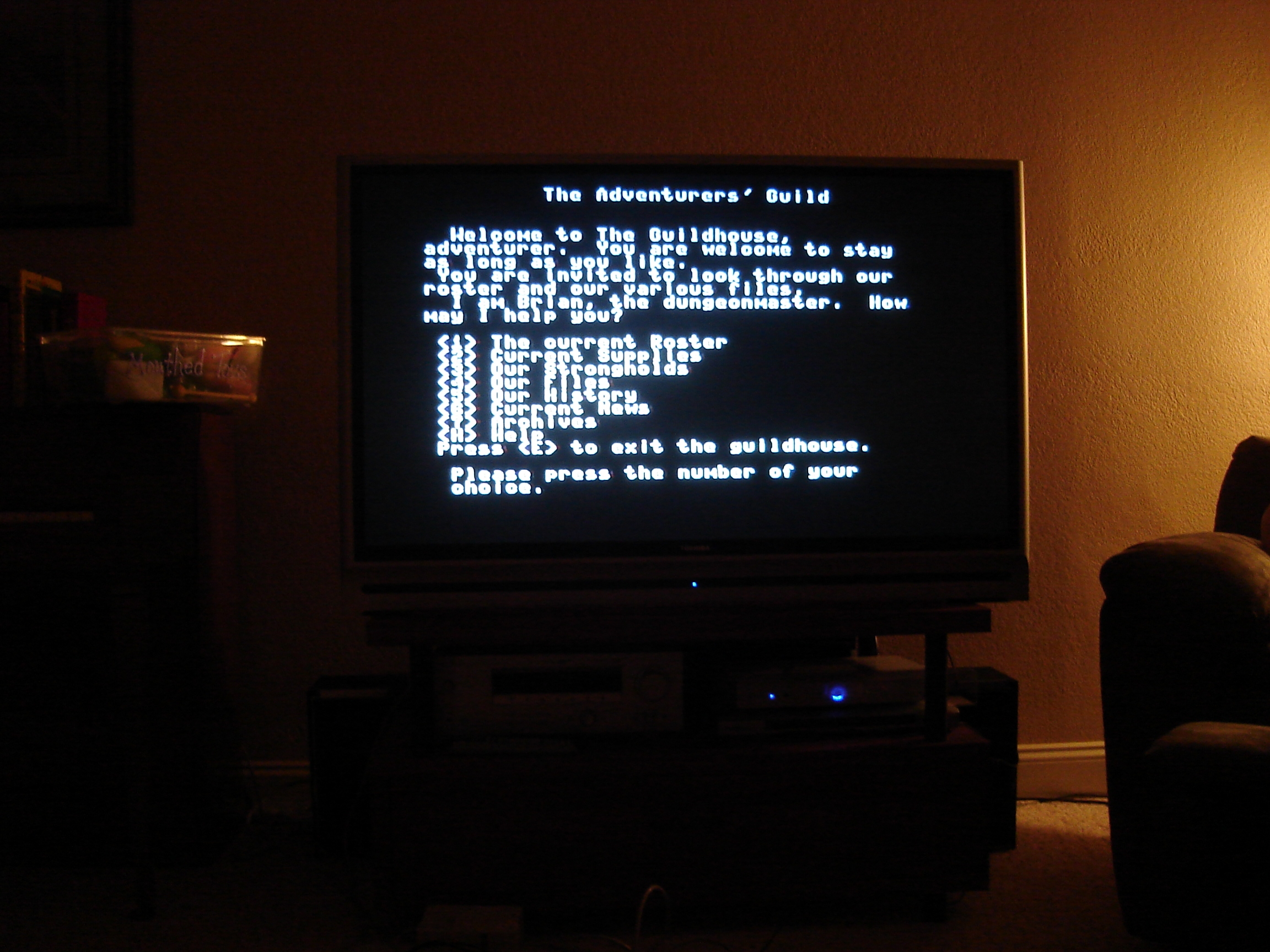
Adventurers' Guild main menu
Click for larger

For example, if you wanted to see the roster, it would go into a subprogram for the roster and you could see all characters past and present that played in the campaign:
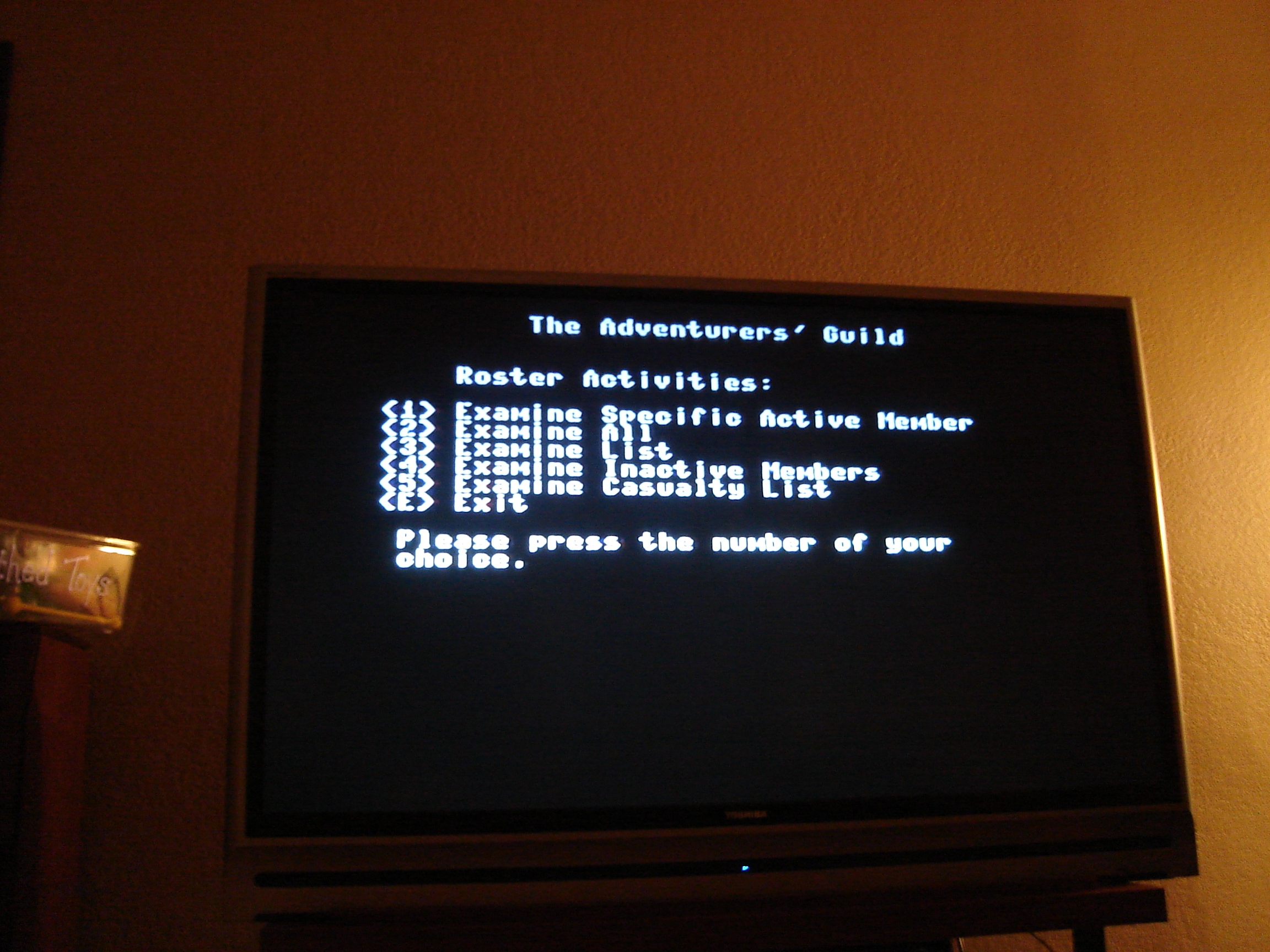
Adventurers' Guild roster menu
Click for larger

For example, here’s my brother’s favorite character as seen when the user has chosen to view all:
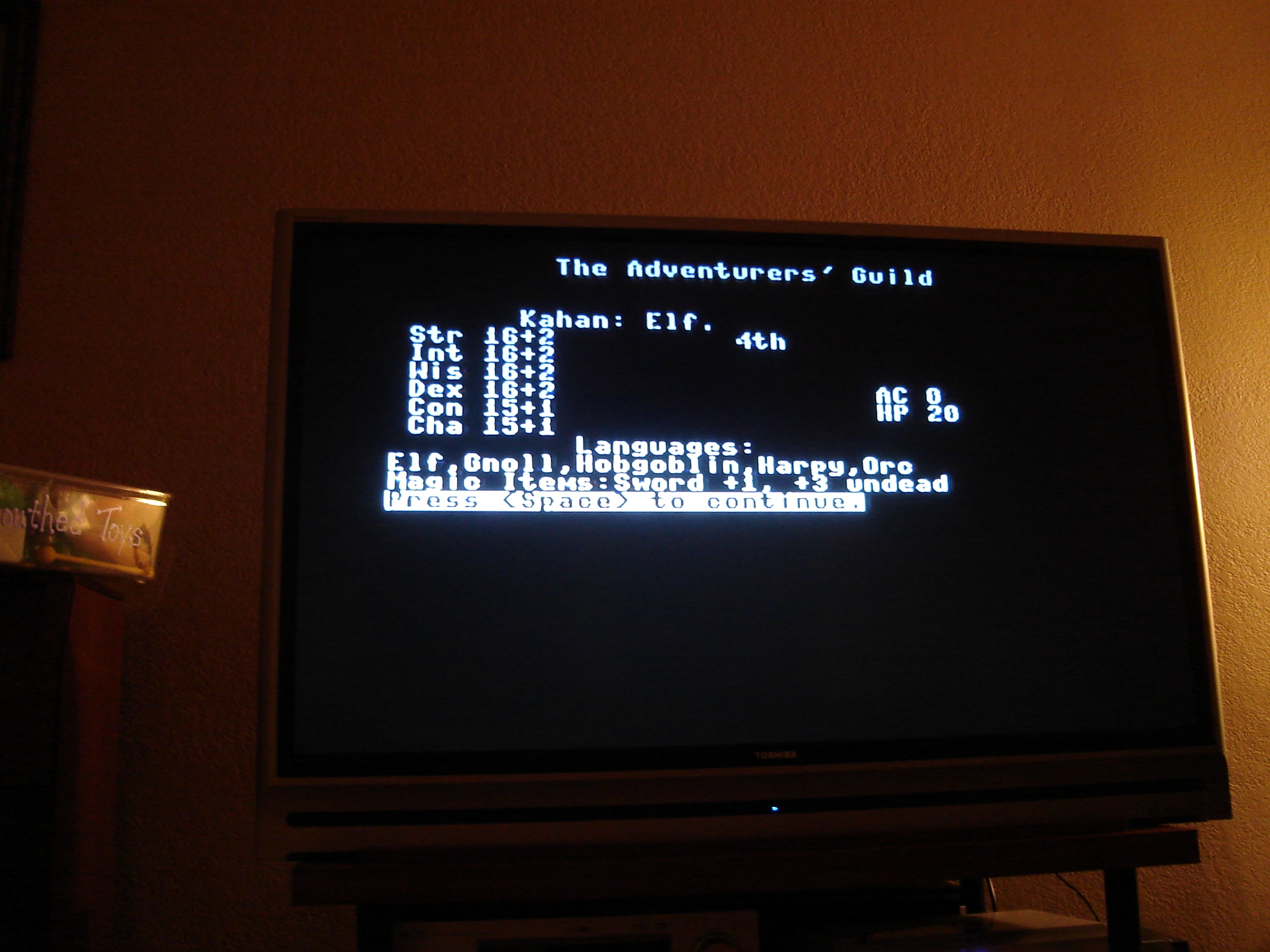
Adventurers' Guild Kahan the elf
Click for larger

And even when I was a junior in high school, I was building help into my applications. Here’s one of my first help files:
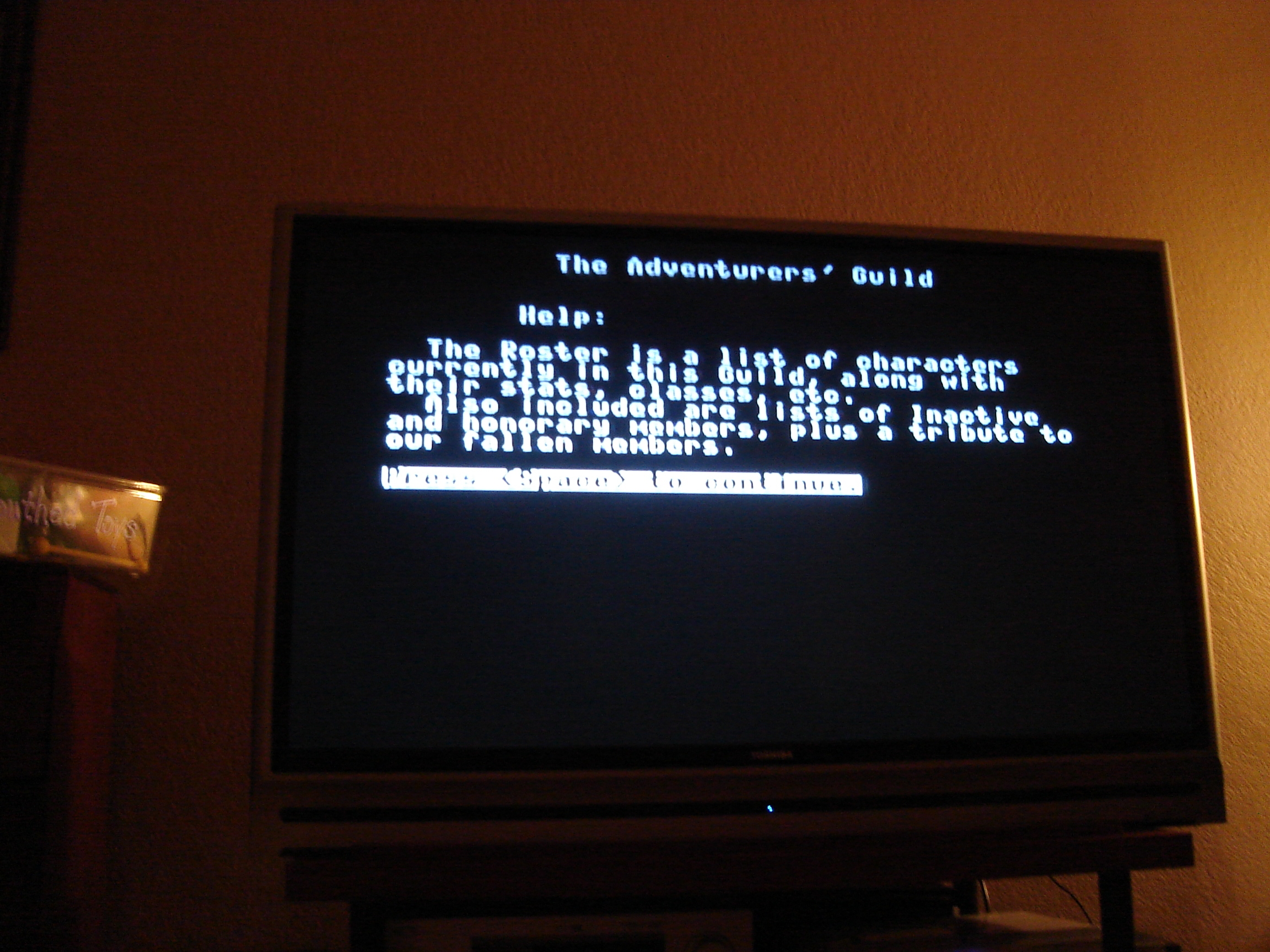
Adventurers' Guild Help
Click for larger

When the user logged out, the Commodore went into hi-res graphics for a moment, painting an exit door:
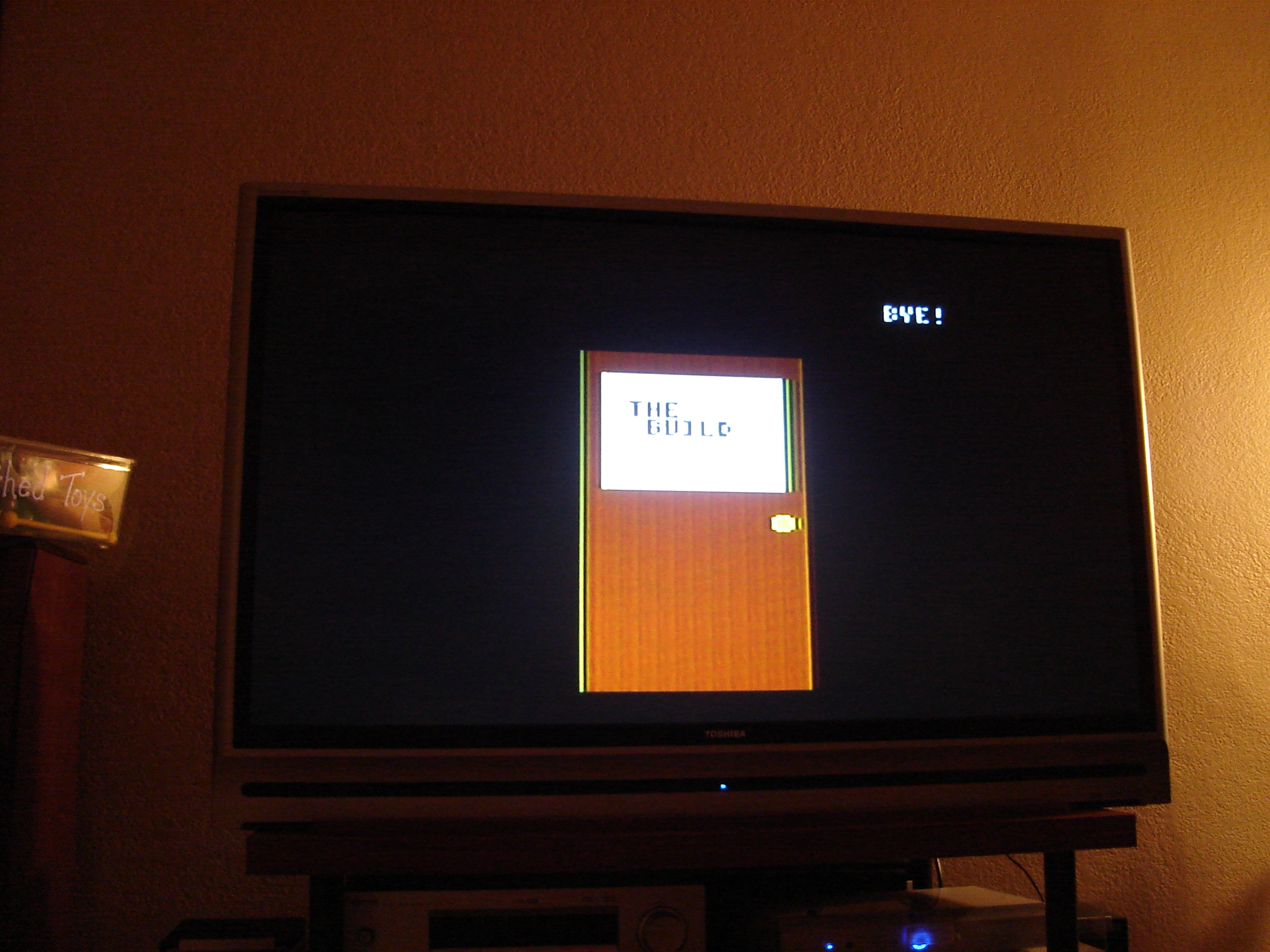
Adventurers' Guild Help
Click for larger

Then it ended turning the screen to default colors and with a final message from the dungeonmaster:
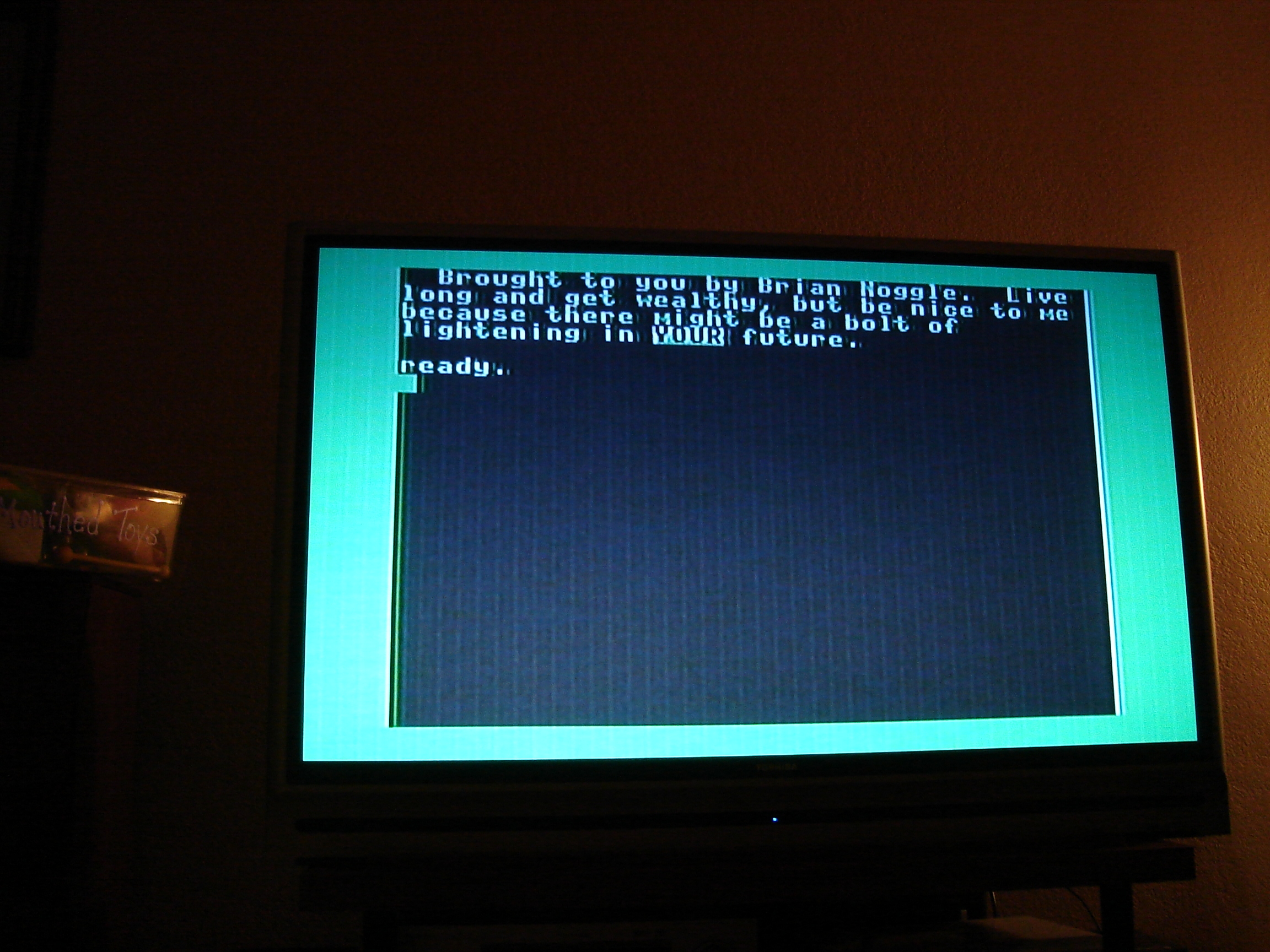
Adventurers' Guild Help
Click for larger

Hmm, lightning is misspelled. I’ll log a defect on that right away.

I wrote a couple of other things, too, including a DMV quiz program after watching the movie License to Drive over and over as only a kid in the boondocks with only Showtime could.
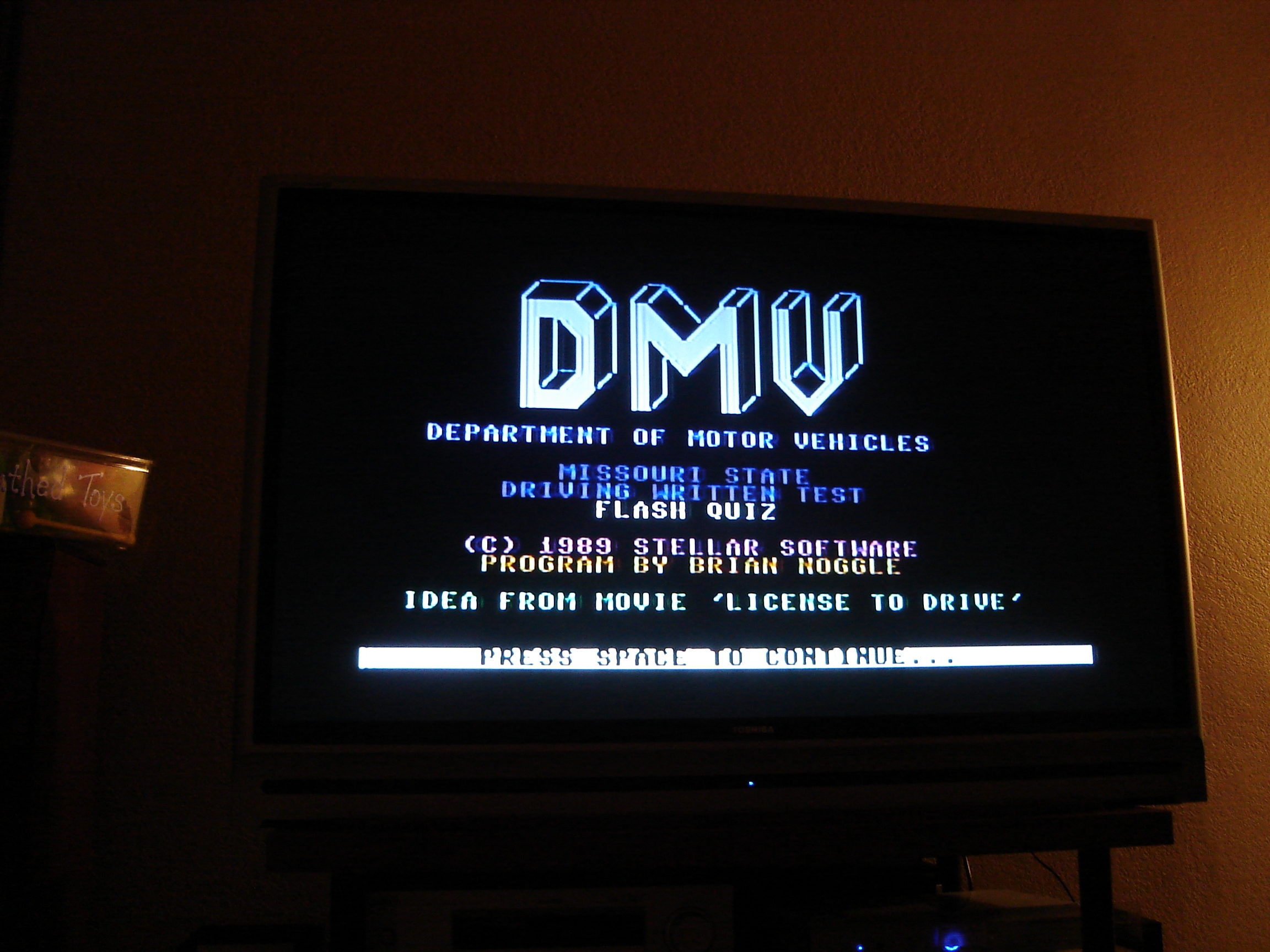
DMV quiz
Click for larger

The instructions included my address back in the day and welcomed correspondence. Back in those days, that’s how you did it without the Internet and e-mail addresses that worked wherever you connected:

DMV quiz instructions
Click for larger

And the Weird Al Wannabe Quiz:
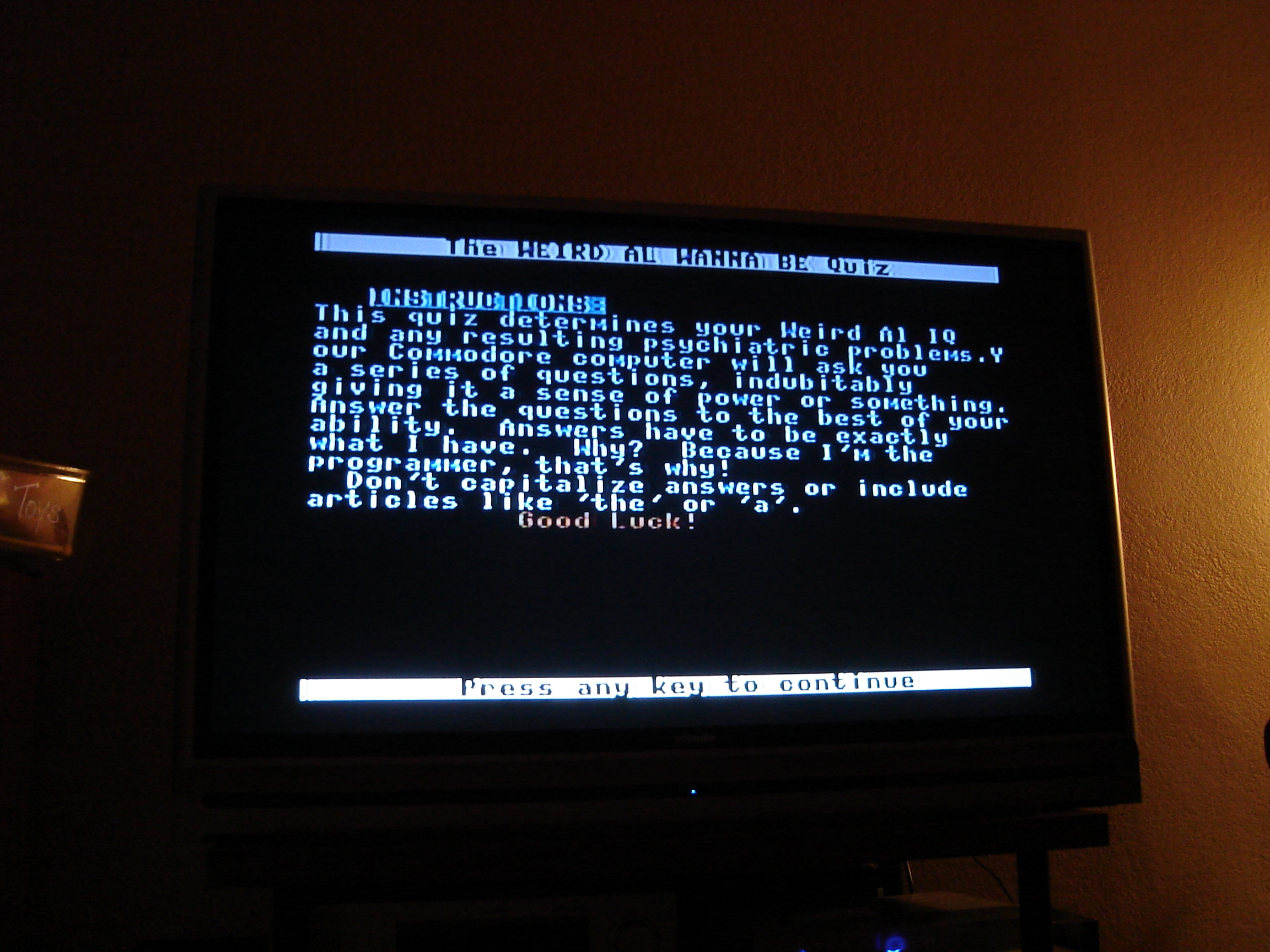
Weird Al Wannabe quiz instructions
Click for larger

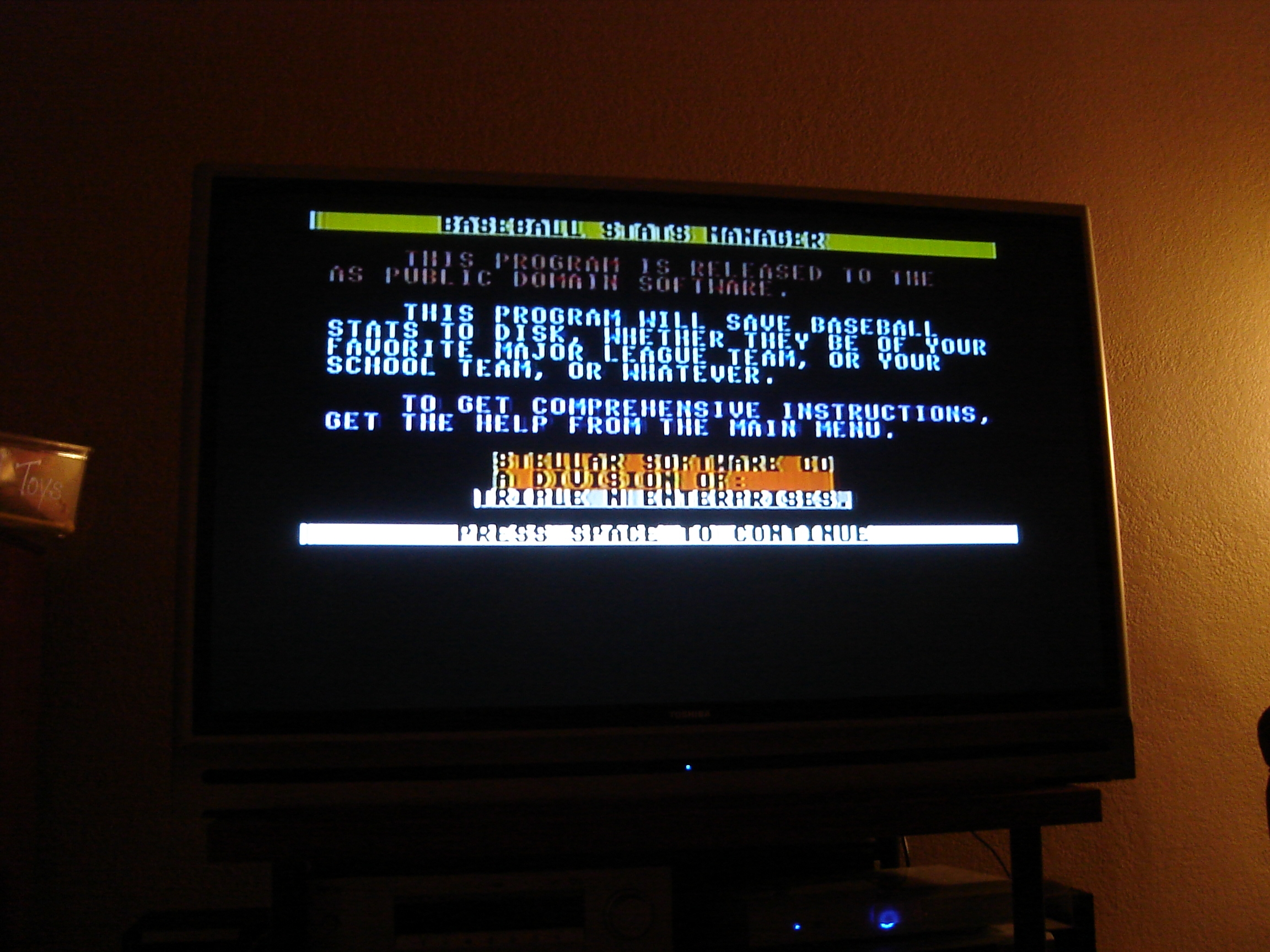
Of course, after I released them to the wild of the Commodore CG BBSes, I’d expect they were never downloaded. I know no one ever came across with a shareware donation. I did, however, make some money programming, as the high school baseball team’s manager wanted a program to keep track of stats. At Stellar Soft, we were happy to gather his requirements, deliver a quality program, and support it with new features as requested for the princely sum of like $50:
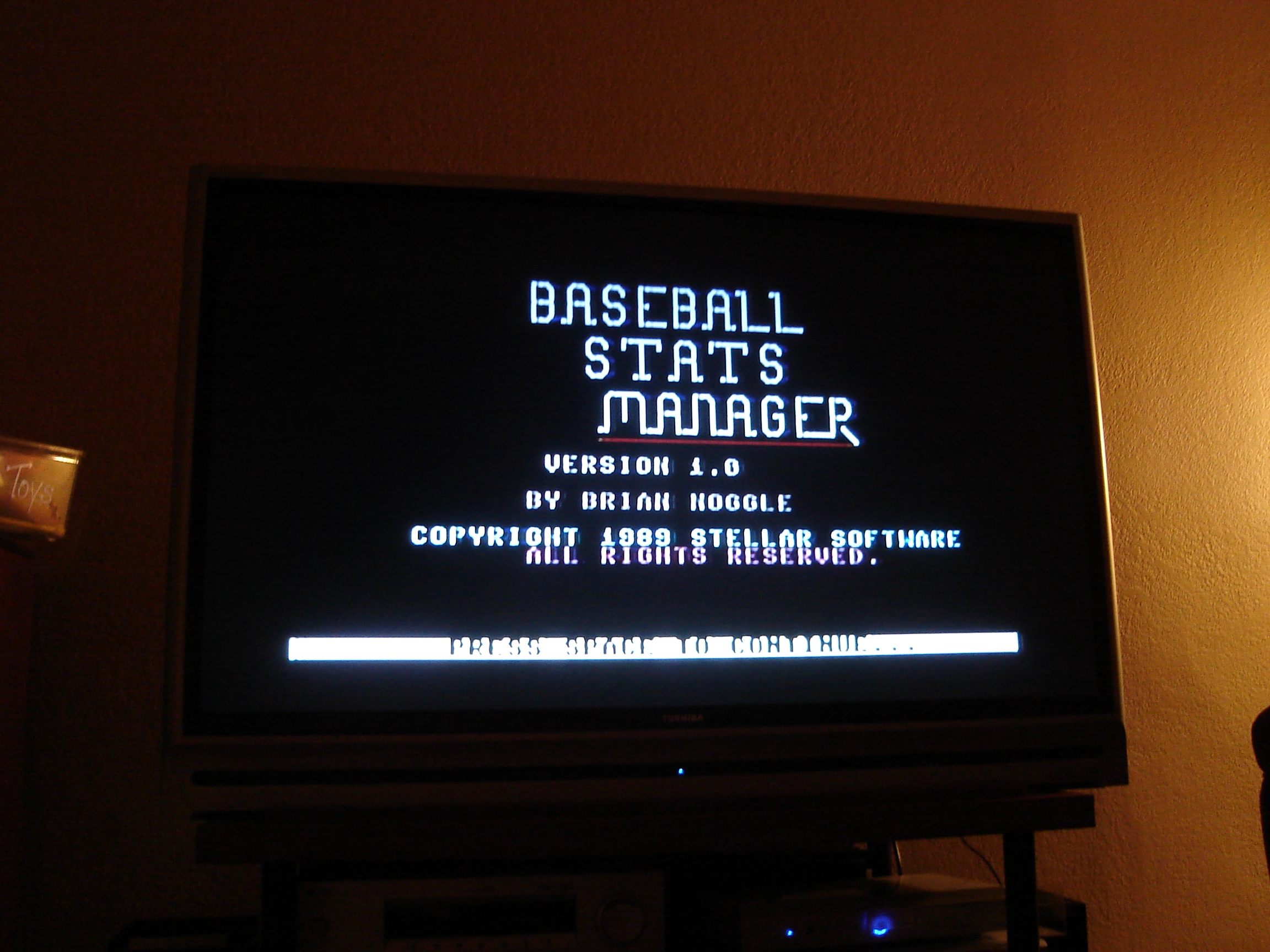
Baseball Stats Manager splash
Click for larger

I see that in the instructions, I listed it as a division of Triple N Enterprises:
Baseball Stats Manager instructions
Click for larger

Considering that Noggle, Noggle, and Neiderriter was our lawnmowing business, I guess I did that for taxing purposes.

Well, that’s my walk down memory lane. What’s my point? I don’t know; I have 20 years of software development experience? Or perhaps to boast once again that I have more Commodores than Michele?

Aw, who cares, I got to post some pictures of an old computer.
Buy My Books!
Buy John Donnelly's Gold Buy The Courtship of Barbara Holt Buy Coffee House Memories

I’m Steve Jobs, Bitch!

Apple issues battery program for iPhone: Replacements cost $79, $6.95 shipping, three business days:

The iPhone’s battery is apparently soldered on inside the device and cannot be swapped out by the owner like most other cell phones.

Apple spokeswoman Jennifer Hakes said Thursday the company posted the battery replacement details on its Web site last Friday after the product went on sale.

Users would have to submit their iPhone to Apple for battery service. The service will cost users $79, plus $6.95 for shipping, and will take three business days.

That’s rich. Kinda like their overlord, come to think of it.

Don’t people gather with pitchforks and torches and DoJ attorneys outside the walls of Castle Redmond for this sort of thing?

(More on Kim du Toit and Tamara K.)

Buy My Books!
Buy John Donnelly's Gold Buy The Courtship of Barbara Holt Buy Coffee House Memories

Nancy Pelosi Fails QA

Well, not Nancy Pelosi herself, but her Web site has gotten the wrong sort of attention on the blogs recently (here and here and so on). It’s a simple Macromedia Flash presentation embedded within a Web site, but it has a number of problems that a trained eye would have caught.

First and foremost, whomever created the presentation used stock imagery in the most sloppy manner; they chose, to represent a story on American military medical care, a stock image of someone with a uniform featuring an epaulet talking to a doctor. Unfortunately, that epaulet said “CANADA”:


The erroneous epaulet

Her political opponents (of which I am one, don’t get me left) were quick to seize upon this as something more than a failure (or lack) of quality assurance, but they’re just looking for something to make noise about anyway. Still, someone who reviewed this with any degree of exactitude would read all text and identify any extraneous logos within stock photography. And someone would have read “Canada” and said, “Uh, no…..”

This particular failure has been remedied, as the slide that offended the bloggers no longer appears. However, the site still fails QA in the following manners.

At the change of each slide, the text from the first slide (“Green the Capitol”) displays during the transition. Now, unless you’re actually trying subliminal advertising, perhaps you don’t want this to occur. Perhaps you want a smooth fade of the words and the fade in of the new slide. Still, unrelated text shouldn’t appear:

The phantom text

Next, the embedding of the Flash object is faulty. It gives the user too much control over the behavior of the object, including the ability to zoom so that the images appear pixellated or the text displays outsized. Since the Flash object has a certain set size, only a portion is visible, like this:

The outsizing

Finally, as you should know if you build Web sites for a living (or pretend to), Macromedia Flash Player is a plugin whose presence should not be taken for granted on the user’s Web browser. Any time you provide animation or other documents through plugins, you should provide a handy mechanism so that those users without the plugin can get them if needed. Does Nancy Pelosi? No:

The missing plugin

Instead of a static graphic or a link to Macromedia Flash Player, we get empty space. That Other America that I’m always hearing about, the one without Flash, gets left behind.

I am tempted to go into metaphors about legislators whose Web sites aren’t checked before they’re put up and the implications for legislation, but I’ll save that for another blog post and will point out that a couple of hours’ worth of time of a trained Quality Assurance professional would have ferreted these issues out before releasing it to the public, sparing embarrassment and also sparing someone the “emergency” of fixing it.

But, hey, if you don’t want to spend that money or budget on quality assurance, you roll the dice. Sometimes they don’t come up snake eyes, but when they do, you’ll pay for it.

Buy My Books!
Buy John Donnelly's Gold Buy The Courtship of Barbara Holt Buy Coffee House Memories

Users, Consumers Find Web Technologies To Be Mere Tools

In a stunning turn of events, the components of the Web 2.0 phenomenon are seen by users as mere tools, and those users have very little loyalty to particular tools:

Study results show that social networkers have little loyalty for any specific social networking site. Almost half of all social networkers use more than one site and one in six uses three or more.

Interactive marketing agencies better keep this in mind that spending client budget on building/hooking up all sorts of “community” (read: users build the content for the client for free) will have wasted that budget when another company comes up with a slightly cooler set of technologies to do the same thing. You must differentiate the brand using existing Web 1.0 techniques and build that community with good promotions and content instead of hoping “users” will do your job for you.

James Joyner (past client of my company Jeracor, just so’s you know) sums it up thusly:

Not only is this unsurprising but the premise behind the question reflects a deep misunderstanding of the Web 2.0 concept. Social media aren’t about loyalty to sites but rather a means of self-expression and growing and communicating with one’s network.

That will remain true with fickle consumers, so if you’re building a consumer-facing Web site, don’t forget the fresh content when adding expensive technologies to the bill of sale.

Buy My Books!
Buy John Donnelly's Gold Buy The Courtship of Barbara Holt Buy Coffee House Memories

One Thing, Unfigured Out

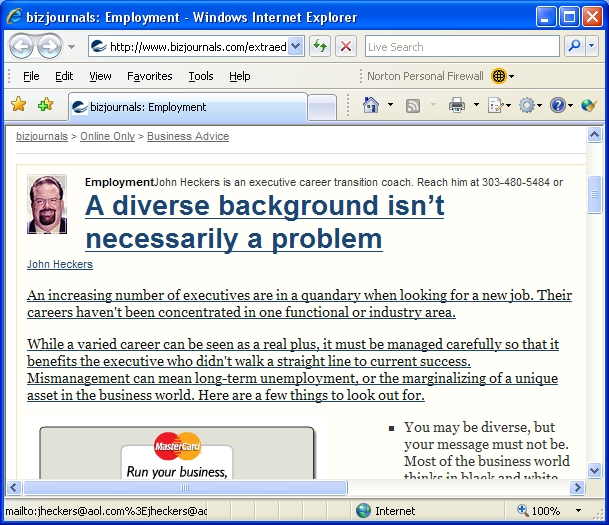
I read an article from Bizjournals.com about varied job backgrounds because, brothers and sisters, I was not just born the pestilence onto software that I am. So this article tries to tell me how to use that: A diverse background isn’t necessarily a problem, but two things struck me.

One, this quote:

Remember from the movie “City Slickers,” old Curley holding up his gloved hand and saying, “One thing — and you’ve got to figure out what that thing is.”

Um, no, both IMDB and I remember it like this:

Curly: Do you know what the secret of life is?
[holds up one finger]
Curly: This.
Mitch: Your finger?
Curly: One thing. Just one thing. You stick to that and the rest don’t mean shit.
Mitch: But, what is the “one thing?”
Curly: [smiles] That’s what *you* have to find out.

Secondly, dude, your mailto link is messed up and is carrying through the headline and the first paragraph:

Bad mailto link

Well, I guess I have found my one true thing, the story to tell my future interviews and clients.

Buy My Books!
Buy John Donnelly's Gold Buy The Courtship of Barbara Holt Buy Coffee House Memories

iPacemaker

Apple’s iPods interfere with heart pacemakers, study shows:

A teenager’s curiosity has uncovered an unsettling side effect of wearing an iPod: It might cause heart pacemakers to malfunction.

The discovery appeared in a study announced Thursday during a research presentation in Denver. The finding, initially reported by Reuters, shows that iPods generate enough electromagnetic interference to hamper effective function of implantable pacemakers, and in some instances cause them to stop working entirely.

Buy My Books!
Buy John Donnelly's Gold Buy The Courtship of Barbara Holt Buy Coffee House Memories

Trust the Administrators

Whenever some developer or project manager tells me that a software application does not have to provide bulletproof validation for administrators because they’re not as dumb as normal users, I pause a moment to reflect upon administrator genius:

trumwill: Over the weekend the company changed everything on the network. They sent out an email with our new network passwords.

morequen: Wait, they sent out *an* email?

morequen: with everyone’s password?

trumwill: Everyone’s password being the same, yes. They advised us to create a new one.

morequen: wow

trumwill: Which would be possible if we could, you know, log in to see the email. Which of course we couldn’t because our passwords didn’t work.

Administrators are just users put in charge of other users. Smarter? Maybe sometimes. But software shouldn’t be written as though its users are Steven Hawking, because sometimes those presumed genius-level administrators are nothing but users tasked with administrative responsibilities.

(Link seen on Dustbury.)

Buy My Books!
Buy John Donnelly's Gold Buy The Courtship of Barbara Holt Buy Coffee House Memories

Charlie Brooker Sends Coded Message

In this column, he subtly hints at how he feels about competing computer technologies:

I hate Macs. I have always hated Macs. I hate people who use Macs. I even hate people who don’t use Macs but sometimes wish they did. Macs are glorified Fisher-Price activity centres for adults; computers for scaredy cats too nervous to learn how proper computers work; computers for people who earnestly believe in feng shui.

No word on how many Linux adherents lost lunch money on the playground to Brooker immediately after publication of said article.

(Link seen on Outside the Beltway.)

Buy My Books!
Buy John Donnelly's Gold Buy The Courtship of Barbara Holt Buy Coffee House Memories

That’s No Phish; That’s An Amphibian

Today, I received this message:


The phish e-mail

Oh, no, I thought like good little phishbait. I didn’t even bid on that.

But instead of clicking through on the e-mail, I go to ebay.com and search for the item.

Well, low and behold, the item number in question was an actual item and it was offered by the seller mentioned in the phish e-mail:


The phish e-mail

Of course, it’s still obviously a phish because:

  1. That’s not the e-mail address tied to my eBay account.
  2. The e-mail lacks most eBay header/footer details.
  3. The message headers indicate it came from somewhere besides eBay.
  4. The auction that I was “delinquent” for hadn’t ended by the time I received an e-mail.

But still, the sophistication of this particular phish is remarkable. It scrapes an actual auction off of the eBay site before or at the time of mailing to make it seem more authentic.

I’m almost afraid enough to vow to never click a link in an e-mail again, but I’d probably get fired.

Buy My Books!
Buy John Donnelly's Gold Buy The Courtship of Barbara Holt Buy Coffee House Memories