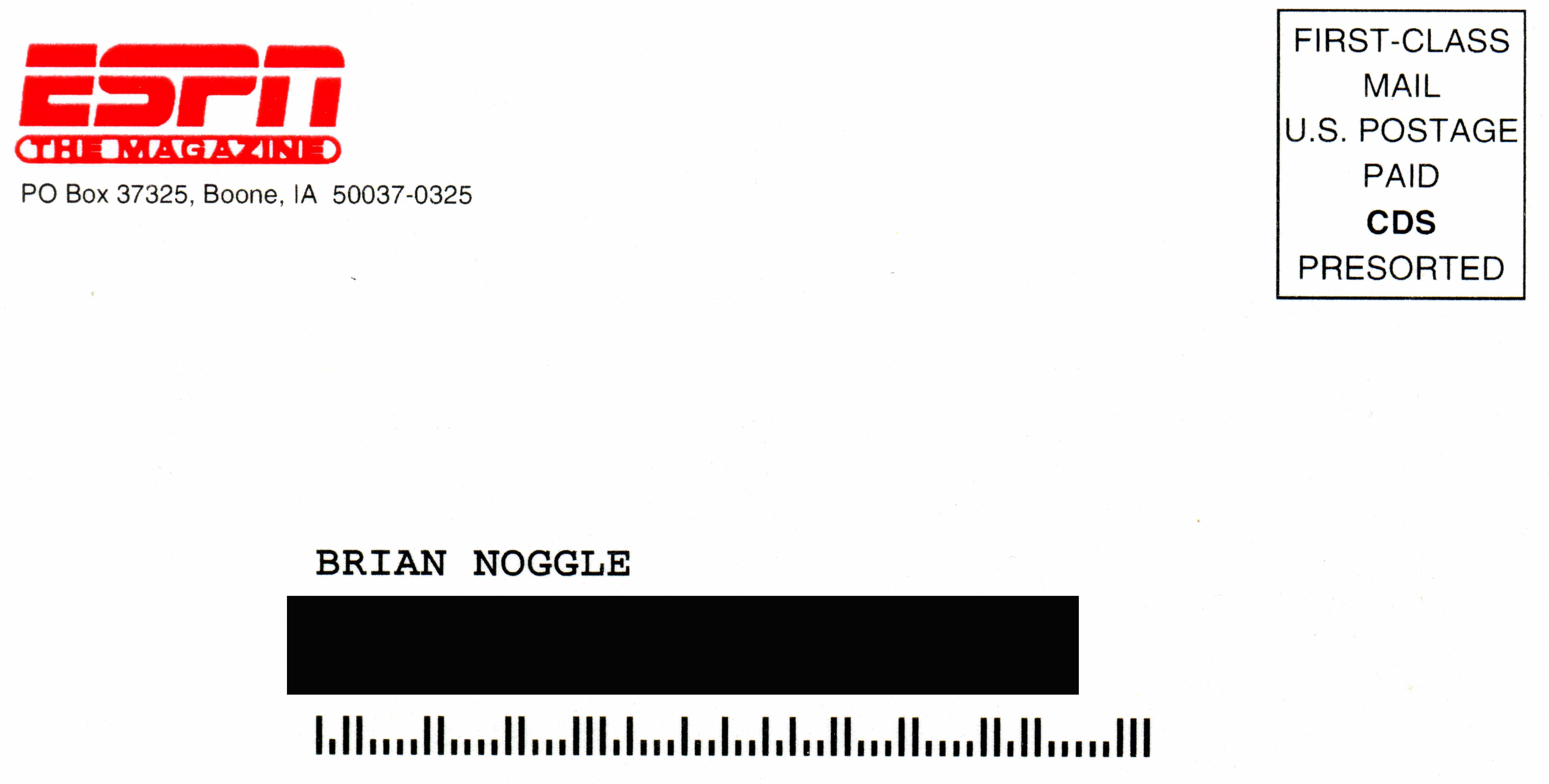
Wow, sending free CDs for a dial-up Internet service:

Dude, when someone comes to you with a marketing plan exhumed from a time capsule, it’s for historical perspective, not implementation.
To be able to say "Noggle," you first must be able to say "Nah."
Wow, sending free CDs for a dial-up Internet service:

Dude, when someone comes to you with a marketing plan exhumed from a time capsule, it’s for historical perspective, not implementation.
Steve Jobs has certainly recognized, so far, that the products and interfaces that most closely resemble the things we’ve been conditioned to expect from 40 years of Star Trek win, but I’ve got two words for him:
Touchscreen is nice on this little tricorder thing (what, you scan it in with the camera and run it through OS X applications and you’d call it something else?), but whomever gives me voice-activated wireless communication with my home network and through the firewalls to the Internet will win.
Whether it’s an affected A like the television show or a little Windows icon on the RFID on my chest that I tap remains to be determined.
Clicking through a link on my MSN Messager, I got the following helpful error message:

Note Microsoft’s tips:
The screen offers me three options, only one of which I can actually try. In that case, the screen should only offer me a single option.
Such things lead a user to believe that maybe the application, or at least the copywriters behind the interface, are out of touch or incorrect sometimes. That blows a user’s trust in an application, or it should.
But me, I am in QA; I don’t trust my watch without checking it against my cell phone, the clock on the computer, and the clock on the phone.
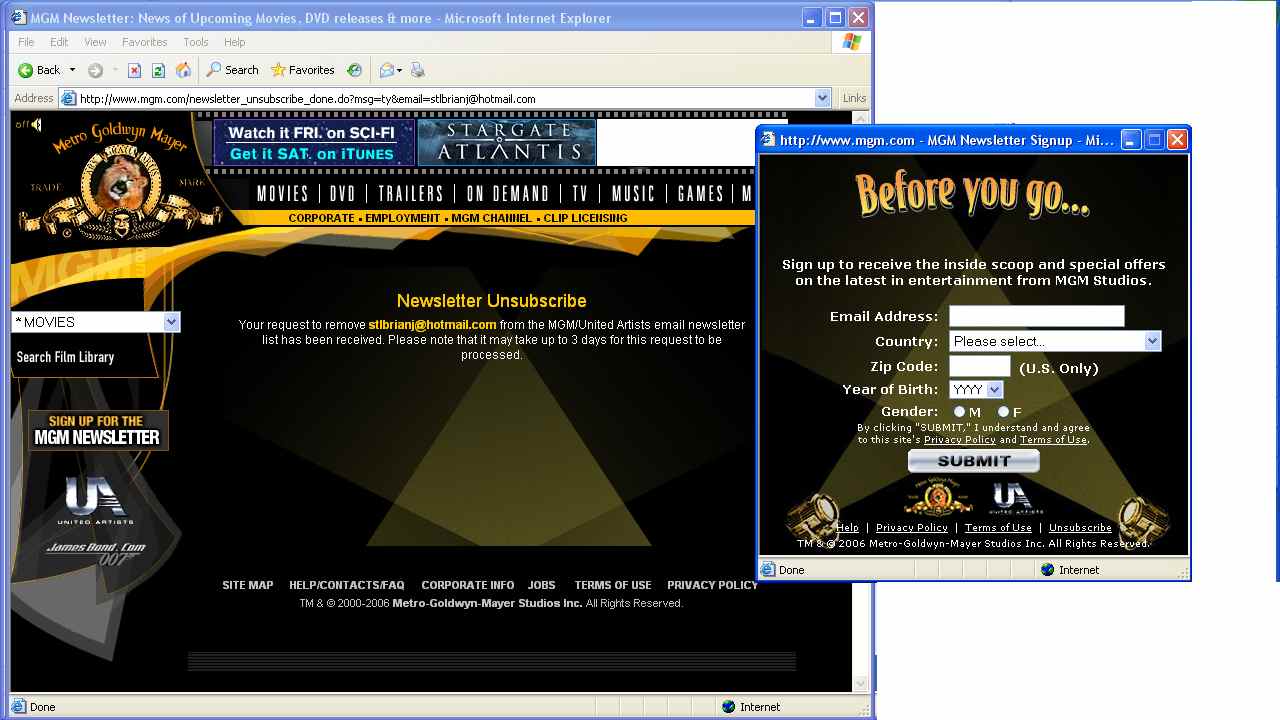
A number of years back, I signed up for the MGM newsletter as part of a contest entry or something. Every so often, one of the newsletters hit my e-mail box, and I deleted it without reading it. Finally, I decided to save myself the step of manually erasing the unread by unsubscribing to the marketing missive.
I clicked through the unsubscribe link and entered my e-mail address. A thank you page displayed and assured me I would be removed.
Meanwhile, a pop-under displayed:

An invitation to subscribe to the newsletter from which I just unsubscribed.
Those kids at MGM are ever the optimists, ainna?
It’s not Microsoft Bob, either; it’s Ms. Dewey, a Flash presentation wrapped around Microsoft’s new search engine.
When someone asks:
Can anybody define the test cases on mobile.
so he/she can use the answers in a job interview, Brian J. steps up to the plate:
Lynne, help a guy out!
To test mobiles, you should ensure that:
* Individual items move freely on their strings.
* If automated, the wind up mechanisms stores kinetic energy and the start/stop controls work.
* If musical, the correct notes play in a recognizable order.You might have to test the mounting equipment as well to ensure it handles the weight of the mobile apparatus.
Some “real” “QA” “professionals” seem unamused.
The old adage which powered a large number of failed startups remains true. If you break into a new industry or make a new product, you have to be the first to offer it and build market share, or no one will think to buy your product when there’s a dominant product already offered.
Case in point: Christian First Person Shooter video games. Super 3D Noah’s Ark is credited with being the first.
And you cannot even think of what might have been the second one, can you?
There’s probably an MBA paper in this anecdote somewhere.
Error message from Hotmail:

Please note the steps to remedy the situation:
Microsoft: It’s some language for placebo.
A former World of Warcrafter laments on how the game ruins lives. He enumerates the fundamental flaws:
First off, let’s go back to the time it takes to accomplish anything in the game. To really be successful, you need to at least invest 12 hours a week, and that is bare minimum. From a leadership perspective, that 12 hours would be laughed at… . The “good guildie” who plays about 10 hours a day and seven days a week.
And:
The game also provides people with a false sense of security, accomplishment, and purpose. Anyone can be a superhero here if they have the time to put in….
And people put everything on the line for these accomplishments with which they associate much value. I know of children and spouses being forced to play and grind for their parents, threats of divorce, rampant neglect, failing grades in school, and thousands of dollars spent on “outsourcing” foreign help. For what, you ask? Honor. The desire to be the best for at least one week…. The accomplishment and sacrifice itself are meaningless a few days later. Then it’s usually off to the races again.
And:
Finally, when you’re a leader there is a call (or more appropriately a demand) for success. Usually those you represent want to keep progressing. They want to keep improving. They want more access to the best things. It is on you to provide it. In my experience, when you fail to progress fast enough, waves ripple throughout the guild and people become dissatisfied. It’s your fault, no matter what.
All in all, it sounds like good training for the business world.
If Face is trademarked by Facebook and pod is trademarked by Apple, if I created something called FacePod, would Apple and Facebook collide cataclysmically in their haste to sue me?
A friend e-mailed me from his new job, and I saw his signature block was doubtlessly a company recommendation:
CONFIDENTIALITY STATEMENT: This e-mail and any attachments are intended only for those to which it is addressed and may contain information which is privileged, confidential, and prohibited from disclosure and unauthorized use under applicable law. If you are not the intended recipient of this e-mail, you are hereby notified that any use, dissemination, or copying of this e-mail or the information herein is strictly prohibited by the sender. If you have received this transmission in error, please notify us immediately by replying to this message and deleting all copies from your system.
Dear unnamed company functionary, please note that my receipt and opening a message that came from your servers does not constitute a legally binding agreement on my part. Come and get me if you must, but please spare me the ill-informed bluster.
Gamers with Jobs, a blog by people who play video games and apparently have real jobs.
Scott Silverman, Chairman of the Board of VeriChip Corporation, has proposed implanting the company’s RFID tracking tags in immigrant and guest workers. He made the statement on national television on May 16.
Silverman was being interviewed on “Fox & Friends.” Responding to the Bush administration’s call to know “who is in our country and why they are here,” he proposed using VeriChip RFID implants to register workers at the border, and then verify their identities in the workplace. He added, “We have talked to many people in Washington about using it….” [Emphasis added.]
So pardon me if I don’t immediately begin my natural libertarian hyperventilation based on this non-story. You’ve got the evangelist for a company saying that its product is the solution for whatever problem you have. That’s what evangelists do, often preposterously.
I, on the other hand, as head of Jeracor, LLC., think what we really need to do, with copious buckets of federal money with little accountability attached, is Rapid Interface Testing and Documentation on immigrants.
Don’t know what it means? Well, first we’ll need a federal grant to explore that.
Thank you. And don’t forget me, Senators Bond and Talent. I’m in your state!
Oracle security sister preaches:
Oracle’s security chief says the software industry is so riddled with buggy product makers that “you wouldn’t get on a plane built by software developers.”
And:
“What if civil engineers built bridges the way developers write code?” she asked. “What would happen is that you would get the blue bridge of death appearing on your highway in the morning.”
Remember, gentle reader, MfBJN thought about that in 2004.
Within a piece about computer security on Macintoshes, Arik Hesseldahl makes the following spurious assertion:
There’s two problems with that statement: First off, Mac users on average pay more for their computers, are self-selected because they tend to know more about technology than your average PC buyer, and by and large are a bit more affluent than those who buy cheapo commodity Windows PCs.
Macintosh users also self-messiah themselves as above the common rabble, so of course they’re smarter and prettier than the Windows-using hoi polloi. But more technical? Not in my limited experience.
I work in a part Macintosh, part Windows shop, and I have had to research and teach some fairly basic Macintosh procedure, such as editing the hosts files and whatnot.
That is, they’re normal users who happen to use Macintosh. On the one hand, some of them are more technical and into the glamour of their chosen technology; on the other hand, that technology and the operating system are pretty much idiot proof, so you don’t have to learn much about the technology since the GUI doesn’t crap out.
On the other hand, Windows machines are pretty much a commodity, so the basic user knowledge baseline is much smaller, but anyone with any curiosity into the technology will have to learn to get it working correctly. Additionally, since they’re default still for youngsters learning, most extremely savvy people will start on Windows PCs, whether they end up on Linux or OS X or one of the even more compartmentalized niche OSes whose acronyms are only known to cabals of the initiates. Maybe these bring the technology savvy average up enough to account for the monkeys trying to compose The Tempest in Microsoft Works or, heaven forfend, Microsoft Paint.
Still, the assertion that Macintosh users tend to know more about technology than your average PC buyer merits an objection, your honor. Perhaps Macintosh users tend to have more hubris about technology than your average PC buyer. Which plays into the hands of those who would threaten the Macintosh users’ security with viruses, trojans, and worms (oh, my!).

Keyless entry, OnStar, and so on and so forth. You saw convenience, and I saw it coming:
High-tech thieves are becoming increasingly savvy when it comes to stealing automobiles equipped with keyless entry and ignition systems. While many computer-based security systems on automobiles require some type of key — mechanical or otherwise — to start the engine, so-called ‘keyless’ setups require only the presence of a key fob to start the engine.
Of course, you know me; I thought that the keyed ignition system was inviting danger and a step back from cranking the engine.
After blowing $26,000,000 on a software system it won’t even use, the executive vice president of the University of Wisconsin system offers a mea culpa. Or the bureaucratic, non mea culpa equivalent:
“We’re very sheepish,” Mash told the state Assembly Committee on Colleges and Universities. “We couldn’t make this work. We’ve got to dig ourselves out of this hole.”
Dig themselves out of the hole? What the heck does that mean in the public sector? Oh, yeah, it means you’ll have to get more tax money to cover your mistakes.
In the real world, this fellow and/or one or two of his ill-informed cohorts would be out of jobs. But in the rarefied world of the public sector, no doubt a little sheepishness and an expression of desire to dig one’s self out of a hole will save him.
And maybe even make available another $26,000,000 in budget to spend.
Maybe Google wants to become the next Netscape: New Microsoft Browser Raises Google’s Hackles:
With a $10 billion advertising market at stake, Google, the fast-rising Internet star, is raising objections to the way that it says Microsoft, the incumbent powerhouse of computing, is wielding control over Internet searching in its new Web browser.
Google, which only recently began beefing up its lobbying efforts in Washington, says it expressed concerns about competition in the Web search business in recent talks with the Justice Department and the European Commission, both of which have brought previous antitrust actions against Microsoft.
The new browser includes a search box in the upper-right corner that is typically set up to send users to Microsoft’s MSN search service. Google contends that this puts Microsoft in a position to unfairly grab Web traffic and advertising dollars from its competitors.
How come Google hasn’t complained that all Gecko browsers, such as Mozilla, Firefox, and Netscape come standard with Google cued up in the unavoidable search bar? Oh, right, because this little tweak benefits Google.
Remember the last time some pioneering Internet company turned away from innovation and tried to protect its market share in Washington?
Neither, apparently, does Google.
The splash screen for the new Netscape 8.1 browser:

Logging in? I just started the freaking browser. Is this browser communicating with its mother ship every time I open it?
Yes.
The better to serve me, no doubt.
Two researchers at MIT have created a man-control mechanism given the chickly name "loving cups" designed to control males:
Researchers have come up with a novel way to keep long-distance lovers in touch — high-tech wine glasses that glow warmly however far apart the pining couple are.
When either person picks up a glass, red light-emitting diodes glow on their partner’s glass. When one puts a glass to their lips, the other glass glows brightly.
Guys, they have couched this into some touchy-feely chick experience of shared love, communal libation, or what have you, but that’s just the hook. The real purpose of the contraption is to provide her with an alarm that alerts her to how much you drink. Sure, it’s a wineglass now, but soon it will no doubt be embedded in your favorite fraternity mug.
All I got to say is that these things should have an epilepsy warning associated with them, particularly if they’re going to blink every time I take a drink.
(Link seen on Electric Venom.)