Just In Case

House-Size Asteroid Comes Closer to Earth Than the Moon Friday:

A newfound asteroid the size of a house will fly closer to Earth than the moon on Friday (Oct. 12), but poses no danger of impacting our planet, NASA says.

I’d like to believe NASA here, but they’ve cut the collision detection slide rule budget for more outreach efforts.

As a precaution, I’ve put a Mok and a sorceress on speed dial.

UPDATE Thanks for the mention, Ms. X. and for the link, Ms. K. Hey, readers, did you know Ms. X. once said my novel John Donnelly’s Gold was “quite an adventure” and “a satisfying story”? Really. You can own it on Kindle for 99 cents, in trade paperback, or for your Apple devices.

Buy My Books!
Buy John Donnelly's Gold Buy The Courtship of Barbara Holt Buy Coffee House Memories

Appealing to the Ronbots

An email from the Romney campaign has a subject line that might appeal to the followers of a certain cranky Texas congressman:

Meet Dad or Paul

I suspect though the text of the message made clear, though, that you’d meet not Ron Paul but Paul Ryan.

I don’t think the Ron Paul fans would be fooled after all.

Buy My Books!
Buy John Donnelly's Gold Buy The Courtship of Barbara Holt Buy Coffee House Memories

The Manatee Wants to Press Charges

I hope the manatee will testify in this case:

The woman wanted by police for harassing and riding on a manatee at Fort DeSoto Park has turned herself in.

Why is riding a manatee illegal?

Gutierrez told deputies she’s new to the area and didn’t realize it was against the law to touch or harass the creature.

According to the Florida Manatee Sanctuary Act, “It is unlawful for any person at any time, by any means, or in any manner, intentionally or negligently to annoy, molest, harass, or disturb or attempt to molest, harass, or disturb any Manatee.”

Does riding a manatee automatically count as annoying, molesting, harassing, or disturbing (or trying to do so)? You’d have to ask the manatee.

Or, as the authorities have done, just assume the answer is yes. Because of the mind-meld, I guess.

Buy My Books!
Buy John Donnelly's Gold Buy The Courtship of Barbara Holt Buy Coffee House Memories

You Airplane Security, Summarized

You: You get to stand in line, take off your shoes, go through a backscatter machine or whatnot, get a free underpants massage, answer silly questions, listen to a loop of monotonous warnings over the PA, and so on.

Your cat? Not so much.

The story of Bob-Bob the cat received national attention last week after he snuck into Maze’s suitcase, made it through screening at Port Columbus International Airport and was loaded into an airplane for a flight to Orlando.

. . .

Mike Groleau, who handled the bags for the group, said he thought he saw the suitcase wiggle, but went ahead and loaded it along with the other bags.

Your bags can wiggle, and that’s all right with airport employees who’ve got other things to do, other planes to load and unload, little cart trains to careen around the tarmac, and whatnot.

Buy My Books!
Buy John Donnelly's Gold Buy The Courtship of Barbara Holt Buy Coffee House Memories

Grenade Fishing: You’re Doing It Wrong

You’re not actually supposed to reel in the grenade:

Matt Tucker caught a couple of bass at Fellows Lake this morning — and fished out a live hand grenade as well.

Tucker, a Springfield firefighter, said he was casting a lure near the highway bridge on the east side of the lake, when he hooked a tangle of line on the bottom.

He noticed an old sock near his lure and pulled the odd bit of trash out of the lake.

Inside the sock? A Vietnam-era pineapple hand grenade with the safety pin still intact.

Some people can’t even grenade fish right.

UPDATE: Welcome, Neatorama readers. You might have heard John Farrier call me “novelist Brian J. Noggle” because my comic IT Heist novel John Donnelly’s Gold is available in paperback, for the Kindle for 99 cents, and at the iTunes store for you iPad people.

Buy My Books!
Buy John Donnelly's Gold Buy The Courtship of Barbara Holt Buy Coffee House Memories

Contrast with an Economic Headline

The newspaper urges caution:

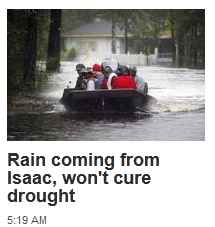
Isaac won't cure the draught

Urging caution, the headline reminds us that Isaac will not heal the fall of the lake levels. It won’t, in a couple of days, fill the reservoirs and the aquifer. As a matter of fact, it doesn’t even seem to indicate that it’s a step in the right direction, some good news amid a summer of only bad, or anything positive.

In short, it’s the opposite of all the economic headlines one gets, where every encouraging step means we’ve turned the corner into a new Gilded Age. Where a fall in the rate of increasing numbers of people seeking public assistance or unemployment benefits heralds a great recovery, regardless of the fact that the numbers of people unemployed increases.

Strange disparity there.

Buy My Books!
Buy John Donnelly's Gold Buy The Courtship of Barbara Holt Buy Coffee House Memories

Republic, Missouri, Opts Not To Curtail Citizen Freedom

The city of Republic, Missouri, which has considered whether to mandate a trash collection service for its citizens instead of allowing residents to choose a trash hauler, has decided not to take that small bit of liberty after all:

A years long trash debate in the city of Republic created a stinky situation. City Council met Monday night to decide if the city should take over trash operations and sign business over to one company. Currently, it’s up to individuals to hire trash haulers. In a 2-6 decision, council silenced the situation and killed the measure.

The citizens’ freedom to choose overcame the government’s self-interest arguments (save money on the road wear) and the government’s benefits for citizens arguments (it would give the citizens a lower rate).

So a small victory for limited government this week in a small town in southwest Missouri. Maybe that explains why it’s so hard to find news coverage of it.

Buy My Books!
Buy John Donnelly's Gold Buy The Courtship of Barbara Holt Buy Coffee House Memories

You’re Just Like Mitt Romney

Here in Missouri, it’s a Sales Tax Holiday weekend:

By state law, the sales tax holiday begins on the first Friday in August and continues through the following Sunday. In 2012, the three-day holiday begins at 12:01 a.m. on Friday, Aug. 3, and runs through Sunday, Aug. 5. Certain back-to-school purchases, such as clothing, school supplies, computers, and other items as defined by the statute, are exempt from sales tax for this time period only.

Now, as you Missourians head out to the shops to get school supplies this weekend to save a couple percentage points on your purchases, you’re engaging in strategic thinking and behavior to minimize your tax liability, to increase your personal cash flow, and to use your capital as you want instead of maximizing your contribution to the collective good as ministered through the various levels of government entities that collect and disburse that revenue.

In short, you’re just like Mitt Romney.

And Harry Reid, and Nancy Pelosi, and Barack Obama, and George Soros, and Charles Schumer, and the dreaded Wall Street cartoon villains, the Koch brothers, Sheldon Adelson, and so on and so forth.

The difference is that this rational behavior is somehow portrayed as bad when Republicans or businesspeople do it. But a lot of people do the same thing every day and, in Missouri, every first weekend in August.

Buy My Books!
Buy John Donnelly's Gold Buy The Courtship of Barbara Holt Buy Coffee House Memories

A Program Whose Name Means What It Says

In New York City, a new program is called Latch On NYC Initiative.

Strangely, it means it literally, not figuratively.

Still, it’s the best program name for an overweening (ahut*) government program I’ve ever seen.

(Link seen Hot Air.)

* ahut represents a vocalization my sainted mother used to make whenever she made a pun or some bit of humor. It was a sort of throat semi-clearing rimshot she used to signify pun intended.

Buy My Books!
Buy John Donnelly's Gold Buy The Courtship of Barbara Holt Buy Coffee House Memories

The Two Commercial Interests, Hey?

Normally, David Nicklaus is pretty reasonable in his columns for the St. Louis Post-Dispatch. But in his latest, In heavyweight fight over card fees, consumers are the likely losers, he underemphasizes an important point:

When two big commercial interests start a fight, consumers would be wise to watch their wallets.

So it is with the dispute between banks and retailers over swipe fees, which the store incurs every time you pay with plastic. The fees average about 2 percent of each transaction and have risen over time.

Congress capped the swipe fee on debit card transactions, costing banks an estimated $8 billion a year.

So whose fault is it that you’re going to have to pay a premium, maybe, at certain shops to use a credit card?

Congress. Or, more to the point, the former Democrat-controlled national legislature that gave us Dodd-Frank.

I’ve given a stray thought to the impact of this settlement. Will retail establishments start charging a 5% premium (or giving a 5% discount) to people who pay with cash? Maybe.

If Amazon doesn’t do it, small businesses (or larger businesses) that charge 5% extra will lose business to Amazon and larger businesses that don’t charge the premium. That business decision will cause more smaller businesses to leave the field. Thanks, Congress! Of course, this will get blamed on large banks and credit card companies who need to maintain their product margin and additional costs of compliance with Dodd-Frank and its Frankenagency’s whims (what, doesn’t the Secretary of Health and Human Services get to arbitrarily impose anything with this legislation? How did she get left out of something passed between 2009 and 2011?).

Hey, let’s travel on a tangent: Why, this very week, I ate at a small business that had a sign offering a 5% discount for cash. When I paid for the bill with cash, the discount was not applied. I didn’t quibble with it. That 5% just came out of the tip. But whenever I see all those twee signs, pictures-with-words that pass for insight on Facebook, and whatnot that says “Buy from a small business” as though a small business is inherently more moral than a large business, I can’t help but think of the times when I’ve been rooked, overcharged, or otherwise immorally treated by a small business. Caveat emptor, I know, but still, the sentiment is twee. I buy from whomever is convenient, least expensive, best quality, and whatnot. Sometimes I like to buy from a small business because I like to support small business. But there’s no moral compulsion to do so, and some small business people are only limited in their immorality by the fact that Bank of America or Unilever have not bought them out and brought them into the executive ranks of a large business.

Where was I? Oh, yes. To sum up: Dodd-Frank sucks, and Congressional action has made things more expensive for consumers, but again in a fashion where they can frame capitalism for it.

Buy My Books!
Buy John Donnelly's Gold Buy The Courtship of Barbara Holt Buy Coffee House Memories

The Headline From 1200 BC Reads: “Society’s Supply of Copper, Tin Limited; No Advanced Civilization Can Function Without Bronze Implements”

The BBC has an alarming report from where environmentalists gather to eat, live it up, use more resources than they would normally have access to in their native lands, and issue alarming reports, complete with scary infographic about how things are running out. The text sez:

If we fail to correct current consumption trends, then when will our most valuable natural resources run out?

As the world’s population soars, so does its consumption, and as a result we are stretching many of our natural resources to their limits.

. . . .

The hope is that talks at the Rio+20 Earth summit will help to steer the world economy on a more sustainable path.

Oh, spare me the Jeremiads. No, that’s not a meteor shower; it’s a type of sermon. Make no mistake about it, those fellows who want to create a “sustainable path” have in mind some very basic controls that The World will have to do to save the planet from the infestation of humans. As though the planet were some weak sister who needs the help of her acolytes to regulate systems whose complexities and subtleties are not yet understood to any great degree by man. But I’m getting off onto my stock climate change rant here. Let me switch back into my limited resources rant.

Any projection of resource usage based on current consumption relies on the misconceptions that what we use now is all we’ll ever use and what we have now is all we’ll ever have. Let’s take each in turn.

What we use now is all we’ll ever use.

As the headline suggests and history shows, humans and civilizations have relied on different resources at different times. In the Bronze Age, they used bronze. In the Iron Age, guess what? They advanced and discovered iron. Even in more recent history, in spans of less than 100 years much less epochs, resource needs have changed. In the 18th century, whale oil fueled lamps for interior lighting. Then they discovered coal oil, also known as kerosene, and that illuminated homes into the 20th century. Anyone rending garments about the limited supply of whale oil would have proven less-than-prophetic in predicting a dark age around 1880 because the whales were gone.

Similarly, buildings were built with brick and wood, but now we see a lot of construction from steel and other materials. Household furniture used to be wood, but a lot of it is now plastic and particle board (which is wood, but used more efficiently).

Take a look at this timeline of battery technologies and see how fast the resource combinations for energy storage have changed. And this is a survey of commercial products.

Now, tell me how someone is going to prognosticate the future resource needs based on today. Especially when one looks at the resource needs and their evolutions in the future.

What we have now is all we’ll ever have.

Take a look at the recent discoveries of petroleum resources in the Bakken formation. Revel in how the estimated amount of recoverable petroleum keeps going up. Or look at the new discoveries off of the coast of Israel. Does the alarmist image take those into account? I looked at the source document, but it doesn’t give the source for its fossil fuel claims, but other claims are made on data from 2010 or before. So we can probably assume that the alarmist icon does not include the new discoveries.

Additionally, the report probably does not take into account discoveries of rare earth metals after 2010, such as Japan’s find in sea beds which could essentially double the earth-bound amounts estimated by the US Geological Survey.

Why do I say earth-bound? Because there’s that Planetary Resources company that has a business plan of mining asteroids. A company. With a business plan to profitably mine asteroids.

So any alarmist paper or icon coming from a transnational or international concern designed to create “sustainability” really does not recognize human ingenuity or the way the human race has acted in the past when confronted with scarce resources or just more efficient ways to use resources.

Undoubtedly, the path to sustainability requires some sacrifice on our part. Because here in the United States, we have a very high standard of living, and certainly we somehow “should” give something up to make sure that natives in Cameroon get to rise to some level of sustainable living. Not the same easy lifestyle we have, mind you, where large portions of the population have the leisure time to collect on resource-intensive devices and computer networks to lament the unsustainability of the lives they enjoy. Some top-down solution must be imposed, something like a potentially hazardous, expensive form of lighting replacing energy-intensive but inexpensive, pleasing, and technologically proven forms of lighting. Something like that. And maybe an energy-efficient stove for a Ugandan family.

The BBC post I linked to above does throw a sop to human ingenuity:

Of course, the assumption is that human ingenuity and market forces will prevent supplies from running out: we could create better or cheaper extraction methods, recycle materials, find alternatives to non-renewable sources, or reduce consumption.

But that is probably just a sop. Do you think the people at the Rio+20 summit are in favor of the free market to find these solutions? Do you think the journalists covering them believe individuals and corporations should mine asteroids, or do you think they more believe that the asteroids are pristine, people-free environments that should be protected because of their intrinsic value qua rocks floating through interplanetary space much like the earth has some intrinsic metaphysical value qua rock with atmosphere floating through space? Me, too.

In lieu of embracing an environmental hair-shirt and hemp-based computer architecture required for a sustainable world, how about we just go on doing what we as humans have done for millennia and really well since the Enlightenment and innovate our way to greater shared prosperity?

Buy My Books!
Buy John Donnelly's Gold Buy The Courtship of Barbara Holt Buy Coffee House Memories

Depends On What “Bellwether” Means

I hate essays and articles that start with a definition from the dictionary. So, in a fit of self-hatred, here’s the definition of bellwether:

1. a wether or other male sheep that leads the flock, usually bearing a bell.
2. a person or thing that assumes the leadership or forefront, as of a profession or industry: Paris is a bellwether of the fashion industry.
3. a person or thing that shows the existence or direction of a trend; index.
4. a person who leads a mob, mutiny, conspiracy, or the like; ringleader.

Now, square that with an article entitled Missouri slips from political bellwether status this fall:

Missouri has been a bellwether state for more than 100 years, with presidential candidates lavishing attention on Show-Me State voters and spending millions on field operations, glossy campaign mailers, and TV ads. But this election? Not so much.

Roy Blunt’s 13 percentage-point victory in a U.S. Senate race led a strong Republican wave in Missouri in 2010.

This year, Missouri isn’t on the list of top swing states — those vote-rich battlegrounds that political experts and campaign strategists say will determine who wins the White House on Nov. 6. Most political handicappers instead have Missouri in the “leans Republican” column.

Somehow, to this professional commentator, “bellwether” means something like “toss-up,” “swing state,” “independent,” “contested,” “battleground,” or “undecided.” None of these are true.

Either the commentator is ignorant as to the meaning of the word and the implication that Missouri is leaning Republican–as the nation in the aggregate did in 2010, or the commentator wants Missourians to, I dunno, straighten up and fly tight to get more ad dollars (evil, I thought, unless I guess they’re spent in your market, maybe) to fill the airwaves with irritating, offputting, and often marginally mendacious approved-by-the-candidate messages.

Buy My Books!
Buy John Donnelly's Gold Buy The Courtship of Barbara Holt Buy Coffee House Memories

Hipsters Can’t Wait For Huge Chain Store To Put Mom & Pop Small Businesses Out Of Business

Sure, it’s a friendly, happy story about how high-income hipsters want an Ikea store to come to St. Louis:

Perhaps no other store has been rumored more often to be coming here soon than that elusive retailer whose very name gives many residents heart palpitations: Ikea.

The absence of the Swedish retailer — whose hulking blue and yellow stores are filled with sleek bookshelves, modern bedroom sets, and eclectic knickknacks— is a sore spot among many St. Louisans. As one of my colleagues put it, it’s one of the last bastions of our retail insecurity.

We now have Trader Joe’s, Crate & Barrel, Nordstrom Rack, American Girl, H&M, Ross Dress for Less, and buybuy Baby (which recently opened a store in Ballwin).

To be sure, there are still some left on our retail wish-list: Zara, American Apparel, Bloomingdale’s, and Room & Board, to name a few.

But there is no bigger Holy Grail than Ikea.

As you can probably guess, I have never been in an Ikea. I’ve done my share of assembling particle board furniture, including a huge honking desk that cost me almost a thousand dollars, more than a dozen Sauder bookcases, many laminated storage cabinets with doors hanging awry, and a couple Sauder printer stands that even today function as major pieces of furniture in my domicile. I’ve bought none of them because of the logo on the box, though, so I can’t understand how prestige and status stem from furniture you have to put together yourself.

But I digress.

So the crowd that we would have called Yuppies thirty years ago want their Ikea in St. Louis. Even though this will put small businesses out of business:

As I wrote last year, there are a handful of businesses that have sprouted up around town that take orders and pick up items from one of the stores in Chicago and then bring them back to St. Louis. One of them is Expedite STL.

Another such company popped up earlier this year called Blue Square Delivery. It was started by brother Dave and Bill Carruthers of Des Peres as a side business. They take a big moving van to Ikea about every three to four weeks.

Sorry, I guess that’s brother-and-brother businesses. But still.

So, how does this differ from Walmart?

Mainly in that hipsters like Ikea, and hipsters do not like Walmart.

Don’t worry, yuppies. Some municipality in St. Louis County will eventually throw enough tax credits, special taxing districts, and other perks to draw Ikea to town.

(Hey, aren’t you a yuppie? No. I’m not that young anymore, and I live in the country.)

Buy My Books!
Buy John Donnelly's Gold Buy The Courtship of Barbara Holt Buy Coffee House Memories

People Move To City For Action, Energy; People Then Decry Action, Energy

Some residents of downtown St. Louis are growing older:

The scene picks up pace on weekends, with the streets even busier and the bars even fuller — offering regular proof of how the neighborhood has transformed in the last 15 years.

But the changes have also brought simmering tension that has now come to the forefront. Residents, business owners and police acknowledge that crime is steadily increasing along Washington, and that cruising on the strip has gotten out of hand. They’ve complained about motorcyclists revving engines, cars blaring music, fights, loitering by teenagers, even some shootings.

They’re just not sure what to do about it.

In the last month, police have experimented with closing off the street to vehicle traffic, circling the area with a helicopter and enforcing a curfew for those under 21.

The Partnership for Downtown St. Louis has helped form a task force to come up with a “code of conduct” for the area, hoping to crack down on noise, littering and congestion.

“We all wanted this growth,” said Tammika Hubbard, alderman for the 5th Ward. “We just didn’t know how we were going to handle it.”

At a residents association meeting two weeks ago, the consensus from speakers was that the area had become a victim of its own success.

The residents moved to the lofts from their quiet suburban homes because they wanted that. Now they’re getting older a couple years later and are outgrowing the party-all-night mentality and want to get some sleep, so they want governmental recourse.

It’s akin to the people who claim that The Simpsons isn’t funny any more. The cartoon hasn’t changed. They have.

Prediction: If they succeed in pushing out the bar and clubbing crowd (who preceded the residents and most of the other businesses), the businesses will follow, as they won’t survive without that crowd. Washington Avenue and other parts of downtown St. Louis will not be a shopping destination (see also Union Station and St. Louis Center), and the hundreds or small thousands of people scattered among the lofts will not support them. Eventually, Washington Avenue will become quiet again, and the loft dwellers will move on.

And the cycle will repeat in 2033 or so. Maybe.

(No, I am not a downtown booster, especially when it comes to centrally planning a Renaissance. It hasn’t worked in downtown St. Louis in the thirty or more years that government officials have been applying the paddles. The minute they lay off with the defibrillator of taxpayer cash, the city or neighborhood flatlines again. The government cannot will a self-sustaining reaction and revitalization through its action, but it sure can put the pillow over the face of one when it tries too much to help or to inspire its citizens.)

Buy My Books!
Buy John Donnelly's Gold Buy The Courtship of Barbara Holt Buy Coffee House Memories

Optimism Must Be Educated Out Of The Populace Or Regulated

Dustbury links to a story about the Feds worrying about the uninformed masses who must be shepherded: Study: Nearly Half Of Consumers Fooled By “Up To” Claims In Advertisements:

The Federal Trade Commission recently commissioned a study that looked out how consumers perceive and comprehend the “up to” conditional in advertisements.

The researchers used different versions of an ad for windows — one that stated that the windows were “proven to save up to 47% on heating and cooling bills,” and one that simply stated, “proven to save 47%.”

Of those who looked at the “up to” version, 45.6% mistakenly said the ad promised to save 47%. Meanwhile, only 58.3% of consumers who saw the unconditional version said the ad promised to deliver 47% savings. According to the FTC, the small difference between the two results indicates that the use of “up to” did little-to-nothing to change consumers’ perception that the ad was promising the maximum level of performance.

Friends, Americans, and countrymen under the DREAM thing, this results from the Lake Woebegone Effect and self-esteem based educational curricula. People all believe they are better than average, better looking than average, smarter than average, and in the tops in whatever they’re measured. Whether they are or not.

So of course they believe that the absolute best possible result of a product applies to them. Some people, not just in Chicago, spend their winters thinking the Cubs might win the World Series. People like blood sausage, too.

Now that the FTC has discovered this fact, what does the FTC want to do about it? Solve the problem of optimism, no doubt.

Buy My Books!
Buy John Donnelly's Gold Buy The Courtship of Barbara Holt Buy Coffee House Memories

Quick Thoughts on Automobiles in the News

Buy My Books!
Buy John Donnelly's Gold Buy The Courtship of Barbara Holt Buy Coffee House Memories

Juveniles A Little Unclear On The Concept

Protesters arrested in downtown St. Louis:

At least 10 people were arrested Thursday night after protesters spray-painted graffiti on a downtown bank and skirmished with officers, police said.

A St. Louis police bicycle officer suffered a minor injury to his hand when confronted by protesters, police said. A property manager at the Fifth Third Bank at 10th and Olive streets also was assaulted after approaching the people about the graffiti.

Protesters were demonstrating against police violence, specifically the actions of police in Chicago at the NATO summit, one of the protesters said.

One graffiti message on the bank’s glass windows read “Solidarity with all who resist.” More graffiti on Peoples National Bank at 826 Olive read “Burn the banks.”

All righty, then. We have two assaults, vandalism, and a call to arson to protest violence.

Kudos to the St. Louis Post-Dispatch for its even-handed treatment of the subject. Undoubtedly, its professional journalists could find some supporters to defend a puppy’s piddling on the carpet, too.

Buy My Books!
Buy John Donnelly's Gold Buy The Courtship of Barbara Holt Buy Coffee House Memories