Book Report: Realm of Numbers by Isaac Asimov (1959, 1967)

Book coverI have tried to read this book many times in the years past; the first time, actually, was when I needed something portable to stick in my pocket so I could read it at the airport while waiting for my sainted mother’s flight to arrive. That, my friends, was six or eight years ago.

So I stuck it in my pocket again recently and, since I’m running behind on my reading this year (I might crack forty books this year if I buckle down), I resolved to finish it. And I did.

But I bogged down a bit in the same spot as last time.

The first part of the book is as much history as mathematics: Asimov explores ancient civilizations and how they began enumerating and coming up with the basic concepts such as 0, addition, subtraction, multiplication, and division. So far, so good. Not only is this basic mathematics, but it’s history and narrative in nature. Then, when he gets to square roots, exponents, and higher order concepts, the history that makes the first half of it so easy and enjoyable to read evaporates, and he focuses on proofs and formulae. As such, the juice that made the book succulent dries up. Yeah, I learned some things, but some of it rolled right over me, and I was content to let it do so.

But at 140 pages, it can be a quick enough read once you give yourself permission to skim the formulae at the end. It’s also a bit of a gateway for me to acutely wanting to refresh my math skills. So if you’re into that sort of thing, give it a whirl. There are a couple of others in the line, Realm of Algebra and Realm of Measure, that I’ll keep my eye out for, but you don’t find a lot of Asimov at book sales and garage sales. Sadly, people have turned from informed and informative books like this to reality television and Twilight fan fiction tie-ups.

Books mentioned in this review:

Buy My Books!
Buy John Donnelly's Gold Buy The Courtship of Barbara Holt Buy Coffee House Memories

Book Report: Rocket Ship Galileo by Robert Heinlein (1947, 1981)

Book coverThis book is one of Heinlein’s young adult rocket jockey pieces, the ones that made him famous and wealthy enough to do his longer, adult sleep-with-your-mother books later.

The book is set in the near future of its publication date (1947). A trio of high school seniors build a rocket in their back yard (roughly). It fails on launch testing, but their steady improvement has brought their attention to a government scientist, a sort of maverick, who happens to be the uncle of one of them. He has them join him in building and outfitting a real rocket on the cheap (government funds are tight, you know) and flying to the moon. When they get there, they pick up radio signals from someone who has beaten them to it… Nazis!

In the 21st century, the book is an artifact. Nazis have been played for fictional foils in the seventy years beyond their actual shelf life, but in 1947 and shortly thereafter, there must have been a real fear of redoubts of holdouts in places like South America. Going to the moon must have seemed like quite a dream. And high school students with that ability and interest? They must have been more common then.

The book depressed me a bit on the meta level. Here was young adult literature in America’s prime. Science lectures wrapped into it, reasoning skills emphasized, and every boy is a tinkerer and a good shot. Some kids who read this book probably went on to make the trip to the moon a reality. Meanwhile, in 2013, young adult fiction is all fantasy, vampires, and intrigues. Not what man can do, unless man is doing it to another man for some slight advantage.

One could argue that we’ve really lost something in how we entertain our young and what aspirations it leads them to. But one would probably waste one’s time.

Books mentioned in this review:

Buy My Books!
Buy John Donnelly's Gold Buy The Courtship of Barbara Holt Buy Coffee House Memories

Book Report: The Phantom of the Footbridge by Ron Boutwell (1999, 2006)

Book coverI picked up this book at the local used bookstore in its local interest section, but it doesn’t seem to be available online even though Springfield is lousy with them. It was published by a local Christian theatre company, and its protagonist is a young pastor who takes over a church (that later becomes the playhouse of the theatre company) in 1925. On his walk from the train station to the boarding house where he’s staying, a hooded figure meets him on a footbridge and tells the new arrival that he will bring a child who needs help tomorrow night, and the pastor must help him. This is the phantom of the footbridge.

It’s a very short novel–140 pages–carries with it more than a hint of Dickens in its plotting and characters. Unfortunately, the execution is not as picturesque as Dickens, but the author did a lot of research on the environs of North Springfield in the middle 1920s, and he makes sure to mention every landmark that people pass as they walk (not that there’s anything wrong with that). But the story lacks in those bits.

But I enjoyed it enough in its expository way.

Buy My Books!
Buy John Donnelly's Gold Buy The Courtship of Barbara Holt Buy Coffee House Memories

Book Report: Let It Rot by Stu Campbell (1975, 1990)

Book coverI bought this book some time ago when I first got into gardening, since I’d heard that composting was all the rage, and I wanted to learn more about it. I’ve been doing some “composting in place” — basically you take some organic material, toss it in your garden, and throw some dirt on it — but I got some extra material from trimming back some bushes and the bucket in which we kept our kitchen scraps was getting full. So it was time to read this book.

It covers a variety of information not only about the history of composting, but also some different strategies, enclosures, basic scientific principles of it, and overall, how neat composting is.

But I won’t be doing it seriously.

Because, brothers, composting is work. It’s not a matter of just throwing waste you generate in your yard and your kitchen into a pile and watering it and turning it every once in a while. For starters, to get the best compost, you’ve got to go out and seek things that you don’t have, or at least I don’t have, including different kinds of organic material, manure, and so on. Secondly, he talks about six inches of this, three inches of that, and inch of this, and then repeating it. That’s a compost berm. Come on, I’m not interesting in rebuilding Cahokia Mounds here.

I can buy the soil amendments I need, even organic compost, in the quantities I need to make my soil better for what bit of gardening I do. Given how little time I have of late to actually get out there and weed or pick ripe vegetables and fruit, I don’t need to take on another bit of labor for it based in the neatness of it or the protection of Mother Gaia.

Still, I learned a lot that I’ll never use, except maybe to make some compost tea–that is, let rain collect in my scraps bucket and water with that–and perhaps consider a little tumbler. But I’m not going to be a proper composter, and I never would have given up on that thought without this book. So I guess I can say it changed my life.

Books mentioned in this review:

Buy My Books!
Buy John Donnelly's Gold Buy The Courtship of Barbara Holt Buy Coffee House Memories

A Quiz! Books You Should Have Read In High School

Buzzfeed as a collection of book covers with the title "23 Books You Didn’t Read In High School But Actually Should". I’m not really sure why they thought it was a high school requirement, especially given the state of current public high schools in the United States, but.

At any rate, here’s the list, and I’ve emboldened the ones I’ve read (although most in college or after):

  • The Great Gatsby
  • To Kill a Mockingbird
  • Night
  • Lord of the Flies
  • Heart of Darkness
  • The Catcher in the Rye
  • Of Mice and Men
  • Nineteen Eighty-Four
  • Slaughterhouse Five
  • Frankenstein
  • Uncle Tom’s Cabin
  • Animal Farm
  • Waiting for Godot
  • Mrs. Dalloway
  • Brave New World
  • As I Lay Dying
  • Catch-22
  • One Flew Over the Cuckoo’s Nest
  • The Bell Jar
  • Death of a Salesman
  • Beowulf
  • Metamorphosis
  • Their Eyes Were Watching God

Not bad.

Of course, the books selected reflect the preferences and probably the books I’ve read sensibility of the person who compiles the list.

So, ultimately, it measures how many books I’ve read that that fellow has read and thinks are important.

Buy My Books!
Buy John Donnelly's Gold Buy The Courtship of Barbara Holt Buy Coffee House Memories

Book Report: The Ophiuchi Hotline by John Varley (1977)

Book coverI picked up this book at the Friends of the Springfield-Greene County Library book sale a year ago, and I regret not macroing out the spelling of Friends of the Springfield-Greene County Library book sale because, gentle reader, I do not touch-type, and typing the name of that particular affair takes a lot out of me. Pardon me while I go nap to recuperate.

Ah, that’s better. Now, about this volume.

As you might recall, I read John Varley’s Millennium three years ago and liked it better than the Kris Kristofferson film.

This book is Varley’s first, and like much speculative fiction of the era (and maybe this era, too, but I get the sense a lot of stuff these days is either urban fantasy influenced or space marines stuff, mostly because I’ve read some of the latter and read blogs from Marko Kloos and Larry Correia–I dunno what contemporary science fiction is like outside of that). This book deals with a genetic scientist who is put into prison and sentenced to death for working on the human genome and cloning. It’s told in the milleiu of invaders who have driven humans from earth to outposts in the solar system because they, the invaders, favor intelligences like that of dolphins an whales. Similar creatures exist on Jupiter, and the invaders ignore humans who do not bother the invaders and the like intelligences. A technologically advanced transmission has erupted from somewhere near Ophiuchi (O-fee-you-key) 70 and helps humanity advance, including genetic technology (which has gone ignored by humanity but a few outlaw scientists).

Anywho, a politcal heavyweight on the moon rescues the scientist by presenting an illegal clone to take her place for the execution. He copies her memories and then trains her to work for him, killing her when she tries to escape and replacing her with a clone. After some number of tries, she goes to a moon of Jupiter and encounters a teacher clone and they plot an escape. And another clone goes to Pluto to try to find a way to Ophiuchi after the transmitters demand payment of hundreds of years of scientific knowledge. And allies of the scientist revive a clone she herself left in place.

For a while, it gets a little confusing remembering which clone team is doing what and why, especially as I had to put the book down sometimes for a couple of nights.

And then the book comes to a resolution, very abruptly, in an unsatisfying fashion.

It’s kind of how Lost ended. Remember that television show? Remember all the plot lines and questions, and how they ended it by setting up a final set of questions they could almost answer, and they did so in an unsatisfying fashion? This book has a lot of compelling things going on, some early questions about the nature of self and whether clones are you, machinations of a politician playing games several steps ahead of the characters, and this all gets abandoned for an abrupt ending that does not answer many of the questions.

It’s an interesting read for the speculative nature, but ultimately left me a little disappointed. But if I find another John Varley out there, I’ll pick it up and hope for better.

Books mentioned in this review:

Buy My Books!
Buy John Donnelly's Gold Buy The Courtship of Barbara Holt Buy Coffee House Memories

Book Report: The Complete Fiction by H.P. Lovecraft (2011)

Book coverI can’t believe I read the whole thing.

This tome is one of the 1000+ page books I’ve been going on about reading for the last year or so. It actually took me over a year–something like a year and three months–to read this book. Short stories will do that–offer you the ability to stop after only five or ten pages in a night, where a longer work with longer chapters will at the very worst compel you to read maybe a dozen, and then maybe another chapter.

Then there is “The Dream-Quest of Unknown Kadath”. I’m not a fan of the Dreamlands portion of Lovecraft; I know he sometimes liked to dabble in the very fantastic, but part of the grounding in his stories is that the bizarre and dangerous happens to people in the real world. When we get into the Dreamlands stuff, where Randolph Carter goes through a series of adventures in his dreams, where the weird does not have the grounding in every day life or reality, I sort of lose caring. So when it came time to read “The Dream-Quest of Unknown Kadath”–which I had never read before–I had to slog. For weeks or months.

At any rate, if you’re a fan of Lovecraft, this book will please you (your Dreamlands mileage may vary). It includes all the fiction, including the longer pieces such as “At the Mountains of Madness” and whatnot. In college, I read a number of shorter paperbacks of Lovecraft’s work, each based on one of the cornerstone stories (“The Lurker on the Threshold and Other Stories”, “The Colour Out Of Space and Other Stories”, and so on). So many of the pieces were familiar to me, but many of the shorter, lesser stores either I had not remembered or had not read.

So all in all, it’s a great collection if you’re in the mood for Lovecraft. And sometimes I really, really was, and sometimes I was not. His archaic style sets a certain gaslight feel to the stories that you cannot get elsewhere, and the language will teach you many neat words. In my twenties, I learned the words “foetor” and “eldritch” from Lovecraft, and I started keeping a list of words I wanted to drop into conversation. However, I misplaced that notebook eight months ago, so I don’t know what words I wanted to learn, and I didn’t learn them very well before that. Ah, well.

In addition to his fiction, the book includes some short stories he wrote as a kid and draft portions of “The Shadow over Innsmouth” and Lovecraft’s nonfiction essay “The Supernatural in Literature” which explores the history of what he calls the “weird” in literature up until his present day (the 1930s). He name-checks a lot of authors throughout history and identifies works he likes. It’s a fifty page treatise, and it at turns made me want to read some historical Gothic fiction and bored me. He lavishes praise on Algernon Blackwood, though, and the complete tales of Blackwood is one of the few books I’ve actually put down with the intention of not picking back up, so I will probably avoid the authors he mentions except Lord Dunsay and maybe Machen. Or not.

This is less of a book report than marking my achievement. Sorry.

Books mentioned in this review:

Buy My Books!
Buy John Donnelly's Gold Buy The Courtship of Barbara Holt Buy Coffee House Memories

The Unsophisticated Past

City Journal has a long (well, it is City Journal) piece comparing women’s magazines of 1963 to those of today, and finds the material different:

Flip through the weighty 50-year-old issues, and you’ll soon feel, literally, a massive cultural shift in what women expect from their periodicals. In 1963, consuming a magazine could take days. Early that year, Good Housekeeping serialized Daphne du Maurier’s novel of the French Revolution, The Glass-Blowers, cramming much of it into a mere three issues. In May, GH ran a large portion of Edmund Fuller’s novel The Corridor, a feat that required stretching the magazine to 274 text-heavy pages. Redbook’s March 1963 issue featured Hortense Calisher’s novel Textures of Life and five short stories, a level of fiction ambition that even The New Yorker rarely attempts now. There is verse, too. At one point, a dense page of du Maurier’s text makes room for Catherine MacChesney’s “From the Window,” letting Good Housekeeping readers experience poetry and prose at the same time. Marion Lineaweaver’s ode to the coming spring in LHJ (“The wind is milk / So perfectly fresh, cool / Smooth on the tongue”) was one of six poems in the March 1963 issue alone.

That erudition is all the more surprising when you consider that women’s magazines reached a far larger fraction of the population in 1963 than they do now. Good Housekeeping hit a circulation of about 5.5 million readers in the mid-1960s, at a time when there were about 50 million women between the ages of 18 and 64 in the country. Ladies’ Home Journal reached close to 7 million readers. Editors assumed, then, that a hefty proportion of American women wanted to ponder poetic metaphor.

Apparently, those women also wanted to read serious nonfiction. Betty Friedan’s manifesto The Feminine Mystique, widely credited with launching Second Wave feminism, was helped in its quest for bestseller status when women’s magazines like LHJ ran prepublication excerpts. In March 1963, Redbook covered a doctor’s agonizing decision to leave Castro’s Cuba after becoming disillusioned with the socialist revolution.

That is, in 1963, women’s magazines expected a higher level of reader sophistication among housewives than you can probably expect from the college-educated people today. It’s not just women’s magazines.

I read a lot of older books, including those from the first six decades of the 20th century, and the books very often include allusions to classical literature that would pass over the heads of many book (or Kindle) readers today (see also my review for Please Don’t Eat The Daisies).

What do we have in our reading material today that makes us think we’re more sophisticated than those backwards people of white bread America? Snark. We have catty comments and sarcasm serving as an in-joke that puts down others, often celebrities (who otherwise should use their celebrity wisdom to tell us how to live). And because we merely think we’re better than they are, we must be. No allusions to works with deeper themes or even understanding of the treatment of more meaningful insights needed!

(Link via …. uh, someone. Sorry, it was lost in my tabs for 24 hours, I think.)

Buy My Books!
Buy John Donnelly's Gold Buy The Courtship of Barbara Holt Buy Coffee House Memories

Book Report: Life Lessons by Bob Dolan (2011)

Book coverI did not come to this book with an open mind. As many of you might recall (and given the readership of this blog in its 10th year, I mean ‘Gimlet and Charles’), I was a big fan of the Weber and Dolan radio program back in the olden days. I used to listen to them, first when I worked in the testing lab at Data Research Associates and shared a dark closet with a gruff fellow who was not much for conversation–as if I am one for conversation. Then I listened to them whenever technology and legality allowed them to stream it on the Internet and I had an operating system that allowed it.

How much of a fan was I? I asked my brother to go get me some of their autographed coffee mugs from the station back when he lived in Milwaukee and I did not, and he did it.

Weber and Dolan signed mugs

As you can see, I still have them proudly displayed in my office.

So I’m a homer as far as the author goes. I forget where I saw that he had a book, but when I saw that, I had to have it.

At any rate, the book.

As you might guess, Bob Dolan’s brother Tim has become the Cardinal of New York, the head of the American church. Bob tells stories about growing up with Tim and their relationship to shed insight into his brother’s character and into life itself. Some of the conversations are a little too exact, which means either they were recreated or, more likely, that Bob recorded them when he thought about writing the book. Some of them do have an interview flavor after all.

I really enjoyed the book. Bob pokes fun at himself, and much of the book is as much about Bob and his travels with his brother as his brother ascends the Church heirarchy. There are a bunch of Catholic themes in the book and some good Christian messaging, but it’s not overwhelming or proselytizing. Mostly, it’s musing, remembering, and humanizing a powerful figure in a way only a brother can. However, the book is more about Bob learning about himself and life with his brother’s occasional counsel as it is a bio of Timothy Dolan. Which is what I related to anyway.

You want to know what kind of man Bob Dolan is? When his brother was in Rome for something or another and Bob’s family was there to celebrate it, Tim gets a couple passes to meet the Pope, wherein he goes up to the Pope at the head of the church and the people with him get to speak to the Pope and maybe get a blessing. Tim offers one of the passes to Bob, and Bob lets his wife go instead. There’s as much for us to learn about life and love from Bob Dolan as his older brother, maybe.

Books mentioned in this review:

Buy My Books!
Buy John Donnelly's Gold Buy The Courtship of Barbara Holt Buy Coffee House Memories

I Aspire

35,000 books:

Tom Johnson, 83, lives in the museum that is his home. In his own non-digital way, he curates his family’s legacy, the estimated 35,000 books and manuscripts that share his 113-year-old meandering and musty house on the Osage River.

Johnson has built wooden corridors that link the family three-story home to the family library, built in 1899 by his grandfather for a collection of 8,000 books, and another that connects the house to the annex library, built in 1990 when the library overflowed. Grandfather Thomas Moore Johnson (1851-1919) was known as the “sage of the Osage.”

There are two tours a month, it looks like. One of these days, I shall make a pilgrimage.

Buy My Books!
Buy John Donnelly's Gold Buy The Courtship of Barbara Holt Buy Coffee House Memories

Book Report: Miami Massacre by Don Pendleton (1970, 1982)

Book coverThis book is a stunning departure from the series, wherein Mack Bolan….

Aw, who am I kidding? Mack Bolan hits a hard site in Phoenix and follows its bosses to a big deal meet-up in Miami, where the mafia heads are getting together to finally take drastic steps to eliminate The Executioner. He liberates a couple women who were under the thumb of the mob and shoots a lot of bad guys and perpetrates an audacious assault on a couple of hard sites. In other words, it’s a lot like the other books in the series.

What’s most interesting in these books is the evolution of the mythology and the beginning of the plot points that get resolved later. In this book, the Talifero brothers are introduced; they’ll hound him off and on for a couple of books.

The book also has a side plot where Bolan helps and is helped by Cuban counterrevolutionary guerrillas. How quaint. In 1970, perhaps that seemed like a possibility. In 2013, that’s a very dated relic.

At any rate, I pick these books up as filler or breaks from longer reading. I’m getting a little down on them, especially when it comes time to say something intelligent about them on the Internet, so maybe I ought to read something else for a while.

Books mentioned in this review:

Buy My Books!
Buy John Donnelly's Gold Buy The Courtship of Barbara Holt Buy Coffee House Memories

Book Report: An Ozark Boy’s Story by John K. Hulston (1971)

I bought this book at a local used book store (Redeemed Music and Books, if you must know) on one of my local history sprees.

The author is an attorney, the progeny of a pretty successful businessman in the first part of the twentieth century, and it covers the attorney’s formative years in school, college, and the military during World War II. The first chapters jump around a bit, and I thought it reminiscient of Over the Hill and Past Our Place (also by a successful man looking back on his life from almost the same time period). The recollections in the beginning are rather pasted together willy-nilly, but the book improves as it goes along and as the boy reaches an age where he can remember the stories better.

As I said, he was the son of a successful businessman, so his experiences in the depression years are mostly recognizing that the depression is going on. The lad goes to the University of Missouri and then goes on to become a lawyer before joining the military in World War II. It’s not high history; it’s more of a vanity project where the fellow put his story down for his family. But the glimpses of the cities around Springfield in that era and the college experience make it very interesting in spots. So it’s worth it if you’re looking for that sort of flavor amid a whole lot of name-checking people who mattered eighty or ninety years ago.

The book has a date range on it, 1915-1945. The author has another book about his time as an Ozarks lawyer after World War II, and I’ll keep an eye out for it.

Books mentioned in this review:

Buy My Books!
Buy John Donnelly's Gold Buy The Courtship of Barbara Holt Buy Coffee House Memories

Book Report: Suspect by Robert Crais (2013)

Book coverThis book is not an Cole/Pike book. It’s more along the lines of Demolition Angel, wherein the book focuses on a member of a branch of the police force that’s not your ordinary detective or street cop. In Demolition Angel, it was a member of the bomb squad. In this case, it’s the K9 unit.

A patrolman is shot and left for dead after being in the wrong place in the wrong time. His dreams of joining the SWAT are out the window, but he remains on the force if only to find the people who killed his partner. He joins the K9 unit and learns the ways of dogs and partners with a former Marine bomb-sniffing dog from Afghanistan and together, they piece together what’s going on.

It’s an engaging read, happily free of political asides that only serve to remind me that the author would rule me if he could, but there are still a couple of knocks. The shifting points of view include anthropomorphizing the dog which seems a little unserious to me. Also, the ending is very abrupt and cinematic.

But Robert Crais is still one of the few living authors I can read.

You’re forgiven if you think I’ve reviewed this book before. But that was Suspects, which I read back in 2006.

Books mentioned in this review:

Buy My Books!
Buy John Donnelly's Gold Buy The Courtship of Barbara Holt Buy Coffee House Memories

Book Report: Battle Mask by Don Pendleton (1970, 1978)

Book coverThis book is the third in the Executioner series and the earliest I have (and one of the last I got). In it, Mack Bolan is fresh from his big LA expedition that left his team dead or in jail, and he’s still in California. He turns to an old army associate to give him a new face as the old one is widely known. The Mafia catches wind of his plans and learns where he went, but not before Bolan infiltrates the local den as a freelance headhunter looking for Bolan.

It’s standard fare, pretty good for the Pendleton books. It introduces Hal Brognola to the series. It has events that later books refer too–and most of the later books refer to the events of these first few books a lot, and then the later books a little. I wonder what Pendleton must have thought about these books and series and how long they would have gone on. Could he have expected to write thirty-something of them over a decade? It might have made these early books a bit tighter in their universe. Or maybe I’m making that up.

At any rate, one more down, seventy-seven (of the Executioner series alone) to go.

Books mentioned in this review:

Buy My Books!
Buy John Donnelly's Gold Buy The Courtship of Barbara Holt Buy Coffee House Memories

Good Book Hunting: April 27, 2013

On Friday, I volunteered at the Friends of the Springfield-Greene County Library semi-annual book sale. So you might think I would then go on Saturday to the same book sale. But ah, my foes, and ah, my friends, that’s the way one gets too many books.

Instead, I went to the Friends of the Clever Library Book Sale, which is held in the firehouse down there and only has six or seven tables of books. That way, I would self-limit on my purchases.

Oh, how the best laid plans of mice and men and so on. Because I did not take into account that one of those tables might be almost completely filled with Mack Bolan / The Executioner related Gold Eagle titles. Continue reading “Good Book Hunting: April 27, 2013”

Buy My Books!
Buy John Donnelly's Gold Buy The Courtship of Barbara Holt Buy Coffee House Memories

Book Report: The Mall of Cthulhu by Seamus Cooper (2009)

Book coverI was wandering around the library, minding my own business, when I caught sight of this book. At first, I thought the title was Call of Cthulhu something, as if Chaosium was releasing a set of new novels with based on the Cthulhu mythos and its roleplaying game. Then I saw it was not, and the title is what it is, and I thought all the better.

The books is about a young man who, as a college student ten years prior, but down a sorority house of vampires and rescued a young lady. The event wrecked his psyche, and he’s been a barrista, mostly, since that period, and he clings to the woman he saved. She’s joined the FBI and is in the Boston office, looking for Whitey. Their relationship is friendship-only since she doesn’t have a lot of respect for him and because she’s a lesbian.

One day in his coffeeshop, a bad customer leaves behind a MacGuffin, a computer disk, that the man pockets. While he delivers coffee to his FBI friend, the bad guys shoot up the coffeeshop looking for the disk. It contains login information for a Second-Life sort of virtual world where the guys are working together to piece together a working incantation to awaken Cthulhu, and they’re going to try it at a mall near a power center.

It’s an amusing book, and I enjoyed it. It’s not a thoroughly professional job, as the pacing is just a little meandering at times where some excess is not trimmed–who am I to talk? It’s got a bit of an X-Files vibe going on and a touch of Odd Thomas in it, albeit in the third person. By that, I mean it’s conversational, and there’s really no sense of menace to it. You don’t think the characters are in real peril–who am I to talk?–and the climax, such as it is, doesn’t really seem like a climax and there’s a second subadventure climax in it.

Still, I liked the book enough that after I finished reading it and returned it to the library, I ordered it in paperback just so the author could get his buck-three-eighty.

So now that that’s out of the way, it’s back to H.P. Lovecraft: The Complete Fiction. Only 250 pages to go.

Books mentioned in this review:

Buy My Books!
Buy John Donnelly's Gold Buy The Courtship of Barbara Holt Buy Coffee House Memories

Good Book Hunting: April 13 – 14, 2013

You’re right, I don’t get out to do a lot of book sales these days, and the number of books that I pick up from garage sales is generally so low as to not warrant mention. But twice a year, we head out to the Christian County Friends of the Library book fair, and this spring we followed it with a trip to the Hope Lutheran Church garage sale for the Republic Relay for Life.

We went to the Ozark library on Friends Preview Night about fifteen minutes after it opened, which meant we were caught in the throng of people with smartphone UPC readers clogging up the aisles and sometimes plopping down on the floor to look over what they’d removed from the tables. I don’t mind saying, on one hand, I do understand them running a business and using tools at their disposal to maximize their revenue and margins. However, on the other hand, they peeve me because they clog up the aisles and they’ll probably get a valuable book I want just to sell it whereas I, a purist, want to have it. Also, I remember when I was doing the online sales thing around the turn of the century, before common smart phones, and I had to do all that research and remember it. Of course, that factor is one of the reasons why I used to do eBay stuff.

At any rate, here’s what I got:

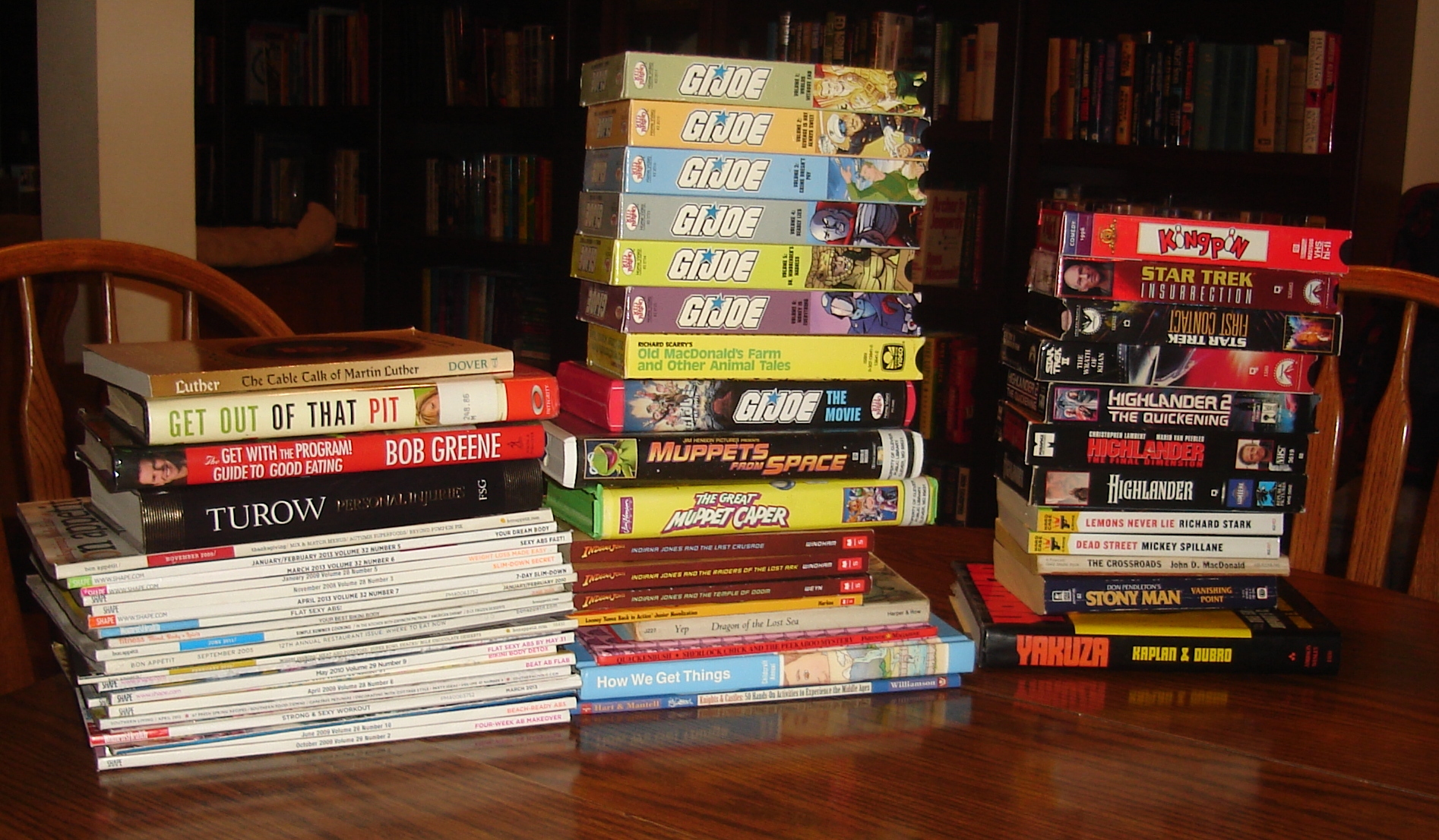
Good Book Hunting April 2013

I got:

  • A Tree Grows In Brooklyn, a book I’ve had a strange urge to read lately. Probably because I’ve seen it on my to-read shelves already.
     
  • A thin book on Wisconsin place names.
     
  • Several in the Gold Eagle Able Team and Mack Bolan series, albeit relatively recent ones.
     
  • History of Theology, a theology textbook which should make for some light reading. I’ll probably read it before I get to the sociology and criminology textbooks I’ve saved from college for lo, these decades, with the intent of actually reading them some [other] day.
     
  • Tom Clancy’s SSN, which I intend to use for identity fraud.
     
  • A hardback copy of Chaucer’s Canterbury Tales which I’ll read someday lo, these decades after reading a select few for a college class. I had a cheap, secondhand paperback for that (and still do); if I’m going to read it in the 21st century, I’ll want something more substantial.
     
  • Writing Mysteries, an inspirational and perhaps reference book should I bother with attempting another novel sometime.
     
  • A book about the Hindu faith. I’ll get right on that after a thick study of Buddhism I bought while I was in college (but that volume was not itself a book for a class, just something I wanted to read someday).
     
  • A western from the Longarm series. Which depicts a man with a pistol on the front. Go figure.
     
  • A book on the cultural significance of Archie Bunker.
     
  • Several episodes of OzarksWatch, a program I’ve been recording on DVR but have yet to view. Now I have several interesting ones on videocassette to procrastinate viewing.
     
  • The three Alien movies I have yet to see. The Hope Lutheran Church sale did not have Aliens.

I am reading less over the last year, so I don’t know when I’ll get to these. Someday. Hopefully, medical care will help extend the human lifespan to make it possible for me to do so.

Would you believe I’ve posted over 80 such expedition recountings for you? Me, either.

Buy My Books!
Buy John Donnelly's Gold Buy The Courtship of Barbara Holt Buy Coffee House Memories

Book Report: Murder Twice Told by Donald Hamilton (1950)

Book coverFresh from the enjoyment of the Matt Helm book The Ambushers, I picked up this book, two of Hamilton’s novellas packaged together for the burgeoning Hamilton fan base.

The first, “Deadfall”, deals with a chemist who had been under suspicion for meeting with a beautiful female Communist agent, is confronted again at his new workplace by the FBI. The questioning leads to further suspicion, his resignation, a meeting with the woman whom he has not seen in a long time, and playing the FBI against the Communists as he seeks to clear his name and to keep his former fiance from murder charges. A bit slow for modern tastes, but I can see how it fit in with the times a bit. A nice bit of twist to it in that the demure former fiance turns out to be a Communist agent and the very attractive former Communist agent is really working for the FBI. It’s sort of a twist like from the film The Mask, but forty years ahead of the Jim Carrey film, of course.

The second, “The Black Cross”, deals with a married professor who has married an attractive young lady and brought her to his old hometown in New England, where she begins to chafe at the monotony of it. After a drunken row at a party, they are involved in a deadly automobile accident that kills her. In his dazed state, he thinks he sees a man murder his wife with a tire iron. The police discourage the man from pursuing a murder investigation, and he wanders around in a bit of a daze trying to figure out who might have killed her, uncovering some secrets from her youth, including connection with a West Coast night club owner and blackmail. Hamilton does a bit to get us wondering who’s on the professor’s side and who is not, and it eventually comes to a climax that clears it up.

The two novellas date from 1947 and 1949, so they’re immediate post-war pieces, but without the punch of the hard-boiled forties guys. The second, in particular, is a bit wordy and dense for the prose’s impact. I wonder if the GI Bill sending a bunch of guys to college made the paperback writers and magazine writers do this up. Sometimes, it’s effective, like in Ross MacDonald or John D. MacDonald, but sometimes it is not effective, and bad lofty pulp is worse than the punchy, pre-Gold Eagle sort of paperbacks. Or even many Gold Eagle things, for that matter.

So I like the Matt Helm series, where the first person narrator kinda tempers this impulse, but this book was not all that.

Books mentioned in this review:

Buy My Books!
Buy John Donnelly's Gold Buy The Courtship of Barbara Holt Buy Coffee House Memories

Book Report: The Ambushers by Donald Hamilton (1963)

Book coverIt’s been a while since I read a Matt Helm book (four and a half years, apparently). This book has two bits in it: Matt Helm goes to a Central American country to knock off the leader of an insurgency tied to Cuba and the Soviet Union. When he does, he sees that the insurgents have somehow gotten their hands on a road-mobile medium range nuclear missile which Helm doesn’t have the ability to disable or destroy as part of his mission. He also rescues another agent who is a basket case after torture and rape.

When he returns, he finds that the upper levels of the bureaucracy are disappointed in the results of the mission, as the missile might have fallen into the hands of a government nominally American-friendly. He drives cross country to a southwestern recuperative facility with the basket case. After a day at the facility, she’s less of a basket case and wants out–so he takes her onto his next mission, seeking out a Nazi war criminal plotting some sort of insurrective event from Mexico. He finds a pair of operatives from another country working to look for the fellow themselves, and he crosses and double-crosses them as they cross and double-cross him in the pursuit.

You know, this book was eighteen years after the war. Nazis as bad guys were believable. The book seems less dated, strangely, because Nazis have been the go-to bad guy in popular culture for seventy years. Can you imagine a movie from the 1970s where the bad guys were the Spanish monarchy? I think not.

Still, the book is a very good change of pace from the Executioner novels. Looking back, I see I bought this almost two years ago in Bolivar. Huh. I’ve read a number of books from that book fair already. Mostly the paperbacks.

This blog is getting to be close to ten years old now. And mostly it serves my nostalgia for books I’ve read and where I bought them.

Books mentioned in this review:

Buy My Books!
Buy John Donnelly's Gold Buy The Courtship of Barbara Holt Buy Coffee House Memories