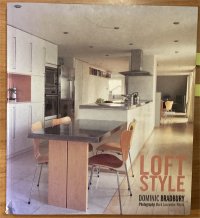
 I got this book in Sparta in 2024 with a couple of other loft interior design books. I read the others, Small Lofts and Minimalist Lofts, not long after I got them. This one, however, languished partially complete beside the reading chair for quite some time before I recently finished it as part of my drive to finish up (or reshelve) books that have been there for a long time.
It’s because it has a high copy-to-photo ratio. It has these chapters:
- the loft look
- space
- light
- materials
- color
- styling
- outside in
Yeah, not capitalized, because that’s stylish.
Each two-page spread has three photos, generally a larger one and two smaller ones, but a lot of gushy, purple, catalog-style prose. Each chapter has a “case study” which is slightly more specific, more of the same. Although the book did not depend upon the word liminal quite as much as the others.
So, to underline (as this book does), the loft style of the early 21st century (and maybe beyond) is to create open floor plan condos that look like Scandinavian museums with their light and neutral colors and simplistic furniture and art presentation (a limited number of things per room), objects chosen for how well they conform to the contempraneous concepts of style and nothing else. Architectural elements like floating steps which look like they might last a decade, but don’t most loft dwellers, especially those buying bespoke lofts like those depicted in books, make me wonder what they’ll be like in five or six years. To say nothing of twenty. But, again, I imagine lofts turn over a lot, and everyone who’s buying a pied-à-terre is going to pay designers and architects to redo it in their vision anyway.
You know, I prefer craftsman to almost lodge design, so for me, a loft has exposed brick and industrial elements but also thick wood accents and tend toward the dark colors. And as for décor, the chapter “styling” opens with:
The key to styling urban spaces is balance. Balance between personal treasures and cohesive, clear and contemporary home style. With our choice in furniture, fabrics, and a hundred other details, we stamp our personality upon a room, we make it ours.
I mean, if you cannot trust a philosophy described with a missing serial comma and a comma splice, what can you trust?
So much of interior design, it seems to me, is self-referential and artificial within the industry itself. Making spaces look like other spaces, with external indicators substituting appearance for meaning. Of course, when I look around Nogglestead, I see things and decorative items with meaning. Going along the mantel on the oversized brick fireplace in our family room, for example, we have a needlepoint girl which was a gift to my beautiful wife; a pair of replica dueling pistols which belonged to her uncle; her acryllic plaque for being on the park board; a shadowbox containing duck and goose calls belonging to her father; a time/thermometer/barometer bit which was a gift; the flag from my mother’s casket; the little crystal lamp I bought in 2018; the cartridges from the salute fired at my father-in-law’s funeral in a triangle flag shadow box; a scale that belonged to my sainted mother; a shadow box containing three garrison caps from my mother’s veterans organizations; a mirror which belonged to my favorite aunt; a marble chessboard that belonged to my grandfather and then my mother; a tin cat garden decoration I bought for my wife; two cat sculptures that belonged to my godmother aunt, including one I bought for her; a fireplace tool set which was decorative at my mother-in-law’s house but is functional (some times) at Nogglestead; and a porcelain cat sculpture I’ve named Darla which belonged to my favorite aunt. I look around the rooms, and I can tell you why the things are here. Some elements do not scream Brian J. did this–mostly gifts consumer art from my godmother aunt or chosen by my beautiful wife (although we have one set, down from two, of cheap consumer art I bought in my Ebaying days). So no balance between personal treasures. All personal treasures.
Should I someday have a loft, it will not look like this. It will look like Nogglestead but probably with a more open floor plan. And I will invent industrial lodge cluttercore.