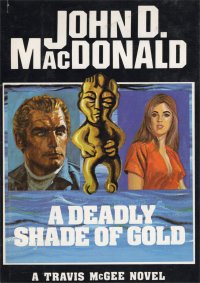
 I bought this from Hooked on Books in January. I remember when I first shopped at Hooked on Books, nearly thirty years ago, that they had a good selection of John D. MacDonald books, but then they didn’t. Since I had a gift certificate from Christmas, I stopped in and discovered that they once again had a good selection of MacDonald’s books. Perhaps the people who bought them twenty-some years ago are now downsizing or dying, and the same books are coming back in. Maybe I’m thinking too much of estate sales this last, apparently, year.
So: This is a 1960s Travis McGee novel. It originally appeared in paperback and then, a decade later, in this hardback edition when MacDonald books transitioned to the big time. A former friend of McGee, a boat bum who disappeared after walking out on a happy relationship, reappears and want’s McGee’s help in reconnecting with the woman he left behind, and McGee meets him, looking haggard and gaunt from a cross-country drive, at a remote motel where he shows McGee a gold statue and alludes to using it to set himself up. But when McGee returns after contacting the woman who wants to see the love of her life right now, they finds the man dead and the statue gone. So McGee and the woman head to Mexico to the town where the man worked during his missing years and find a despised Cuban exile (remember, gentle reader, that when this book came out, the Castro revolution was only a few years on–hard to fathom, since it’s been in place my whole lifetime, but old books and movies remember). Bloodshed, bombs, and much McGee musing, and he eventually breaks up a Hollywood blackmail ring which also preys on expats from Latin America, and finis!
I mean, it’s a lot more than that–the book is 336 hardback pages, which would have been quite a chonker for the paperback era. It’s full of the McGee-musings that give the books their depth–asides where MacDonald goes off on the modern era, the politicians, the culture, and the loss of the preceding era. You know, when I was in my teens, that sort of zeitgeist–you find it in early Parker, too, the 1970s stuff maybe up until the Hollywood era–the loss of something as subdivisions and development (in Florida or inland Massachussetts) encroaches on the wild spaces, and the politicians make things worse. You know, that probably hit me a little more precisely in that adolescent era where my parents divorced and I was removed to Missouri. Reading it now, it’s okay–I can see that MacDonald was an old-school liberal in his inclinations, a little more against big business corporate politicians and up-with-people in an era where the politics weren’t overt sucker-punches calling one half of the country troglodytes (who probably didn’t read books anyway).
MacDonald also sits in between Chandler and Parker in that the plot is labyrinth and shifts and that the resolution ultimately ends with a truce and understanding between the person who killed the boat bum and McGee because he, McGee, has just gotten tired of all the killing in the book. He’s weary in a way that they didn’t really capture at the end of the 20th century in protagonists, not really. The depth of the asides really layers that on.
So MacDonald is still really, really good, but I’m not so sure how I relate to Travis McGee now that I’m older. I might have transitioned to too old for the real figurative consanguinity. But I’ll think again about raiding Hooked on Books to make sure I have a good and completer set of MacDonald’s work.

1 thought on “Book Report: A Deadly Shade of Gold by John D. MacDonald (1965, 1974)”
Comments are closed.