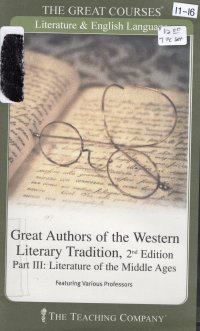
 I manufactured enough trips in the main vehicle to listen to this binder of CDs from the set I bought in 2024 and whose first two parts I listened to earlier this yeara>. As I mentioned, I am writing the reports on this particular course as I go because the whole series is 7 binders, 42 CDs, and 84 lectures in total–it might take me eight months or more to get through them.
This set is taught by Professor Thomas Noble and is subtitled “Literature of the Middle Ages”. Individual lectures include:
- Beowulf
- The Song of Roland
- El Cid
- Tristan and Isolt
- The Romance of the Rose<
- Dante Alighieri — Life and Works
- Dante Aligheieri — The Divine Comedy
- Petrarch
- Giovanni Boccaccio
- Sir Gawain and the Green Knight
- Geoffrey Chaucer — Life and Works
- Geoffrey Chaucer — The Canterbury Tales
So: I got a little more out of this than parts 1 and 2 because it did not overlap with so many of the other lecture series I’ve listened to. Of the source material, I’ve read Beowulf, parts of The Canterbury Tales and The Divine Comedy, Chaucer’s Troilus and Criseyde (mentioned in the Life and Works), and probably some Petrarch. Undoubtedly, I have more of the source material available–a good hardback reading copy of The Canterbury Tales which I bought in 2013 (?!) and some Classics Club editions. And the series wants to make me read them.
At any rate, a decent set of lectures covering the end of Roman times and leading into the 1400s or so. Although the next part of the set, already loaded in the truck, calls itself the Literature of the Renaissance, arguably this series covers the Italian Renaissance which came before the rest of the European Renaissance. Aren’t I clever to draw the distinction? Not clever enough to steep myself in these authors and time periods; just clever enough to read them.
An interesting listen, a lot of coverage of who’s influencing whom (apparently, everyone back then read The Consolation of Philosophy), and a good background biographic material when available as well as indentifying the limitations of the source material (fragmentary in some cases even into the end of the Middle Ages, but the number of extant copies of the works increases over time). It makes me feel smahter than listening to the 200 “Greatest hits of the 80s, 90s, and today” scattered over the radio stations here. And, as I mentioned, I have a couple boxes full of these courses, acquired cheaply at book sales over the years, and I need to get cracking on them if I want to get them out of the closet and onto the bookshelves dedicated to them. Maybe I will luck out and my next job will require a commute. To St. Louis or Kansas City every day. I did not say good luck.