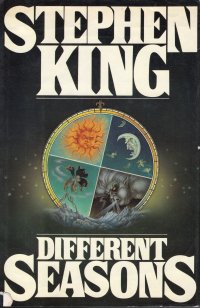
 The 2006 Winter Reading Challenge has a category “500+ Pages,” and, to be honest, I had a little trepidation about what I would find to fill that category. And here I had just been talking about my shelf of Stephen King which I might never get to. As it turns out, not only did I get to it, but we had a second copy of the book which had been in my son’s room for a time and then moved to the parlor when he cleaned his room a couple weeks or months ago. It was my mother-in-law’s copy, sans dust jacket, which she had loaned to my youngest when he was grounded from electronics, and he managed to make it through the first story and onto the second, but that’s when his grounding ended, and I’m not sure he has opened a book since.
So, the combinations of those factors, thinking recently about the Stephen King shelf, and talking about 11/23/63, which my mother-in-law enjoyed as a book and, as she has started watching the miniseries and is not enjoying it, and encountering a copy of this book led me to think of Stephen King for this category, and I checked some of the books. Early novels are not 500 pages; later novels are too much so. But, it turns out, this book weighs in at 527 including the self-indulgent afterward that some authors tack on.
As you might know, gentle reader, this book is a collection of three novellas and a short story which King had written in the gaps between his early successful novels Carrie, Salem’s Lot, Cujo, and The Shining (he’s about to write Christine according to the afterword, although the title is not given, but 44 years later, we know). Three of the four, all the novellas, were made into major motion pictures. This guy was a juggernaut in the late 1970s and 1980s, as hard as it might be to imagine now that he’s been around forever.
The book contains:
- “Rita Hayworth and the Shawshank Redemption” (made into The Shawshank Redemption, the biggest of the films or at least the one most fondly recollected) is about a banker, Andy Dufresne, who is convicted of murdering his wife even though he proclaims his innocence (he is, in fact, innocent). The story is told by Red, who is a long-time inmate at Shawshank Prison and is known for “getting things.” He gets Andy a rock hammer so he can continue his geology hobby, and the story covers decades of the lives of the inmates at Shawshank. One morning, they cannot find Andy and discover he has been tunneling from his cell to a wet wall for decades and has escaped to a new life with an alias he had set up before he went into the can. The coda finds Red paroled and on his way to meet Andy in Mexico. Haven’t you seen the film?
- “Apt Pupil” (made into Apt Pupil, appropriately enough) is set in the early 1970s. A middle school aged boy recognizes his neighbor as a superintendant of a concentration camp and wants to hear all about it. They end up mutually dependent and mutually blackmailing each other to keep the secret. I really didn’t like the story because the first half of it, 100 pages or so, is two evil people doing evil things. Finally, it starts to move in the second half, but King introduces sympathetic characters, but you know he’s going to slaughter them. Well, it turns out, not all of them, but for much of the book you really don’t have anyone to really sympathize with. Not the boy, not the war criminal, not even the boys’ self-involved and self-indulgent parents. The book ends with more implied bloodshed, not a real climax, really. Looks like the film changed it in significant ways–setting the story in the 1980s instead of the 1970s, but it should definitely have the macramé-decorated feel to it. The boy is changed to a high schooler in the film, and the end is apparently ambiguous and not as final. I haven’t seen the film; I haven’t had the urge to see it; and the written story has not made me want to.
- “The Body” (which became Stand By Me) tells about a group of boys who learn of a dead body and then hike and camp several days to see it. It’s sold as a coming of age story, but the double-effect narrator is a wealthy horror writer who is dissatisfied with his current state of writing by rote for money and who longs for those days again. I haven’t seen the movie in probably 30 years, but I wonder what they might have changed from it.
- “The Breathing Control Method” (not made into a movie) is a double story of sorts. A midling employee of a law firm is invited by a partner to a nondescript club with no obvious dues where the “members” tell stories. One Christmas Eve, a retired doctor tells of a case where a single mother carried her baby to term, but has an accident arriving at the hospital and she delivers the baby after her death.
So: I mean, the prose moves along, for sure. King wrote very frankly for the time about things that might have been shocking then, but then were not shocking, but now are prohibited. The stories are all set in the past, although I guess “Apt Pupil” was fairly recent past. He uses the word nigger and the word Republican both as perjoratives–I am pretty sure that all the stories have that, the baddest word, in them, although maybe “Apt Pupil” only uses the German equivalent. I don’t remember him using the word Democrat for anything, so I guess that was just normal to him even then. So the guy didn’t just start slagging on those who disagreed with him in the George W. Bush administration.
As I might have mentioned, I have a shelf full of King, and I’m not sure when I’ll be inclined to get to them. Maybe I’ll read one or two this year. Although if I get a hankering for thick tomes, maybe I should finish the second volume of The Story of Civilization (it’s been three years since I read the first, and at that pace it will take me almost as long to read it as it took the Durants to write it) or the Summa Theologiae which I received as a gift in 2021 and which I have not started, but it looks nice on my shelves. More likely, though, I might pick up Herodotus or Thucydides (he says, having just heard lectures on them, but the lecture series is long and I’ll likely want to read other books as well when I hear about them).
First, though, the Winter Reading Challenge. With this book, I have hit five, which is what you need to read to get the mug. But I must press onward in my quest for filling all fifteen categories.
I bought that back when I would automatically plunk down coin of the realm for anything King wrote. I’ve reread it since, and enjoyed everything but “Apt Pupil.”
I don’t know about “Apt Pupil”. I mean, it’s two bad people doing bad things. By the time the early 1980s rolled around, that sort of thing kind of appeared in pulp, but even then it wasn’t successful. Neither of them is an anti-hero or especially interesting. Maybe King was just noodling around with the themes or story type. It does really seem as though he changed direction in it after a while and then abruptly ended it when he wasn’t having fun with it.