 So for the In a Different Country category of the 2026 Winter Reading Challenge, when I was gathering prospective reads for the categories, I grabbed Nadine Gordimer’s July’s People, a literary novel elevating the bleks and putting white South Africans in their place which I read in college (in a copy I might have borrowed from the campus library as was my wont in those years) and later picked up in hardback. Undoubtedly, this is what the librarians wanted: a proper literary book with a proper literary message. Oh, but no. You get a Tarzan novel.
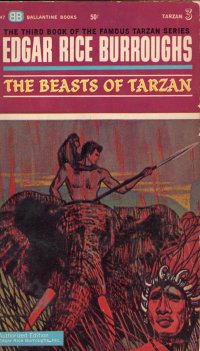
Not sure where I picked this copy up, but I do know that somehow I ended up with two copies of this book, both in the 1960s Ballantine printings with the hideous 60s covers. And I’ve been reading the Tarzan books out of order, apparently; I read both Tarzan of the Apes and The Return of Tarzan, the first two books in the series, in 2009 and Tarzan, Lord of the Jungle, the 11th book in the series, last year. This is the third book, but I probably did not have it when I read the other two books–although without its (or their, considering I bought two copies probably at different times), perhaps I did but it was shuffled in the move. Certainly, in those days, the Nogglestead library was not quite as double-stuffed and unkempt as it is now.
So, after quickly reviewing the previous book reports, I guess this is a pretty stock Tarzan plot. Something connives to get Tarzan to Africa, where wild things happen. In this case, Russian nemesis, presumably from the last book, escapes prison, links up with a colleague and some unsavory fellows, and they kidnap Tarzan’s son and tell Tarzan they’re going to have him raised by a tribe of cannibals. They connive to get Tarzan, too, and they do. And! As a bonus, Jane follows Tarzan to an unsavory meeting and they get the drop on her, too. So they strand Tarzan on an island not far off the coast of Africa which allows Tarzan to gather a troupe of apes and one panther to cross to the mainland and begin the chase.
So a series of set encounters occur, and Tarzan twice decided to sleep in the village of hostile natives, allowing the bad guys to get the jump on him. The book shifts perspectives from Tarzan to that of Jane and/or the bad guys, sometimes shifting into the past to catch up with one group or another, but allowing to end a chapter and section on a cliffhanger to be resolved a couple of chapters later.
So it’s an okay piece of pulp, and, again, an enduring character–this edition came out fifty years after the original, and I’m reading it over a hundred years after it was published. So it’s got that going for it, which is nice. Also, for something coming out at the turn of the 20th century, one (educated in the very end of the last century or beginning of this one) would think it all racism and misogyny, but although Jane is sometimes helpless when overpowered by stronger males, she definitely is not a docile character. And some of the African natives are bad, but some are good. You know, a little like real life. So the pulp of 1914 is more realistic and treats people more akin to people rather than message-conveying ciphers that you get in some modern cartoonish depictions. But that’s why I read the old books.