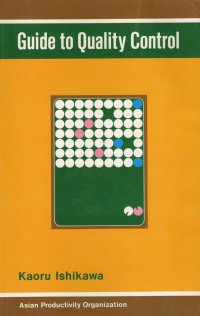
 For the 2026 Winter Reading Challenge‘s “Translated” category, gentle reader, you might have expected me to pick up a martial arts book of some sort as that is my wont. But, ah! My translated martial arts books are getting a little thin, and the adjacent material that I have is pretty deep and dense for the final charge through the winter reading challenge. So I decided to pick up a Japanese manufacturing quality textbook from the 1970s!
So that’s what this is: It’s a manufacturing quality book, which means that its focus is on testing lots or examples of repeated machine work or chemical work. And it was designed as a textbook: It’s for quality circles, which were little afterhours learning groups at Japanese factories at the time when they were about to surpass the United States in reputation for quality. It relies on a lot of data collection and statistical analysis to look for places to improve. Which is not like software quality assurance at all.
I’ll be honest, though: I only skimmed a lot of the formulae within the book, and I did not diligently, as the book recommends, work through them to fully grok how to do the different analyses. The first half of the book is the explanation of the different types of analysis and, mostly, how to present the information in graphs and charts to make useful decisions based on the bars, lines, and points and figures. The second half is practice problems which the book recommended you work out individually or in your study group. I guess, in the 21st century, the next step (not depicted here, of course) would be to get a certificate of completion or other certification (and spend a lot of money to take the test, if not to take the training as well). I rather only scanned the problems to refresh the concepts in them. So did I really read this book? It took me several nights despite not working out what the square root of the x with the bar over it divided by pN means.
You know, I sometimes “work” in the software quality assurance field, and there was some effort to make SQA more like physical quality control a long time ago. I was even a member of the American Society for Quality (ASQ) around the turn of the century, and the bulk of the magazine was like this–and they had a cartoon called Mr. Pareto-head. Well, this book helped to cement what that diagram really is–a bar chart with the values in descending order with a line chart atop it which shows those values as they add up to total percentage as you move to the right. Also, I learned a bit about the different types of charts, about the Ishikawa fishbone cause-and-effect diagram (named after the book’s author sometime perhaps between the first edition and this, a translated multi-printing American edition). But, really, the most directly applicable (sideways) chapter is the one on samples and sampling techniques because that could be an interesting way to describe/conceive of sets and subsets of tests to run.
At any rate, it closed out the fifteen categories for the Winter Reading Challenge, so I am eligible for a mug when I can be arsed to get up to a library branch for it in the next week.
And now you’re wondering if this will be the year where Brian J. works on reading all the quality assurance textbooks which he has accumulated over the course of the 21st century. Or even merely another. Prediction markets are leaning toward no.