Book Report: Timeless Places: Paris by Judith Mahoney Pasternak (2000)

Book coverI borrowed this book from the library specifically for browsing during football games; I started the Sunday night when the Packers played the Giants, but I did not end up watching a lot of football that evening, so it was later that I returned to the book and finished it off during the Eagles-Cowboys game before halftime.

It’s a picture book featuring scenes from Paris. The first bit of text in the book talks about, at a high level, the history of the city from the times of the Parisii through Roman times to the modern day. It covers the famous artists who lived there, and I can’t help note that it puts more paragraphs on homosexuals (Gertrude Stein, Oscar Wilde, Rimbaud) than on individual heterosexuals. F. Scott Fitzgerald, for example, gets a passing mention in a comma-separated list of people. Perhaps it’s only to emphasize the open, accepting culture of Paris. I dunno. But I noticed it because the culture wars have really made me sensitive to it.

At any rate, I don’t know what to say about the photographs themselves. Paris has a lot of things to depict, so I get the sense one could take meaningful and appealing photographs of Paris if one dropped one’s camera periodically.

Still, the text of the book provided me with some insight into the history of the city and the images were pleasing. So the book was educational as well as useful in my annual march toward 100 books. Which I will not hit this year, but there’s always next year.

Books mentioned in this review:

Buy My Books!
Buy John Donnelly's Gold Buy The Courtship of Barbara Holt Buy Coffee House Memories

Book Report: Genghis Khan and the Mongol Conquests 1190-1340 by Stephen Turnbull (2003)

Book coverThis book is a brief (fewer than 100 pages) military history of the Mongols, starting with Genghis Khan. It’s part of a series of short, topical books by Osprey Publishing that look pretty interesting; I’d look for them myself at book fairs, but I recognize that these days, I’m just sniffing among the trash left by Internet-device-enabled book dealers who will find these things before I do and will try to then sell them to me at more than $1 each. Look down there at the price of this one, for crying out loud. It’s almost enough to make me consider not returning this book to the library (but I did).

At any rate, it focuses more on the military conquests of the Mongols starting with the consolidation of their central Asian power base and continuing through their campaigns in Europe, the Middle East, China, and Southwest Asia. Its focus, as I might have mentioned, is on the military strategies and tactics of the Mongols, and the focus really, er, focuses on how brutal they were. This slender volume does not have any of the leavening effect of their administration, religious tolerance, and other homer bits that run throughout Genghis Khan and the Making of the Modern World.

Still, it’s a quick read, with lots of images and maps helping to fill the pages. So it’s more like a long encyclopedia entry than a scholarly book. But a good read and a good primer. Man, I’ll have to seek out some more of these Ospery books.

Books mentioned in this review:

Buy My Books!
Buy John Donnelly's Gold Buy The Courtship of Barbara Holt Buy Coffee House Memories

Paperback Readers

I’ve added a couple bits to the sidebar for pulp fans like me. Well, it is for me, since I’ll be using them, but they’re good reads for paperback lovers:

That ought to hold you between my silly little book reports.

Buy My Books!
Buy John Donnelly's Gold Buy The Courtship of Barbara Holt Buy Coffee House Memories

Book Report: Winter Has Lasted Too Long by James Kavanaugh (1977)

Book cover Given the tone and type of look of this book, one can’t help but think of Rod McKuen. In tone, both are about aging poets in love with their own poetry and their role as poets, both talk about relationships coming and going and the heady starts of them and the different ways the relationships end, many of them with disappointment.

But, interestingly, Kavanaugh has a different background than McKuen: He was a priest who wrote a 1967 book about how the Church should change in all the ways that they say now that the Republican Party should change. In a speech at Notre Dame, he tore off his clerical collar and stomped on it and became, ten years later, the poet that he is in this book. His interest in marriage didn’t end with one wife, apparently, and one assumes he had other women between them. (According to his bio at the James Kavanaugh Institute.)

At any rate, the tone of the poems, as I said, are of an aging man in the middle of his life, dealing with the knowledge that he’s no longer young but not yet old. The poems have moments where they connect with men of a certain age (and had an audience in the middle 1970s, where the sweaters and the poetry books were an outward sign of coolness even in early middle age), but (as my beautiful wife pointed out), they aren’t very poetic. The verses do not contain a lot of evocative imagery drawing out the theme and conclusions. It’s philosophical musings with line breaks.

So there you go: It’s like McKuenesque poetry with a more dramatic poet backstory. There might be something in it for you, but the moments are just moments amid a whole book of sometimes repetitive sentiments. Which is what you get with any book of work by any single poet, even Edna St. Vincent Millay or Robert Frost.

Books mentioned in this review:

Buy My Books!
Buy John Donnelly's Gold Buy The Courtship of Barbara Holt Buy Coffee House Memories

Book Report: Monster From Out of Time by Frank Belknap Long (1970)

Book coverOne of the 1000+ page books I’m working on this year to which I constantly refer is the Complete Works of H.P. Lovecraft. Man, I hit “Dream-Quest of Unknown Kadath” and bog down every time, which is why I have not ever read that story before and why I keep putting the volume of Lovecraft down. So in the interreadnum, I picked up this book by Frank Belknap Long because I know he’s associated with Lovecraft, it even has the title like something Lovecraft would have written.

The story is about two scientists and their significant others in Mexico, both of whom encounter a strange beast that arises from the Earth, and suddenly they’re transported to an icy plain. They have to learn to deal with their predicament.

And they do, wordily.

The writing style is the worst of Lovecraft, with a lot of verbiage that throws the pacing off. Working against Long, he writes in the contemporary lingo so the discourse lacks some of the delicious archaism that works in Lovecraft, and some of that wordiness lies in philosophical chit-chat that’s preposterously placed. For example, when one couple comes to their senses on a frozen plain, they talk about whether it would be okay to kill the stranger in the distance for his clothing if he turned violent and did not want to help strangers. They discussed this for several minutes before realizing that they were, in fact, dressed for the Mexican jungle on a frozen plain.

So it’s a short book, more akin to the juvie science fiction work of the 1950s than to actual Lovecraftian horror. The scientists team up, a little woman acts intemperately and gets kidnapped by the large-footed natives of the region, the scientists follow the trail and end up in an arena scene, and suddenly they are back to their own times. They speculate on the titular monster, who does not make an appearance after triggering their transport to the past, and the end. The monster is only the catalyst that leads to their ice age adventure, as it were. Which, I guess, is a bit Lovecraftian; it would not be otherwise if it were answered, bested, or understood.

So it’s a quick little read, probably interesting if you’re interested in a cross between juvie sci fi and Lovecraft that’s unbalanced toward the juvie sci-fi. It’s short enough for a one- or two-day read, too, but it does not lend itself well to continuing “The Dream-Quest of Unknown Kadath”.

Books mentioned in this review:

Buy My Books!
Buy John Donnelly's Gold Buy The Courtship of Barbara Holt Buy Coffee House Memories

Book Report: The Official Polish Joke Book / The Official Italian Joke Book edited by Larry Wilde (1973, 1980)

Book coverBook coverThis book is really just one book. It’s got a flip cover, where you look at the front and it’s the Polish side and you look at the back and it’s the Italian side. The pages with the corresponding ethnic jokes align with the cover, so halfway through the book, you get to flip it and start the other side. For the record, I only counted this as one book in my annual list.

Ah, me. Ethnic jokes. I remember when I was a child, during the era when this book was in print and, apparently, selling, hearing them. So I bought this collection this year, and it awaited the middle of the football season.

But the humor? Not really funny. I mean, it’s not that I’m offended (you can get the same joke without the offense by swapping out Italian and Polack with dunce or Goofus or whatever). It’s that the jokes just don’t move me. Of course, most joke books leave me cold (see also here, here, here, here, here. Why not add here? That just doesn’t make any sense.).

Which isn’t to say I won’t keep getting them and flipping through them. Because there might be a talking dog joke somewhere that I have not yet heard.

Books mentioned in this review:

Buy My Books!
Buy John Donnelly's Gold Buy The Courtship of Barbara Holt Buy Coffee House Memories

Book Report: Star Trek Speaks edited by Susan Sacket, Fred Goldstein, and Stan Goldstein (1979)

Book coverThis book comes from that great Star Trek dark age, a dark age that was about to lift: The time between the original series end and the motion pictures. I’ve remarked on that dark age before, but I can’t help but notice that we’re about to embark on another one, what with the last series ending in 2005 (that’s seven years already, old man) and the motion pictures probably thinning.

At any rate, this book collects a number of quotes from the original series categorized around a number of topics, from War and Peace to Love to Life and Death. Each section of quotes has a little intro pre-interpreting and hagiographatating the quotes for you, and there are many black and white stills from the series to hold you until the next time the show airs on a UHF station on Saturday afternoon. Or you can scrape together enough money to see them on the big screen. Your 1979 self probably cannot conceive of an 18-year span of television with new Star Trek every week (sorta) nor, probably, the end of manned space exploration. But how time will surprise you.

A cool bit of Star Trekiana. Something to browse during football. You probably won’t see much along the lines of this in print for the latter series, but that’s what the Internet (kinda imagined, but not acutely in 1979).

Books mentioned in this review:

Buy My Books!
Buy John Donnelly's Gold Buy The Courtship of Barbara Holt Buy Coffee House Memories

Book Report: Open Air Designs by John Drieman (1988)

Book coverThis book stems from what seems like the early days of decks. Maybe it marks a shift in my socioeconomic movement in the middle class, but I don’t remember many decks before the middle 1980s. Patios, sure, but not wood structures above it all. Well, some of the mobile homes in Siesta Manor Mobile Home Park had, instead of a simple set of steps leading to the doors, a couple of square feet with railing around them and storage underneath. Were these decks?

I digress. This book is a picture book for people who are thinking of renovating their yards at the end of the Reagan administration. It talks about considerations with construction, landscaping, and whatnot. It includes a couple of lightweight step-by-step guides. It’s not a guide to how to do the things within, like building a deck or a patio or a shed or installing outdoor lighting, but the guide provides high-level design considerations, photos, material choices, and such and just enough how-to information that you can get a bit of an inkling of what you might be getting into if you decide to do it yourself.

In addition to the deck revolution, the publishing industry might have moved away from books of this stripe–less detailed than your average Sunset book–and into more detailed how-to sorts of things, leaving the magazine market to the design inspiration ideas. Or maybe I don’t know because those books haven’t made their ways to the book fairs yet.

At any rate, a quick enough browse, but no source of inspiration for Nogglestead. Yet.

Books mentioned in this review:

Buy My Books!
Buy John Donnelly's Gold Buy The Courtship of Barbara Holt Buy Coffee House Memories

Book Report: Flashfire by Richard Stark (2000)

Book coverSure, read a Parker book earlier this year and another one this year, and suddenly I fancy myself some sort of Parker expert, capable of passing judgment on Parker books and the series or making sweeping statements about it. But it’s my blog, and I’m going to anyway.

This Parker seems a little less cold-blooded than the old ones.

The earlier book I read, The Handle, was published in the 1960s, and the series started then and ran until 1974. After that, it lay fallow until resuming in 1997, 25 years later, around the time the film Payback went into production. In the big screen film treatment, Parker has a relationship with a woman (not just a woman, but a woman who looks like Maria Bello), so maybe this book plays off of that, since Parker has a woman in it, too. Of course, I’ve read two Parker books from 36 years apart. Maybe at some point in the earlier novels he began his change and I’m late to the party.

At any rate, Parker gets stiffed in a job and tracks down the guys who took his money as seed money for a heist. This one takes place in Florida, so it brought to mind some of the John D. MacDonald work along with the Carl Hiaasen and the other Florida partisans. It occurs to me that Florida, as a location, matches LA, San Francisco, and New York City as far as the place that is consistently presented as a sort of character. Stark gets this one mostly right, although he talks about West Palm Beach as a lesser light than Palm Beach, and from what I remember in my visits, West Palm is kinda nice, too, relative to everything else. But I might be mistaken.

I almost started the second paragraph in a row with “At any rate….”, but I’m going to break that off. The book doesn’t hang together as a whole very well–some parts are episodic and detached from the main plot a bit, and Stark shifts viewpoints a bit to no great meaning to the story. He was dashing these books off against his other prodigious output. It’s still good enough reading. I’ll continue to keep my eye out for cheap Stark books.

Oh, and apparently this book has been turned into a Jason Statham movie, Parker, scheduled for release in January. Perhaps I’ll go see that. The fact that the film has the name Parker in it might indicate that sequels will be forthcoming. Donald Westlake (Richard Stark) had allowed film treatments of the books, but only if they changed the names unless they were going to make a film series. The fact that the movie is named Parker might mean sequels, or it just might be because Westlake passed away and his heirs are not so demanding.

Books mentioned in this review:

Buy My Books!
Buy John Donnelly's Gold Buy The Courtship of Barbara Holt Buy Coffee House Memories

Book Report: The Stained Glass Handbook edited by Viv Foster (2006)

Book coverThis book really is a handbook instead of a little crafting book. It starts out like a craft book, with a brief history of the art of working with glass, then moves into the tools used with making stained glass windows or painted glass art, and then it goes into a couple of projects with both stained glass and painted glass. Then it goes into a rich and detailed history of glass artistry from the medieval period all the way to the present, with the rises and fall of different techniques (and technologies), and it includes a couple of profiles of individual artists in their eras.

A fascinating introduction that gives you an idea of how to do it and a history of it. Academic and practical.

But not that tempting to me; I probably won’t do much in the way of stained glass in my lifetime (although painted glass apparently has proved to be something I tut-tutted when I read the books on it and then something I tried with mixed results).

On the other hand, I still maintain the lack of urge to do sand art. So it’s fifty-fifty at this point whether my home’s next transom will be a Noggle original. Okay, way less than that. But fifty-fifty that I would be crazy enough to try a transom.

Books mentioned in this review:

Buy My Books!
Buy John Donnelly's Gold Buy The Courtship of Barbara Holt Buy Coffee House Memories

Book Report: Meatballs by Joe Claro (1979)

Book coverThis book is a 1979 young adult novelization of the Bill Murray film. It’s quite mindbending, when you think about it. In 1979, Scholastic was publishing 91-page-long novelizations of screwball comedies. A couple decades later, Scholastic would publish weighty young adult fantasy novels that got translated into major motion pictures. A mind bender, huh? An who owns the copyright to the novelization of Meatballs? Haliburton Films. Well, probably not that Haliburton. More likely it’s related to Haliburton, Ontario. But that’s neither here nor there.

So what’s the book like? The movie, maybe. I haven’t seen the film yet. It’s a screwball comedy, with young men trying to attract members of the opposite sex and with a camp of lessers pitted against a camp of athletes and well-to-do. There are a couple set pieces and an uplifting plot of a young boy being taught how to be a better person by the whacky camp counselor portrayed by Bill Murray.

As a book, it’s a collection of disjointed scenes with little continuity between them. In a movie, which I suspect in the matter matches the novelization after a fashion, this works better with the visual comedy and such. But in a book, it’s very juxtaposed to the point of just being juxt.

So take that for what it’s worth. It’s not a bad read, I suppose, if you’re thirteen years old in 1982 and your parents have coughed up a buck and a half for the book club order and you don’t have cable or a Betamax to watch the actual movie (which was a real condition in 1982, and it explains why books like this exist). But the book holds up less well than the film, probably.

Books mentioned in this review:

Buy My Books!
Buy John Donnelly's Gold Buy The Courtship of Barbara Holt Buy Coffee House Memories

Wherein a Simple Mistake Shows The True Source of Brian J.’s “Classical” Education

So my wife and I are discussing female cat names the other night. It’s easy for me to come up with literary male cat names; all of history and literature is rife with them. But female cat names are a different story. I don’t know many female literary names with the same zing of male protagonists. I mean, who wants a cat named Warshawski?

So in a moment of inspiration, I turned to Norse and Celtic mythology. Brigit, I offer (leading to the inevitable discussion of how you pronounce Brigit). Boadicea, I say, undoubtedly pronouncing it wrong without any ensuing discussion. Lady Sif, I offer.

However: I characterize her as the Marvel Comics rendition, not the actual Norse rendition.

Which betrays the fact that I have not read a single edda in my life. Saga, either.

I really do try to punch above my intellectual weight, though, and I’ve got a pretty good façade going. Do you see the ç there? BECAUSE OUTWARD DEMONSTRATION OF LITERARY HIPSTERISM!

Strangely, though, although I’ve thought of it before, I did not bring the name Morgaine into the discussion.

Not because of the Mallory. Because of the literary Rosenbergism.

Buy My Books!
Buy John Donnelly's Gold Buy The Courtship of Barbara Holt Buy Coffee House Memories

Brian J. Noggle, Literary Hipster

I was having an imaginary conversation the other day, and I was slightly thunderstruck to discover something disquieting about me. Not that I spend a lot of time alone, and I run through a number of imaginary conversations in my head–I have known that about myself for some time. But something more sinister. Well, maybe not sinister, but certainly some adjective that needs to be italicized.

I was talking about classic British literature, and I was naming some my favorite books from various authors, and none of the books were widely known or collegiately studied classics.

Charles Dickens?
Cricket on the Hearth.

Thomas Hardy?
Under a Greenwood Tree.

Rudyard Kipling?
Puck of Pook’s Hill.

And suddenly, in my head, I’ve got horn-rimmed glasses on (with plain glass, natch), a striped sweater, maybe a scarf, and some ironic headgear (maybe a “contemporary” fedora (::spit::)), and I’m talking about how everyone loves A Tale of Two Cities or Kim.

I’m a literary hipster. Which is almost as bad as an academic.

Buy My Books!
Buy John Donnelly's Gold Buy The Courtship of Barbara Holt Buy Coffee House Memories

Book Report: A Hand to Hold, An Opinion to Ignore by Cathy Guisewite (1987, 1988)

Book coverThis book dates from the 1980s, so it is dated in some regards, but only in minor ways. Well, minor ways if lived through the 1980s. No one uses a computer or a cell phone, for example. Cell phone? Geez, even that’s dated; I’m the only one in the world except Jitterbug customers still carrying around anything but a smart phone these days. My poor children have no diversion when we’re waiting somewhere except for horning in on other children whose parents have provided them with a digital pacifier. But I digress.

Some of you might remember this strip, which ran for 34 years in the newspaper (geez, that’s dated, too). It dealt with an 80s career woman who was perpetually on a diet, sort of involved with a lightly stereotyped 80s man named Irving, and dealing with older, traditional parents who did not get her at all.

The material seems to hold up well; although I’m not a career woman, I have seen some struggle with the same issues that Cathy makes light of. Except they have cellular phones now, sorry, smart phones, and computers. It’ll probably hold up a little better than, say, Dilbert, which depends on technology and on surreal humor that will be about as funny and relevant as Bloom County remains today. Sorry, Scott Adams, but there it is. Cathy, like Calvin and Hobbes, comments on the human condition, not just the contemporary workplace or political landscape.

Books mentioned in this review:

Buy My Books!
Buy John Donnelly's Gold Buy The Courtship of Barbara Holt Buy Coffee House Memories

Good Book Hunting, October 12, 2012: Friends of the Christian County Library Book Fair Preview Night

On Friday, my beautiful wife and I went to the members-only preview night of the Friends of the Library book fair in Ozark, Missouri. We’ve been off-and-on members since we’ve been down here, but this is the first time we’ve deployed our membership to get a look at the books before the general public could. Well, the general public could pick through the books and pay a $5 premium at the end to join if they needed to, but that’s neither here nor there.

It was a little crowded at a little after 8pm when we got there. The main library was closed, and the book sale was a little bit of light in a sea of darkness. It was just crowded enough and we were on short enough time before picking our children up that I didn’t tip into the buying frenzy I sometimes get into, but I got a few books.

Friends of the Christian County Library book fair, October 12, 2012

I got:

  • Several films on both DVD and VHS. Given that I watch six new movies a year, these should hold me a while, especially coupled with the others I’ve stocked up over the last couple of years. And yet sometimes when I want to watch something, I don’t have anything that jumps out right at that moment.
     
  • Science, Numbers, and I by Isaac Asimov. One of his short nonfiction books. I like them, although I haven’t read one in a while. So how much can I say I actually like them, then? I dunno.
     
  • Spectrum II, a collection of sci-fi short stories.
     
  • Monster from Out of Time, a book whose title sounds an awful lot like a Lovecraft story. I haven’t checked up yet, but I think Long was in that milieiu.
     
  • Knight of the Scimitar, a novel about the Crusades. Given its age, it probably has a clear-cut moral idea.
     
  • The Broken Snare, an ex-Library book about someone building a ranch in the Canadian Rockies.
     
  • One of William Shatner’s many autobiographies. Internet, how come no one has done a parody of the theme from Shaft called “Shat”?
     
  • Richard Marcinko’s guide to success. As you might remember, I read his autobiography Rogue Warrior in March.

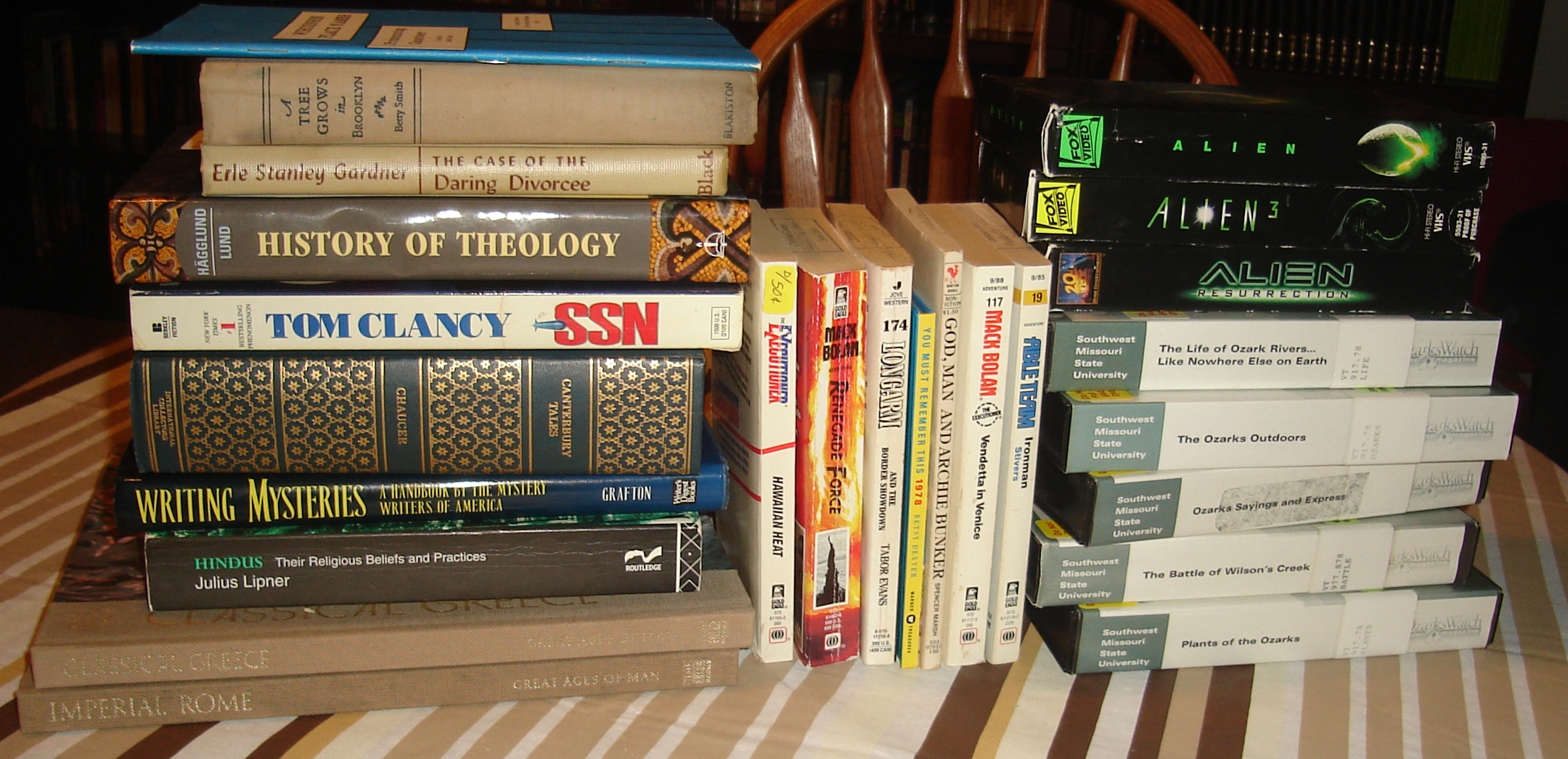
I was a little disappointed that the sale didn’t have any Gold Eagle pulp paperbacks; I have found my first Executioner and SOBs titles at this sale in previous years. Also, one of other attendees was a twit scanning all the books with his smartphone to find what he could sell for more than a buck on Ebay, and I have a whole post’s worth of disdain for that behavior that I’ll have to get into later.

At any rate, I ended up with fewer books than I got at the Friends of the Clever Library book sale, but I did get a new FoL t-shirt in black. I’m also just about ready for the Friends of the Springfield-Greene County Library book fair coming up the penultimate week of the month. Since I’ll hit that one on half price day or bag day, I might end up straining my bookshelves again.

Buy My Books!
Buy John Donnelly's Gold Buy The Courtship of Barbara Holt Buy Coffee House Memories

Book Report: Dogbert’s Clues for the Clueless by Scott Adams (1993, 1996) and Shave the Whales by Scott Adams (1994, 1996)

Book cover Book coverThis book and this book are a couple of titles early in the Dilbert series (the years on them are 1993 and 1994 respectively). They predate Dilbert.com, okay? Scott Adams invites you to mail him or email him at his AOL.com email address. I was still in college when these cartoons were in the paper. Wow.

The first volume (actually, the third in the series) is centered on strips featuring Dogbert’s etiquette advice, and the second (fourth) is just a run of topical strips. As such, each book offers a certain continuity theme. They’re amusing, but they’re missing a number of the characters that have come to represent the Dilbert world. Wally doesn’t make many appearances (and he shows with a different name in one). The boss’s hair is not yet pointy. You know. If you’re steeped in the later Dilbert, this might be strange.

At any rate, amusing enough, but it’s a while before Adams reaches his stride and becomes part of the zeitgeist. Or maybe it’s a while before I’m working in the IT office environment and I recognize and share the geist. Since I’m out of that now, the cartoons might have lost a certain resonance. Or maybe it’s because they’re just not the peak of the Dilbert world.

At any rate, worth reviewing if you’re into Dilbert.

Books mentioned in this review:
 

Buy My Books!
Buy John Donnelly's Gold Buy The Courtship of Barbara Holt Buy Coffee House Memories

Book Report: “Sad Victory” by Jan Christensen (2004)

Book coverThis book is a short story chapbook published and, I presume, distributed to promote Christensen’s 2004 novel Sara’s Search.

This particular volume, if you can call it that, is 14 pages long and first appeared in a 2000 anthology of some sort. It’s a British-style mystery, with a rich great aunt whose sister recently fell down the stairs pretty sure that her great neice and great nephew are about to marry two ne’er-do-wells only looking for the future inheritance. So she gets them to tell their fiances (fiance and fiancee) that they’ve been disinherited, and sure enough, the two scram. The great aunt then tells the two about her suspicions regarding the death of her sister and leaves instructions as to her will if she should die suddenly, which leads to her sad victory.

Hey, it’s a British style story, with tea and domestic help. If you like that sort of thing, it’s your bag. It’s the sort of thing you read a couple of in any given month of Alfred Hitchcock’s Mystery Magazine or whatnot.

But it counts as a book, because as I mentioned, I’m trying to make the annual hundred while reading, slowly, through 1000+ page books (and 450 page books).

Buy My Books!
Buy John Donnelly's Gold Buy The Courtship of Barbara Holt Buy Coffee House Memories

Book Report: Paladins by Joel Rosenberg (2004)

Book coverOn July 24, sometime commenter A. Rothman friended me on Facebook, prompting me to comment “Brian J. Noggle got friended by a Minneapolis concealed carry instructor. Noggle feels compelled to read a Joel Rosenberg book now.” This book is the one that sprang into my hand. Which means it took me several months to read it. Wow.

The conceit is this: Magic exists, and Mordred defeated Arthur. Hundreds of years later, the British crown is in a power struggle with the Dar al Islam and another empire whose provenance I’ve forgotten. Priest warriors for the crown carry swords imbued with the souls of either saints (white swords) or very evil men (red swords). Apparently, the swords were made in ancient times and are the magic that has created them has been forgotten or driven from history. But in the Eastern Mediterranean, where the three empires clash, a new red sword has been found. Two active members of the holy order, the paladins of the title, bring a former member of the order, their former mentor, out of retirement to investigate. Their former mentor recruits and deputizes a local fisherman–fisherboy really–to their order and gives him the sword, which has been infused with the soul of a baby (but somehow, this becomes a red sword). The young paladin and the mentor depart to investigate on their own, leading the other paladins, including a conflicted paladin bearing a red sword carrying the soul of Genghis Khan, to follow them.

So it’s a very rich book, and it clock in at 450+ pages, so there’s plenty of room to spread the wealth and depth. We have well-rounded Marines and side adventures in taking a pirate ship. We have a little battle with darklings, the nature of which is unclear (and whose presence is remarkable, according to the characters, but is not resolved). We have an aging Navy man in port duty intriguing within the Navy and with the enemies of the crown. We have hints and some details about the past, why the mentor left the order, some history regarding the other members of the order, and, as I said, a lot of depth.

Which is then lost on the plot.

The story of the new live red sword runs through it, but the ulimate resolution takes place suddenly by comparison. I won’t spoil it for you because the book might be worth reading on its own–I’m a bit ambivalent because of the ultimate weakness of the plot or at least how the main plot is resolved–but the climax comes out of left field with some unheard of people working on their own plot unrelated to the things investigated, off and on, by the paladins for 350 pages. Then there’s a scene with the king at the end, a sort of Star Wars award ceremony, except R2 D2 doesn’t come back to life (although his return might have been foreshadowed).

There’s only one more book in this series, so I don’t know what Rosenberg had planned. Maybe a series of seven or eight which would have made more use of the deep background. I haven’t read the early books in the Guardians of the Flame series, so I don’t know if that’s how he did it with that series. Or maybe these books didn’t sell well enough to continue.

Jeez, it took me since July to read this, and it’s not even one of the big books I’m sorta reading.

Books mentioned in this review:

Buy My Books!
Buy John Donnelly's Gold Buy The Courtship of Barbara Holt Buy Coffee House Memories

Book Report: Rembrandt by Trewin Copplestone (?)

Book coverOf all the picture books I’ve been browsing lately, this book has a distinction: I actually started looking through this book last football season, and it remained on the side table, often-dusted, until I finished it this season.

This book, as its title might indicate, is a retrospective of Rembrandt’s work and a pretty detailed biography of the man. Too much text, almost, to read and keep one’s place while watching the intermittent plays of a football game. I learned a bit about Rembrandt’s rise and fall and the meaning of chiaroscuro. That might be the only thing I retain long term, but it’s enough.

Related story: I’ve had two copies of Rembrandt’s Man in a Gold Helmet in my life. The first I bought when I was in college with a freshmanly minted credit card. The Alumni Memorial Union had a print sale in it, and I wanted copies of Wyeth’s Christina’s World and Seurat’s A Sunday Afternoon on the Island of La Grande Jatte. Since it was three for $15 or $6 each, I picked a third. The third was Man in a Gold Helmet.

Sometime later, I divested myself of those prints, but I found a framed one inexpensive at a garage sale or an estate sale back when I was hitting them all the time. I bought it, and I hung it in Casinoport, and I hung it in Old Trees, and I hung it at Nogglestead. But when I was talking to my beautiful wife about the painting, I couldn’t remember where we’d hung it. The living room is rife with Renoir, the bedroom has a Monet (I’ve discovered recently it’s a Monet) and a couple of Hargroves, but I drew a blank on the Rembrandt. I didn’t know if we’d stored it or if we’d donated it, but I’ll be darned if I remembered it or could find it.

Until my wife and I were sitting in a chair together, a chair I don’t normally sit in, and I saw it: it is in the small hallway between our offices, a hallway that we rarely light. I pass by it several times a day, but I’d lost it there until such time as I was sitting somewhere I normally don’t and looked into that hallway.

So I still have it, and now that I have reviewed this book, I can definitively and with more authority say that it’s my favorite of Rembrandt’s work. Probably partly because of the history I have with it, but also probably because the affinity I have for it thematically and stylistically I would have had with it even if I’d seen it in the book for the first time.

So the book’s worth checking out. Rembrandt was a very interesting painter, and he lived a very interesting life.

Books mentioned in this review:

Buy My Books!
Buy John Donnelly's Gold Buy The Courtship of Barbara Holt Buy Coffee House Memories