Book Report: Shaman King #17 by Hiroyuki Takei (2008)

Book coverThis book is my very first manga, and this book report is my first chance to make the joke Manga but pawn in game of life, although it could probably have used more setup. I wonder if anyone else has ever made that joke before; however, in lieu of researching it (I mean, searching the Internet for the phrase), I’ll just accept my primacy.

Where was I? Oh, manga.

Well, this is the seventeenth volume in this particular story, so I’ve missed quite a bit. There’s a page of characters in the beginning and a couple of paragraphs of The Story So Far. So, the story: There’s a tournament of shamans in Japan. Every five years, they choose a shaman king, and there’s a tournament to see who it will be. There are a bunch of young sorcerors fighting each other to win; there are some alliances happening, and one of the boy’s father comes to teach something but first fights a couple of them. Then the bad guy allies of one come to fight the couple using dirty tricks. And then there’s a cliffhanger. To be continued in Shaman King #18. I think there are 36 in all.

This ain’t my bag, baby.

For starters, it was definitely odd to read from right to left. Undoubtedly, it is good for my brain to do strange things like that, but. Also, the influence of video games on the art and plots mean it’s full of interludes, combat, reflections on player stats (everyone goes on about one character’s 1,250,000 mana!), and panels that identify some power, attack, or spirit animal by putting it all in capitals amongst an explosion image. Also, the book contains numerable-but-why-count-that-high panels of character reaction shots where the startled characters say, “Huh?” I don’t know how many ways Japanese language has to convey this; maybe a bunch of subtle things have been simplified for English readers. Or maybe not. Maybe I’m not the target audience, either, since I’m not all about the comic art and gauge books on the words and plots. But I’m unimpressed.

I still have three or four of these to go through from my recent purchases, and I’ve been warned not to judge all manga from a single volume of some series, but I’m not that eager to jump into another one. Except they’re short, and I’ll be able to let my son look through them. So I’ll probably knock through the whole bunch by the end of the summer.

Books mentioned in this review:

Buy My Books!
Buy John Donnelly's Gold Buy The Courtship of Barbara Holt Buy Coffee House Memories

Book Report: Kickback by Ace Atkins (2015)

Book coverMy beautiful wife saw this book at the library and brought it home for me to read in a hurry, since it’s a new book and is only available for a week checkout. So I did.

Welp, the book is an Ace Atkins Spenser book, and he’s moving more into his style than merely imitating Parker’s here. In the book, Spenser works to investigate the relationship between a judge in a small Massachusetts town who sentences juveniles to a for-profit rehabilitaton facility and the for-profit company running it. Of course, the new mob is involved somehow, although I’m still unclear as to how.

My enjoyment of the book is probably diminished by how soon after the Travis McGee books it came.

Atkins’ style for these books, as I’ve mentioned, seems informed by television; the scenes are television-like scenes of scenery and dialog, and the ending of the book wraps the plot up with an explanatory resolution and then some things that might be woven into a future episode. Or not.

The writing also suffers from a couple other flaws:

  • The reliance on the italicized other point-of-view chapters. Instead of the criminal, though, we get a tangentally related unfolding story of not Spenser’s focal point on the island, but another youth sentenced to the facility for a crime we’re only sort of aware of. His story isn’t fully fleshed out, but it’s included because it gives the book a Youth In Jeopardy storyline so favored in Brandman’s Jesse Stone books and gives the book grounds for a cinematic but otherwise extraneous Spenser swoops in in the nick of time to rescue said youth.
     
  • Some extraneous wordage, including some repeated things. At the outset of the book, when Spenser’s in his office, there’s a touch of description and interaction with the mother of a teen sent to the institution, and there’s a sentence tacked on that says his Brooklyn Dodger hat and peacoat are hanging by the door. But the sentence is tacked onto an unrelated paragraph. Throughout, we’re told about his Dodgers hat and peacoat over and over. Aside from that, there’s a whole chapter of Spenser meeting someone at a textile museum that adds nothing to the story but does describe the museum in detail. It makes one wonder if the author researched it or visited it and had to throw that in to justify writing the trip off.
     
  • It lacks the depth of MacDonald’s writing, where the asides add some resonance and muse on the meaning of life aside from the crime story. To be fair to Ace Atkins, Parker’s writing started to skip over those flourishes around the time of his trips to California for the television series Spenser: For Hire.

Is it a good book? Is it a bad book? It’s a modern crime fiction book, and it’s probably not a bad example of the genre. But it’s nothing compared to the paperback originals from fifty years ago.

Books mentioned in this review:

Buy My Books!
Buy John Donnelly's Gold Buy The Courtship of Barbara Holt Buy Coffee House Memories

Book Report: A Tan and Sandy Silence and Two Other Great Mysteries by John D. MacDonald (1971?)

Book coverThis book collects three Travis McGee novels from the late 1960s into a single hardback edition. The originals, it should be noted, were in paperback. The three books are A Tan and Sandy Silence, The Long Lavender Look, and Bright Orange for the Shround.

In A Tan and Sandy Silence, McGee investigates the disappearance of an former lover after her husband comes looking for her upon The Busted Flush and tries to kill McGee. Travis discovers a disturbing financial plot, philandering, and a sociopathic French Canadian accountant involved in a land development scheme with the husband. The book also has a subplot about McGee contemplating retirement and marrying a wealthy widow. In The Long Lavender Look, McGee and Meyer find themselves framed for murder in a remote Florida county where they’re mistaken for murderers of a local hoodlum who just got released from prison after his last score. Locals, including some of the police, are on the hunt for the proceeds of the heist. In Bright Orange for the Shroud, a formerly well-to-do acquaintaince finds Travis and eventually tells of how his new wife involved him in a land development swindle that picked him clean. McGee tries to recover some of the money from the swindlers and finds a backwoods badman of which nightmares are made.

It’s been a long time since I’ve read a McGee book (actually, it’s only been four years since I read The Turquoise Lament). It seems like longer, though, because I tore through these in high school and have not made a concerted effort to re-read them since (unlike the Spenser series, which I last read through from start to finish about fifteen years ago–there were a lot fewer to get through fifteen years ago). So after a little taste of MacDonald with End of the Tiger and Other Stories, I picked up this collection I had standing around. And I’ve rediscovered how much I like this series.

There’s action and interesting plots that we discover along with McGee (remember when this was a thing–that the reader discovered the plot along with the protagonist instead of having the bad guys have their own chapters in italics so everything was clearer at the outset? Modern readers must lack patience, or authors fear the old people who still read books might die off before seeing their genius machinations at the end of the 400-page thriller). The books are at times a bit wordy, a bit musing, but the passages include digressions such as this from A Tan and Sandy Silence:

I went below, turned on a few lights, built a drink, ran a thumb down the stack of tapes, picked Eydie, and chunked her into the tape player and fixed volume.

Eydie has comforted me many times in periods of stress. She has the effortlessness of total professionalism. She is just so damned good that people have not been able to believe she is as good as she is. She’s been handed a lot of dull material, some of it so bad that even her best hasn’t been able to bring it to life. She’s been mishandled, booked into the right places at the wrong time, the wrong places at the right time. But she can do every style and do it a little better than the people who can’t do any other. Maybe a generation from now those old discs and tapes of Eydie will be the collectors’ joy, because she does it all true, does it all with pride, does it all with heart.

So I settled back and listened to her open her throat and let go, backed by Trio Los Panchos, Mexican love songs in flawless Mexican Spanish.

Twenty five years later, and I know what he’s talking about.

At any rate, the asides, philosophical musings, and bits of self doubt have more depth in them than the similar things you find in the Don Pendleton Executioner novels; given how Pendleton’s paperback originals came after MacDonald’s, I can’t help wonder if the former didn’t directly influence the latter.

I didn’t remember much from these books–the subplot from A Tan and Sandy Silence being the thing I remembered the most–I should really look back to this series and reread it for pleasure. Although I’ve got few of them on my to-read shelves, and I feel obligated for the most part to hit those before returning to books that I actually enjoy. So maybe I’ll get lucky and find some other omnibus editions in the book sales of Springfield sometime soon. Of course, I have plenty of other MacDonald paperbacks to read, and my recent experience has reiterated that they’re worth my while.

Books mentioned in this review:

Buy My Books!
Buy John Donnelly's Gold Buy The Courtship of Barbara Holt Buy Coffee House Memories

Book Report: Wilderness Trek by Zane Grey (1944)

Book coverI was talking to a friend of mine, and he mentioned that he was reading a Zane Grey western. It’d been a while since I read one (December 2011 to be exact), so I picked up this book.

The book takes place in Australia; two cowboy friends hire on as drovers for a man who is part of a large expedition designed to drive several thousand head of cattle from several “stations” (ranches) across the Australian outback. However, during the course of the trip, one of the two vies for the affection of a lovely young lady with a suspicious drover who has cattle-rustling designs on some of the docile Australian cattle.

The book is 304 pages long, and it feels every one of them. The descriptions are lush, and the action is slow to start as the characters, the relationships, and the courtships begin. Strangely, the confrontation and gunfight with the bad guys takes place at about page 200, which leaves 100 pages of wondering what’s coming next. As it stands, natural disaster and natives provide the set pieces between then and the successful arrival a continent away and the promises of marriage that follow. As my friend says, Western novels are just romance novels with horses and gunplay.

The book isn’t paced as fast as I prefer, and it’s not my bag (although it’s more my bag than, say, the Gunsmith series). Still, the Australian setting triggered my rewatching of Quigley Down Under and might have inspired the recent purchase of Crocodile Dundee. So it’s got that going for it.

Books mentioned in this review:

Buy My Books!
Buy John Donnelly's Gold Buy The Courtship of Barbara Holt Buy Coffee House Memories

Book Report: House on the Rock

Book coverThis book is a picture book sold at the House on the Rock to help you remember your visit. It does more than that, actually, as the photographers used lights in taking the pictures. You can actually see the rooms.

For those of you who haven’t seen it, the House on the Rock is a domicile of sorts built by a man atop a sandstone column starting in the 1950s. The original house stands atop the column, but over the decades between then and now, the fellow (Alex Jordan) and the people he picked to maintain the building have continued adding to it. So the flavor is something between (I would presume) the Winchester House and Hearst Castle. The original house is now surrounded by gardens, other buildings, and a museum dedicated to Alex Jordan, so it’s not clear to the casual visitor that the house is on a rock at all.

But back to this book: It’s a tourist hagiography of the facility and a bit of Alex Jordan, so don’t expect any depth or criticism. Instead, it goes on in marketingese about the various collections and oddities that the attaction houses, which is useful, since one should expect to be overwhelmed when visiting the place in person. It took us almost four hours to go through all the stuff at a pretty consistent pace throughout, without dithering or lingering on anything in particular.

The images in the book are brighter and clearer than the underlit interior of most of the actual House on the Rock itself which has a definite cave feel. Whether they do this to spotlight different things in each room or just to save money on lighting, I don’t know; however, the images are better than the real thing in the areas that they depict.

At any rate, it’s worth a look if you find the book at a book sale. It might not be worth the $20 they charge for it (shrinkwrapped, so you can’t see its contents until you’ve ponied up the dough) at the gift shop.

Buy My Books!
Buy John Donnelly's Gold Buy The Courtship of Barbara Holt Buy Coffee House Memories

Book Report: Old Trails and Duck Tales

Book coverThis book is a small booklet that recaps the tour of the Original Wisconsin Ducks in the Wisconsin Dells. I recently took this tour, so I know.

I was a little torn as to whether to count this as a book read or to write a book report on it, but I’ve done so for similar booklets offered by tourist attractions I’ve not visited (such as Thomas Jefferson’s Monticello), so I figured why not?

So the trails and tales are the same that you ride on if you tour with this particular flock of ducks (in Wisconsin Dells, there are many, many companies running tours with the Ducks, apparently). The tour talks a little about the Dells, about the history of the area (which includes a lost town of Newport), about the benefactor who donated land for the Wisconsin Ducks to tour on and the home her heirs still share, and about the flooding in 2008 that almost altered the artificial topography of Lake Delton and the Wisconsin River forever until a massive effort of man returned it to its “natural” original artificial existence.

The booklet is very lightweight and doesn’t delve much into the region or any of the historical anecdotes it covers, but it does serve its purpose of refreshing a visitor on the things he or she has seen. It might be a little fresher or novel for someone who hasn’t taken the tour; reading it without the experience of the ride and the guide’s patter as she recounted the stories from the book in order might make the book seem a little deeper (although the paragraphs in the book are slightly more detailed than the audio presentation, but not much) might give one more urge to learn more about the things herein. Or maybe not.

At any rate, it’s worth the quarter I’d pay for it in a book sale, and because I took the trip, it’s worth the fiver I paid for it on the duck.

Books mentioned in this review:

Buy My Books!
Buy John Donnelly's Gold Buy The Courtship of Barbara Holt Buy Coffee House Memories

Good Book Hunting: June 12, 2015 at St. Elizabeth Ann Seton Catholic Church

The Catholic church down on Republic Road had its annual garage sale this weekend, so I sneaked off on Friday afternoon to see if there was anything for me. I don’t know why, but I’ve been a little down on going to garage sales of late. In the past, I’ve found things I could use in crafts or around the house; I’ve found things to sell on eBay for a bit of walking around money; I’ve found things I collect myself, like old computers and electronics; and I’ve found books and music.

However, I’m not doing the crafts or the eBay much these days, and I’m stuffed to the rafters with books to read. You don’t find old electronics in garage sales these days, as they’ve already found their ways into collections by this point. And the household stuff available is generally ticky tack, and although I’ve been a bachelor and once had a cable spool covered with shag fabric as a central piece of furniture in my loving room, I’m entering the age of my life (that is, married a while) where I’m moving away from pressboard if I can. We’re even down to only two secondhand (garage sale, natch) Sauder printer stands as central pieces of furniture in our house. So the only thing I’m really interested in is maybe some music or records. But I’m still drawn to garage sales for old times’ sake and because, hey, who knows. But I favor the church sales because normal garage sales are rife with kids’ things and things young families want to get rid of. I’m not in a young family, so I don’t need what they have to offer.

At any rate, I did find something:

Among the books, we have:

  • A Norwegian-English dictionary, just in case I ever get to greet the members of a-ha in their native language.
     
  • Four books in Andre Norton’s Witchworld series in a box set.
     
  • A book of holiday jokes to scan during fall football games and then to pass onto the joke-loving children.
     
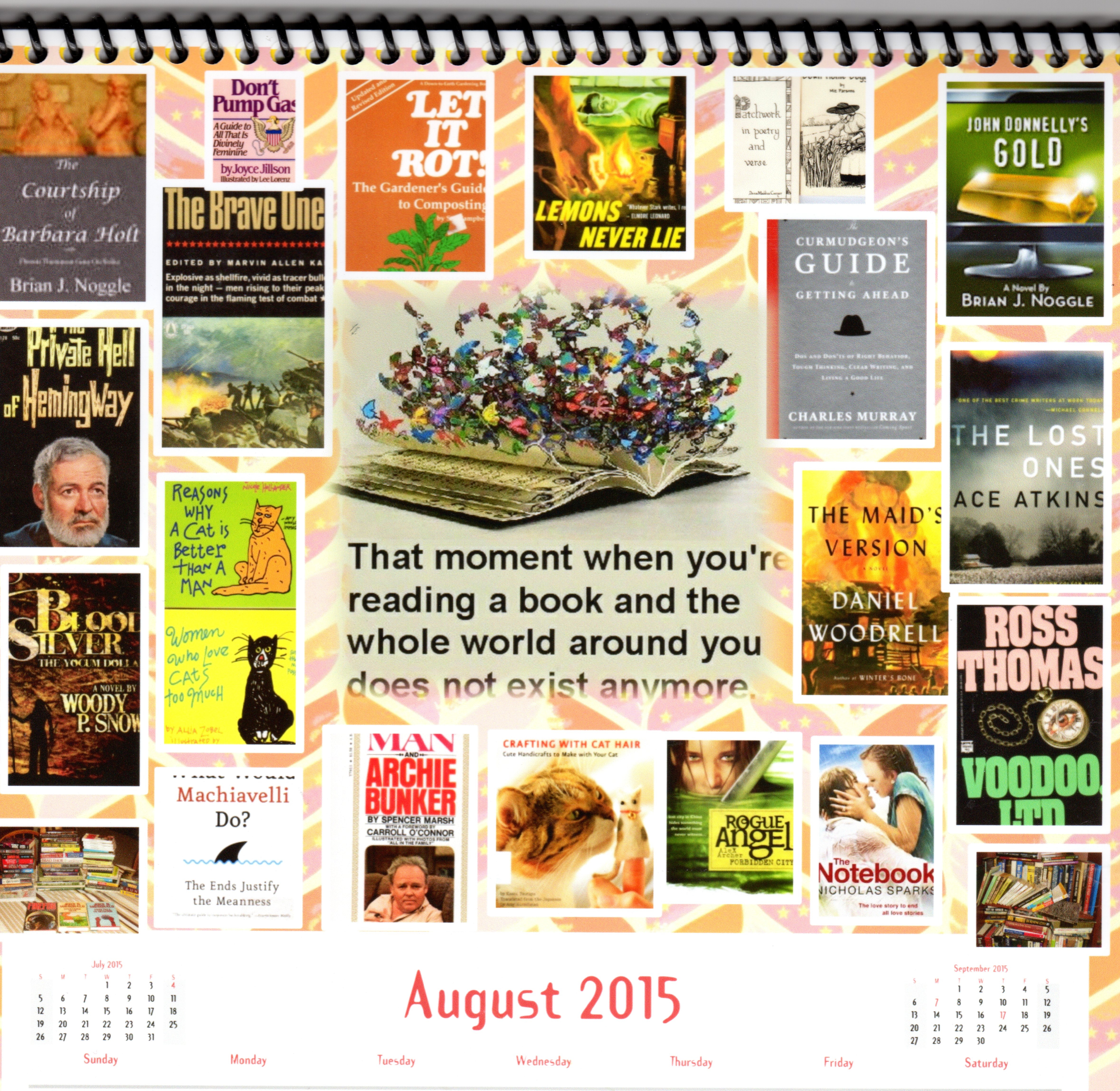
  • Two of the Richard Marcinko Rogue Warrior novels whose names I didn’t recognize.
     
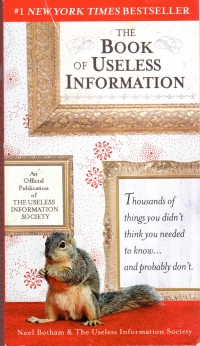
  • The Book of Useless Information, another to flip through between football plays on Sunday afternoons.
     
  • A couple books of manga. I don’t know anything about manga, even how to pronounce manga. I want to pronounce it with a j sound, like mangia, but that’s because I did an open mic night at a little restaurant called Mangia Italiana a couple times back in the day. I’m not sure whether to try it like mango (as Americans pronounce it) or mango (like it’s properly pronounced by Spanish speakers). Given that I spoke Japanese with a Spanish accent back when I tried to learn it from a text-based computer program and pronounced all transliterated Japanese words with Spanish phonemes, I’ll go with the latter until I embarrass myself and say it in front of someone who knows how it’s pronounced.
     
  • Mele Abbey a guidebook for a landmark of some sort to flip through during football games. Hey, it’s OTA time for the NFL. I have to prepare for the season, too.
     
  • The Road to Serfdom by Hayek. For fifty cents.

As to music, I got:

  • The Denver Brass, Misbehavin’ on CD.
     
  • The Best of Romance of The Spanish Guitar on CD.
     
  • The Dave Brubeck Trio, Time Out (1959) on vinyl.
     
  • Pearl Bailey, Saint Louis Blues on vinyl.
     
  • A 78 rpm picture record of Joan Edwards singing “More than You Know” and “Go West Young Man”. It lists on eBay for 40-80 dollars. W00t! And it sounds good.
     
  • A couple of Bing Crosby 78s. It’s the binder for songs from the film Going My Way, but of the 3 platters, only one is included, and its spindle hole is damaged and requires repair; another disc is “White Christmas”.
     
  • A 78 song and story book for “Little Toot”.

Additionally, I picked up two videocassettes: Crocodile Dundee and It’s the Great Pumpkin, Charlie Brown along with a book about drawing heroes that I’ve passed onto my children.

The total cost was $17.50. I was tempted to return today to buy the rest of the 78s for a buck (it’s a dollar for a bag at noon), but I’m resisting it.

Buy My Books!
Buy John Donnelly's Gold Buy The Courtship of Barbara Holt Buy Coffee House Memories

Book Report: End of the Tiger by John D. MacDonald (1966)

Book coverThis book is a collection of short stories MacDonald wrote for various slicks throughout the 1950s. Although some of them feature a crime, others do not, so they show the range of things MacDonald could make interesting.

The collection includes:

  • “Hangover”: As a man awakens from a night of overindulging at a corporate function, he remembers the events that led up to his firing and worse.
     
  • “The Big Blue”:An experienced fisherman regrets agreeing to sharing a charter boat with two companions, a blowhard and a weak young man who can’t shake the blowhard. Very similar to Hemingway’s “The Short Happy Life of Francis Macomber”.
     
  • “End of the Tiger”: The courtship of a coarse young man and a woman ends after his cruelty to the family’s chicken.
     
  • “The Trouble with Erica”: A business partner protects his young partner from a disastrous courtship with a woman prone to seduction by seducing her.
     
  • “Longshot”: A clerk at the horse track watches as another crooked clerk runs into trouble when betting out of the drawer.
     
  • “Looie Follows Me”: A young man in the country has his world turned upside down when his parents take in a troubled youth from the city for a couple of weeks.
     
  • “Blurred View”: A man who murdered his actress wife is caught when her film making friends recreate the murder in blurry photographs and pretend to blackmail him.
     
  • “The Loveliest Girl In The World”: A married middle-aged photographer breaks off contact when he gets to close to one of his models.
     
  • “Triangle”: A businessman encourages a female colleague with whom he’s too close to confess to his wife her attraction to him to convince his wife they’re not having an affair; this is to cover his actual affair with another woman.
     
  • “The Bear Trap”: A man on a road trip with his wife and children remembers his girlfriend from his youth who was killed by a bear in a cage.
     
  • “A Romantic Courtesy”: A rich rancher meets a woman he wooed in his youth who abandoned him for a man with prospects and an unhappy marriage.
     
  • “The Fast and Loose Money”: A pair of skimming angle-shooters are caught by their former commanding officer who is now a Treasury agent.
     
  • “The Straw Witch”: An assassin thinks of a folk tale told to him by a dying comrade a long time ago as a difficult assignment goes bad.
     
  • “The Trap of Solid Gold”: A young up-and-coming corporate man finds himself caught up in a vicious fiscal tailspin while trying to keep up the appearance of successful executive on the small salary he makes.
     
  • “Afternoon of the Hero”: A famous comedian, atop the world, reacts to a story about him in the media that says he’s very afraid by making light of it, hiding his actual fear.

The collection is very solid, and MacDonald makes the main characters in the stories very approachable. It’s been far too long since I’ve read MacDonald (2012? Really?), but it won’t be long until I read more. He’s a joy to read, and the length of his books don’t make you think about how long they are. He balances description, plot, and dialog better than most writers I can think of, and his stories–even his short stories–have pretty interesting plots.

Recommended.

Books mentioned in this review:

Buy My Books!
Buy John Donnelly's Gold Buy The Courtship of Barbara Holt Buy Coffee House Memories

Book Report: Mad About Town by the staff of Mad Magazine (1983)

Book coverThis book dates from 1976, but it was still in print seven years later. It collects Mad magazine bits from the early 1970s, including the send-up of All the President’s Men. As such, it might not relate well to today’s youth. I’ll have some first hand knowledge of this when my oldest boy absquatulates with this book.

I’ve moved out of the middle 1970s Mad demographic these days; while some things were amusing a bit, I only laughed out loud at two bits. One was about a boy who turned everything into a gun given a bat and a ball and told to go outside to play, and the boy promptly turns the bat into a gun (and, left unspoken, the ball into a grenade). I’ve got boys, and this is true. The second was about a man recounting an argument with his wife, and the punchline was very good indeed.

It’s a good reminder of how much most humor is rooted in its time, and how very little humor really hits upon the major themes of humanity that can extend across mere decades. But the best of it can do so without footnotes, and unfortunately, this book would probably need some if it were held up as a classic. As it is, it’s an amusing browse for an hour or so for old men like me.

Books mentioned in this review:

Buy My Books!
Buy John Donnelly's Gold Buy The Courtship of Barbara Holt Buy Coffee House Memories

Book Report: Poor Richard’s Almanack: Benjamin Franklin’s Best Sayings edited by Dean Walley (1967)

Book coverThis book was printed by a greeting card company (Hallmark) as a cheap gift you could pick up for someone as you were picking up the card. Pause a moment to reflect on the decline and fall of these sorts of books. From truisms, aphorisms, and self-helping little nuggets in the 1960s to feel-good and self-affirming poems to…. Do they even do these any more?

At any rate, this book collects some of Benjamin Franklin’s pithy sayings from his periodical and presents them with some period woodcut images. It’s a lot like reading a Twitter feed (or the meditations of Marcus Aurelius, for that matter). Some of the sayings are humorous descriptions of life, some are prescriptions for self-discipline and self-improvement, but all are worth reflection. It’s best not to try to read this as fast as you can–which is pretty fast indeed, as it’s sixty pages of three to five sayings per page–but instead to savor them, maybe even to read them aloud unless you’re in public (or perhaps even then).

Worth a look, and in book form, it’s more resonant than a collection you’d find on SmartyQuotes.com or whatnot.

Books mentioned in this review:

Buy My Books!
Buy John Donnelly's Gold Buy The Courtship of Barbara Holt Buy Coffee House Memories

Book Report: The Avengers #2: The Laugh Was On Lazarus by John Garforth (1967)

Book coverThis book did not have Iron Man in it. I guess Robert Downey, Jr., wanted too much to do it.

I guess not; this is the wrong The Avengers. This set is the 1960s British Secret Agents, mod 60s woman Emma Peel and staid John Steed. I’ve never seen the series, and I even missed the almost twenty year old film starring Uma Thurman and Ralph Fiennes, so I didn’t really know what to expect.

It’s a slightly silly, disjointed book. A biotech company can raise the dead, and there’s a priest, and zombie American servicemen who can remember how to fly a stolen plane to the Pentagon. Or to New York.

I don’t know what to make of the story, how it relates to the others in the series, or to the television program. The book has a lot of interior Steed attracted to Peel but unable to say, and I don’t know if this is something that showed up in the program or if it’s a bit of the author’s own invention, thinking that Steed would because what man is not hot for Diana Rigg in a cat suit? I’ve seen that sort of thing before in books, although I cannot recall in which television series or movie novelization book report I remarked on it.

At any rate, of the two period television shows whose tie-in books I’ve read recently, the Kung Fu books (here and here) are better.

But I’ve got a couple more from The Avengers; maybe they’ll grow on me since I’m not going into them cold.

Books mentioned in this review:

Buy My Books!
Buy John Donnelly's Gold Buy The Courtship of Barbara Holt Buy Coffee House Memories

Book Report: Renegade Agent by “Don Pendleton” (1982)

Book coverThis book is a tedious, wordy little side-scroller of a men’s adventure novel.

The plot is exceedingly similar to Paramilitary Plot mashed up with Terrorist Summit: An ex-CIA agent is looking to put together a super-network of extra-national intelligence professionals and arms smugglers to help fund terrorists. Bolan has to find him and to rescue a prisoner–in this case, Toby Ranger, a recurring character from the War on the Mafia days.

Unfortunately, in the worst entries in the series, the writing does little to mask how similar these plots were to one another. This entry is particularly week, as entire chapters are chewed up in the musings of Mack Bolan. Where Pendleton would thicken/leaven his stories with a bit of philosophy, later authors simply rehash what Pendleton did and use it as padding to hit word count. This book often features a chapter or two of the musing/exposition, a chapter of Stony Brook team members getting information and thinking about it and the danger Mack Bolan is in, and then a chapter (maybe) that’s an action set piece. Then it repeats. Sometimes, we get a couple extra chapters of philosophy thrown in.

Not worth a read unless you’re compelled to read books on your to-read shelf as I am.

Books mentioned in this review:

Buy My Books!
Buy John Donnelly's Gold Buy The Courtship of Barbara Holt Buy Coffee House Memories

A Bonus From This Was Cicero

As a bonus, This Was Cicero included a blow-in card for the Classics Club:

Click for full size

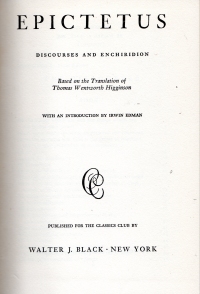
As you might know, gentle reader, I collect Classics Club editions (and a variety of other series published by Walter J. Black).

And although I’ve already invited the three fellows (Plato, Aristotle, and Marcus Aurelius) mentioned in the flyer into my home, I’ve only so far spent time with Marcus Aurelius.

Also, note in the flyer that the spines only say the name of the author; in reality, the spines also contain the titles. At least in the ones I’ve seen they do.

Buy My Books!
Buy John Donnelly's Gold Buy The Courtship of Barbara Holt Buy Coffee House Memories

Book Report: This Was Cicero by H. J. Haskell (1942)

Book coverThis book is nominally a biography of Marcus Tullius Cicero, but in reality, it’s a history of the fall of the Roman republic wherein Cicero sometimes makes appearances. I guess the author was working from a lot of Cicero’s letters (as do so many historians from Plutarch on), so he focused on Cicero. But there are huge stretches of the book where Cicero is not mentioned at all, including the first couple of chapters.

The author is a Marxist, of course. He refers often to the proletariat in Rome; he defends Catiline because Catiline was in favor of redistributing the wealth; he name-checks the poor oppressed Sacco and Vanzetti; he touches upon themes and books mentioned in Books That Changed America (namely, conservative opposition to public schools and The Influence of Sea Power Upon History, 1660-1783 by Alfred T. Mahan referring to either Pompey or Caesar’s understanding of naval transport of armies); and he often equates good with progressivism/Marxism and bad/corruption/know-nothing aristocracy with “conservatives.” But he’s an early twentieth century Marxist, so it’s lacking in the invective you get in later works.

As I mentioned, the author spends a lot of time talking about things other than Cicero, and he spends a lot of time equating the lives of Roman citizens in Cicero’s lifetime to different periods in history, including seventeenth century England and modern (~1940) America. The comparisons are probably too facile, especially when trying to equate the political groups of the period to modern equivalents (which boils down mostly to Tories/Republicans/Old Senate Factions = bad, Democrats/Redistributionists/Caesar and anyone shaking up the order to make it fairer for the proletariat = good). However:

This is still a pretty good book to read. It is pretty in-depth coverage of Roman history during Cicero’s lifetime, which includes the First Triumvirate and the Second Triumvirate and the Civil War from a different perspective than Julius Caesar. It’s the story of one man with hopes of a restoration of the Constitution that never comes and the slow, continued dissolution of the ideal of the Roman Republic from an ideal state that probably never existed to the seeds of empire based on strong, charismatic men with armies ruling.

It also provides a good deal of context for Cicero’s orations and his other works, including the historical details of why and when the pieces were written. Reading a collection of Cicero’s words will get you a little context, but this book fills in all the gaps.

The author does not paint a flattering picture of Cicero, though. The subject of the book, when he appears, is presented as vacillating, vain, vainglorious, and too much in love with his own oratory. Also, Cicero, in this book, seems to think his words alone could counter armed insurrections of various stripes. A tale with modern parallels.

I enjoyed the book and learned a bunch from it. It’s not without its flaws–politics aside, it does give the subject a bit of short shrift and it has a tendency to draw back from a point in time to provide historical context which gives the reader a bit of whiplash–but informative none the less.

Recommended.

Books mentioned in this review:

Buy My Books!
Buy John Donnelly's Gold Buy The Courtship of Barbara Holt Buy Coffee House Memories

I Guessed Better The Second Time Around

At OregonMuse’s prompting, I took the Christian Science Monitor‘s Famous Literary Detective Skills Quiz.

When I went through it the first time on my phone, I got a 73%, but when I went through it on my computer preparing this blog post, I got:

77%.

This indicates I guessed one better on the English detective novels on the computer. Note the mobile version of the quiz does not show you the right answers as you go along, which explains why I only did one better guessing the second time around instead of getting them all right to impress you, gentle reader.

Buy My Books!
Buy John Donnelly's Gold Buy The Courtship of Barbara Holt Buy Coffee House Memories

Good Book Hunting: Friends of the Springfield-Greene County Library, April 24, 2015

So I went about an hour early before my volunteer shift started at the Friends of the Springfield-Greene County Library book sale. When I went on Wednesday, I thought I’d bought a copy of Olivia Newton-John’s Olivia, but the platter inside the cover is If You Love Me, Let Me Know. So I’d hoped the donor had just misfiled them, and that I could find the cover for If You Love Me, Let Me Know with Olivia inside.

Alas, no.

I did buy additional albums, including Newton-John’s Come On Over. Eleven additional albums, which puts me at 42 for the week.

Here’s what I got:

Books include:

  • Poor Richard’s Alamanack, a collection of Ben Franklin’s best sayings from the periodical.
  • The Year 1000, a book about what normal life was like in Britain in 1000 AD.
  • The Stephen King Companion since I’ve started a 1000 page Stephen King book, naturally I expect I’ll want to read about Stephen King when I’m done with his novel.
  • The Red Badge of Courage in the Reader’s Digest edition. Not the condensed edition.
  • Three Classics Club titles, including Locke’s On Politics and Education, Bradford’s History of Plymouth, and Swift’s Gulliver’s Travels, of which I only needed the last.

I got three films:

  • Jackie Chan’s Rumble in the Bronx.
  • Wonder Boys starring Michael Douglas, Tobey Maguire, Katie Holmes, and some red boots.
  • Muppets From Space

Additionally, I got three sets of university courses on CD, including The Teaching Company’s Origins of Great Civilizations and Greece and Rome as well as The Modern Scholar’s A History of Ancient Israel. The Friends of the Springfield-Greene County Library book sale often has these courses pretty cheap, but the key is to pay attention to what each binder contains. This time out, they marked each binder $10, but some courses are in library binders, where only two discs of a course are in the binder and a whole course might have seven binders. That would be $70 versus $10.

So I’ve got a few things to read, a few things to watch, and a whole lot more to listen to. And I’ve avoided the siren song of half price day today and expect I’ll evade the siren song of bag day on Sunday.

Because, believe it or not, I am running out of places to put books here at Nogglestead. Until I build my stand-alone library building.

Buy My Books!
Buy John Donnelly's Gold Buy The Courtship of Barbara Holt Buy Coffee House Memories

Book Report: A City in the North by Marta Randall (1976)

Book coverThis book should fit right into my wheelhouse: An abandoned city of an advanced civilization lies on a planet inhabited by intelligent, but primitive, ape-like beings. A shipping magnate and his off and on again rival shipping company magnate wife arrive on the planet to steal into the restricted area to visit the city. On planet, they find a mostly impotent governor tending a native garden while members of the corporation running mining operations on the planet run most of the show. The corporation members look at the tourists as though they were agents trying to figure out the illegal scheme the corporation is running. The tourists get permission from the apes to visit the forbidden city, and as they hitch a ride on a transport car between the only two bases on the planet, they avoid an attack from the corporate killers and flee with the apes who are migrating north toward the forbidden city. The wife seems to be going native and the husband wonders if his obsession with viewing the city, sparked by a talk he saw when he was younger, is worth the cost.

The story uses multiple points of view shifting intrachapter (but with clear demarcations via heading–this is Toyon’s Journal, this is Alin’s journal, and so on), and it has a pretty slow buildup. The world is interesting and alien, but the reveals at the end are kinda blurted out by principals to the main characters, and then the climactic action takes place. It could have been handled better, but I was afraid the ending and the mysteries would disappoint me, but they did not–only the execution of the story did.

It really brings to the fore the theme of humans coming into a world and observing it for a limited time and how much of that world throughout the ages they might miss, creating a flawed understanding. A good theme for sure.

So give it a look if you get the chance to do so inexpensively.

Books mentioned in this review:

Buy My Books!
Buy John Donnelly's Gold Buy The Courtship of Barbara Holt Buy Coffee House Memories

Good Book Album Hunting: Friends of The Springfield-Greene County Library Book Sale, April 22, 2015

Today, I visited the Friends of the Springfield-Greene County Library Spring Book Sale for the first time. Over the last couple of years, I’ve adopted a staged approach to the book sale. First, I go for the albums, and then I go back and look over the books, preferably on half price or bag day.

So today I bought 31 record albums (at $1 each). I also got a couple books as I passed by the History and Poetry tables in the Value Books section.

Here they are:

I got:

  • Four albums by the Four Freshmen. I already had The Swingers and have hoped for the opportunity to expand the collection. This time out, I got Four Freshmen and Five Guitars, Freshman Favorites, In A Class By Themselves, and Fresh! which is from 1986 and is probably a new set of singers.
     
  • Linda Ronstadt’s What’s New which looks to be a collection of standards.
     
  • Pete Fountain’s Mood Indigo. I got a couple of Pete Fountain’s albums in the autumn, and I liked them well enough to look for more.
     
  • Mary McPartland Plays the Music of Billy Strayhorn
     
  • Ray Parker, Jr., The Other Woman
     
  • Yello, One Second featuring “Oh Yeah” (which also appears in Ferris Bueller’s Day Off. When my children were littler, I played this song for them a lot on YouTube. It will seem strangely familiar to them now when I play it on record.
     
  • Doc Severinson and the Sound of the 70s, Feel Good
     
  • An album of Gregorian Chant
     
  • The soundtrack to the film Xanadu to replace a copy I bought last autumn which skips.
     
  • Two other Olivia Newton-John albums, Don’t Stop Believin’ and something else because my beautiful wife has a lots of her albums. When I showed her the new ones and asked if she had them, she said no. Also, she doesn’t really like Olivia Newton-John.
     
  • Diana Schuur, Schuur Thing
     
  • Tito Rodriguez, Este Es Mi Mundo (This Is My World).
     
  • Jackie Gleason, How Sweet It Is For Lovers
     
  • A collection of television theme songs not by the original artists.
     
  • A bunch of classical stuff because it looks as though the college radio station was dumping a lot of classical records. It’s hard for me to pick amongst classical things, as I’m not sure what of the great composers we have or lack (aside from knowing we have a lot of Beethoven but no Fidelio).

This year, the Rat Pack and Herb Alpert were poorly represented; only The Dean Martin Show and a copy of What Now My Love were present. A lot of Olivia Newton-John, though, and a lot of Barbra Streisand.

I also got a couple of packs of poetry chapbooks (bundled together for a buck each), A History of Rome to 565 AD, and a collection of musings called Ginger Snaps.

So my bookshelves are not bulging much more from the purchase, but my record storage is now sadly lacking. I’ll have to invest in a nice record cabinet sometime to store them properly.

And I’ve discovered that I get a more acute sense of anticipation buying record albums than books. When I bring the records home and put them by the record player, I find myself inventing reasons to be in the parlor just so I can listen to another of the new platters. When I bring the books home, I’m often interested in reading them, but I no longer really get a I can’t wait! feeling. Because, as the years have proven, I often do wait.

Buy My Books!
Buy John Donnelly's Gold Buy The Courtship of Barbara Holt Buy Coffee House Memories

Book Report: Bloodsport by “Don Pendleton” (1982)

Book coverThis book finds Mack Bolan in Europe, where he is looking into the disappearance of a number of Olympic-caliber athletes, including a martial arts expert, a skier, a gymnast, and a fencer. Bolan infilitrate a West German terrorist splinter group to stop whatever plot is afoot and to rescue the hostages if they’re still alive.

The book was written less than ten years after the Munich attack in Germany, so its plot was almost based on real life events. The book runs smoothly from set piece to set piece, including the disruption of an arms deal and Bolan posing as a fugitive United States Army pilferer and dealer of stolen goods to infiltrate the terrorist organization. Unfortunately, its plot ultimately is too ripped from the headlines and the pacing again turns abrupt as the word count nears novel length.

Still, by pacing the books out a little more (although this is the thirteen Mack Bolan book I’ve read this year, it’s the only one in a month’s time), I enjoy them a little better as time smooths the disparities between the different authors. And I am reading these for enjoyment, not some project to educatedly discourse on men’s adventure fiction. Well, okay, I do have a goal of someday reading the set I received for my birthday a couple years back, but they’re enmeshed in the larger collection I’ve picked up since then. So they’re a Quixotic quest involved. But it’s still 80% enjoyment.

Books mentioned in this review:

Buy My Books!
Buy John Donnelly's Gold Buy The Courtship of Barbara Holt Buy Coffee House Memories