Courtesy of Vodkapundit:
The last time the NHL failed to award Lord Stanley’s Cup, it was due to a global flu epidemic that killed 20 million people. This time, millionaire owners and millionaire players can’t agree on a few contractural issue.
To be able to say "Noggle," you first must be able to say "Nah."
Courtesy of Vodkapundit:
The last time the NHL failed to award Lord Stanley’s Cup, it was due to a global flu epidemic that killed 20 million people. This time, millionaire owners and millionaire players can’t agree on a few contractural issue.
Buy My Books!
A special tip of the WTF hat to the advertising genius who centered the JC Penney’s Valentine’s Day ad campaign around the song “99 Luft Balloons“.
Buy My Books!
This is another book in the Elvis Cole series, and as with the last one, it’s moving quite to the series. Entire chapters and subplots do not relate back to the main plot of the book and carry on their own see-you-next-book cliff hangers. While my beautiful wife likes this sort of thing, I find that it bogs down the action.
But it’s a pretty good book, once more pitting Elvis Cole against organized crime. This time, a Russian mob wants a counterfeiter who’s disappeared and has left his kids looking for a private detective to find him. The Russians want to kill him, Elvis wants to return him to his happy home-in-flight, and Vietnamese revolutionaries want him for their own ends. So Elvis Cole has to dodge bullets, former Spetsnaz, and teenage crushes as he sets it as right as possible. When he can squeeze it in between being in love with the lawyer from the other LA and mooning over her.
So he does, eventually, and the final plot twist was obvious from early in the book. Perhaps I,the writer and the paranoia shidoshi, can sniff out a plot like this early, but I flatter myself. It was obvious. I explained it to my wife last night how it would end, and I was right.
Still, a cut above in writing and whatnot. I’ll continue the series, and not just because they’re on the bookshelf.
Buy My Books!
MfBJN: Your number one Yahoo! hit for:
brian looks like long term methamphetamine
Thank you, thank you. But I must confess, it’s only the two pots of flavored Gevalia Kaffe coffee I drink every day, not crystal meth.
Buy My Books!
End to Amtrak funding unpopular:
Wisconsin’s top transportation official Monday blasted President Bush’s budget proposal to eliminate all federal funding for Amtrak.
“I think it stinks,” state Transportation Secretary Frank Busalacchi said.
Who joins this apparatchik in bemoaning the loss of federal funding for a railway used by a few but employing many?
Similar comments came from Amtrak management, the National Association of Railroad Passengers and the United Transportation Union, which represents Amtrak conductors.
Oh, yeah, the cool kids.
A more accurate headline more likely would have been End to Amtrak funding met with general apathy by majority, but that hardly tells Journal-Sentinel readers what to think, ainna?
Buy My Books!
Neil Steinberg says today:
I never knew the name of the actor who played Dean Wormer in “Animal House” — John Vernon — until he died this week, at age 72. While the obituaries didn’t mention it, he uttered one of the great lines in movie history — “Fat, drunk and stupid is no way to go through life, son.” At least to those of us who struggle with all three.
Obviously, he does not read blogs every day; that line was mentioned in almost all of the blog memorials I read last week.
Steinberg, like many of other commentators, does Vernon disservice by not remembering Vernon’s role in Terminal Exposure and Sledge Hammer!.
A good fellow who looked a little too much like John Lithgow for true immortality.
Buy My Books!
I bought this book from the Bridgeton Trails branch of the St. Louis County Library for a quarter because I am a good Republicanesque fellow who remembers fondly the Contract with America and the disbelief of a Republican House of Representatives occurring for the first time in my lifetime.
The book collects and groups a number of contextless quotes and bon mots that Newt Gingrich said or wrote in any number of forums, including his own books. By his own admission, Gingrich decided early to run for Congress and to do whatever it took to put the Republicans in power. That admission makes the choice of quotes interesting. Gingrich defending Social Security and shrieking that Bill Clinton wanted to reform it. Newt saying on the same day that Panetta was a scoundrel and that Gingrich could work with him. Newt Gingrich in 1984 attacking someone juxtaposed with Newt Gingrich in 1994 loving that person. I agreed with Gingrich on some of his positions as neatly encapsulated in these sentences, but I disagreed with him on many points, including the politically expedient (at the time) defense of social security from a Chief Executive who would ravage it.
As such, the book doesn’t really build Gingrich up, but perhaps that’s not the point. The treatment’s even enough, and although it doesn’t leave me witha complete view of Gingrich’s thinking, it does make him more resemble a politician than a visionary.
But that’s what you’d expect from a book that’s just a collection of soundbites.
Buy My Books!
Listen, fellows, you won’t miss hockey if you go to Sports Juice, which carries Internet streams of many AHL hockey games, including those from the Milwaukee Admirals and the Worcester Ice Cats.
Because it amalgamates the streams from their sources, you get an interesting hodgepodge. For example, a Christian music station carries the Milwaukee Admirals, so you get the commercials and promos you would expect on a Christian station. The stream for the Worcester IceCats (formerly the farm team of the St. Louis Blues before the NHL collapsed) carries the live feed from the mics on the commentators instead of the radio feed, so you get to hear what the commentators say to each other during the breaks.
For example, tonight the commentator expressed belief that you would think the Missouri River Otters would be doing better than they are because of the players they have after reporting the signing of the former Blues defenseman Barret Jackman.
You know, we should cross the river to see a UHL game before the season is over….
Buy My Books!
When my beautiful wife and I were in the grocery store, a disparate pair of magazine headlines intruded upon the sane world in which we live:
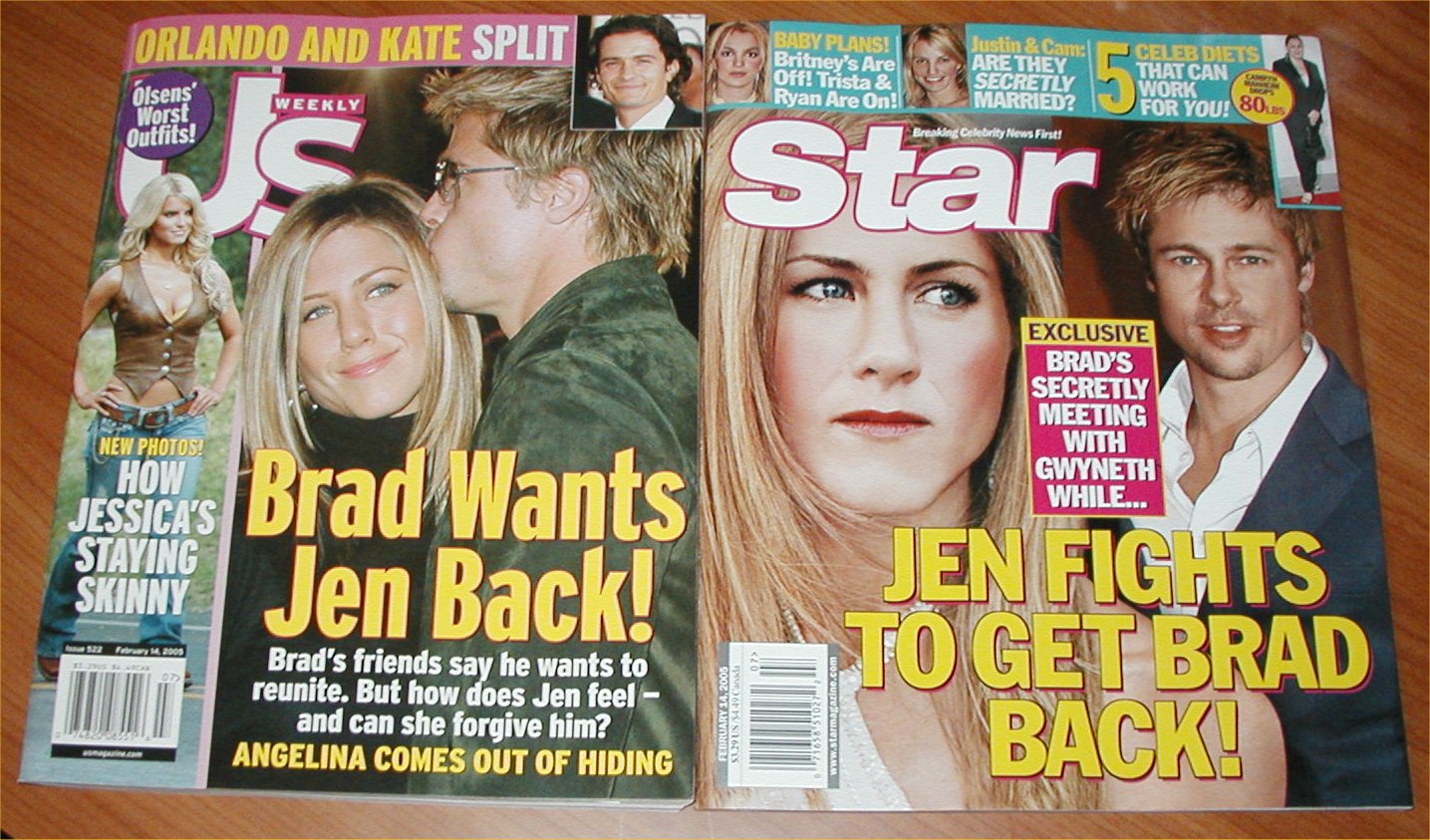
So Brad Wants Jen Back! and Jen Fights to Get Brad Back!? Yeeks, these are direct opposites by implication. Tabloids should be careful since their regular readers, who seem to care about the state of Bradnifer’s marriage, might suffer from brain implosions when trying to comprehend how Brad is fighting for Jen and Jen is fighting for Brad.
Fighting whom?
Yeah, I know, I bought the magazines and only encouraged them. Shaddup.
Buy My Books!
This book is where the Elvis Cole books become an obvious series, and that’s not a good thing for a standalone novel.
The plot revolves around Elvis Cole’s experience as part of a high-profile defense team of a wealth restauranteur whose wife’s body is found after she was beaten to death. Although investigators find the murder weapon on the estate of the husband, Elvis Cole uncovers proof of a kidnap plot the husband asserted. Or perhaps he’s being made a patsy by the nationally-reknowned lawyer heading the defense.
Unfortunately, Elvis has the evolving love with Lucy Chenier, which means that we have to deal with passages and chapters which deal with the series storyline, which detracts from the novel storyline. As a matter of fact, the middle of the book features a section where Cole has apparently solved the murder and is being feted as a hero but when Lucy grows distant. So the reader, or at least I, had to bridge this bit of emotional baggage with only the hope that something else would happen in the remaining 150 pages. Of course, as I am a glutton even for bad writing, I waded through the chapters until another problem/mystery presented itself, but that’s a hard fjord to cross, brother, and might poor practice.
I admit, I prefer series that are less sequential and where the books are self-contained units where the characters’ growing/aging/lives don’t represent a chunk of individual books. But then again, I prefer not to need to read books in order to get the most of them.
Still, it’s a fairly good book. Worth a couple bucks used. Even better when it’s a gift.
Buy My Books!
Attention other husbands out there: Les Miserables is not an up-and-coming blues band. Your wife is tricking you to see a singing play. Don’t fall for it, or you, too, might find yourself having nightmares about living in a world where everyone communicates by singing, and you only understand one word in four.
Or so I heard.
UPDATE: Another band geek weighs in.
Buy My Books!
Professor Bainbridge muses on Donald Rumsfeld’s reluctance to go to Germany:
So Donald Rumsfeld is afraid to go to Germany because he might get arrested on war crimes charges. So much for the NATO alliance, eh?
Well, that’s only on the good end of the spectrum. There’s always a chance that German Foreign Minister Joschka Fischer and some of his other leather clad apparatachiks might firebomb his motorcade or beat him to death with a brick.
Because that’s the caliber of leaders to which some would have America aspire, or to whom America should kowtow.
Buy My Books!
As Farrah explains at Cam Edwards.com:
To run an effective, popular blog takes a significant amount of time. Time that is taken away from revenue generating activities (like a day job) and that money needs to be recovered somehow.
Here at MfBJN, we keep our costs down! Our secret?
We run an ineffective, nonpopular blog!
And we pass those savings on to you!
(Link seen on Michelle Malkin.)
Buy My Books!
Trek fans, spot the error in this story about the end of Star Trek: Enterprise.
Here, let me help:
Enterprise, the fourth spinoff of the 1966-69 flagship, and the first prequel, contributed 98 episodes to the institution when it signs off on May 13. That’s the shortest run since the original series was axed by NBC after only 80 adventures; it’s the first spinoff series to last less than seven seasons.
Let’s count the spin-offs, in reverse order:
That’s for, by golly. You damn kids! You always, always forget:
Which lasted only two years, so it’s the shortest Trek series yet and it illuminates that there has been hot new Trek action in every decade since the 1960s, which somehow coincides with the same decades in which Cher has charted hits….. Hmmm….
(Link seen on Signifying Nothing.)
Buy My Books!
So, gentle reader, what do you think will result from this crime?
As the store’s alarm rang, thieves made off with 32 rifles and handguns from a Fremont gun shop early Wednesday, less than two weeks after police announced they will soon ignore burglar alarms unless there was a confirmed crime.
Irvington Arms owner Martin MacDonald was livid over the break-in at his shop, where burglars used an aluminum baseball bat to break the front door and smashed display cases with a crowbar before making off with $20,000 in weapons.
MacDonald blamed the break-in on the Police Department’s policy — announced last month but not effective until Feb. 18 — that officers won’t respond to burglar alarms unless they are told there is evidence of a break-in or security breach.
“I think they basically invited crime into the neighborhood,” said MacDonald, 35. “It’s on every channel and in the newspaper. They might as well have said, in bold print, ‘Commit robbery in Fremont,’ because the PD won’t respond. This was unacceptable.”
Will the community of Fremont:
If you’re here for anything but a weird Google search involving hot pix of one sort or another, you know which one I think Fremont will implement.
Buy My Books!
Global warming: scientists reveal timetable:
A detailed timetable of the destruction and distress that global warming is likely to cause the world was unveiled yesterday.
Excellent. I ask of you, gentle reader, if you’re brave enough to make it to the bottom of this article, please e-mail me the exact date of the end of the world because of global warming.
Buy My Books!
I’m involved in some personal study on Visual Basic.NET and have picked out an appropriate text, but sometimes it’s hard to sit down and actually read and study. So last night, I developed the Noggle Method of education:
Repeat.
Last night, I read almost a hundred pages. Sure, I can’t remember much of what I read, but that’s another feature of the Noggle Method–apparently, not only is the learning quicker, but so is the forgetting.
Also, my self-esteem is pretty high.
Buy My Books!
Story in the San Francisco Chronicle: Delighting in the dollar’s decline: Foreign visitors find bargains abound in S.F, other tourist areas:
While Federal Reserve Chairman Alan Greenspan is worried about the weak dollar, it has been a boon for foreign visitors and San Francisco’s tourism industry.
The precipitous drop of the dollar against the euro and other major currencies has increased the buying power of foreign tourists. Hotels are seeing more overseas guests, and business at shops and restaurants has picked up.
I’m no economist, but having people want to buy your goods and services sounds good to me.
Buy My Books!
From the morning’s Law and Order round up:
Man is killed in crash after police attempt to stop him
An Alton man was killed late Monday after he drove off at high speed from an East Alton police officer and crashed a few blocks later.
Wouldn’t it be more appropriate to say Man dies in crash while fleeing from police?
Well, not in the St. Louis Post-Dispatch, whose unofficial motto is “It’s always the police’s fault.”
Buy My Books!
I bought this book from the Bridgeton Trails library for a quarter. Why? I don’t know.
This book is the worst piece of pulp writing I’ve read in a long while, if not ever. Check it out:
Behind him, Burke heard footsteps clambering up the winding staricase to the left of the catwalk. He sprang up and dashed toward the guard he just killed. Scooping up that man’s weapon as he moved past him, he continued to the end of the catwalk and paised at the top of the second winding staircase. He turned and crouched, an AK-47 clutched in each hand.
At the far end of the catwalk, a face appeared as a guard reached the top of the steps located there. Burke squeezed the trigger and his weapon chattered out a message. The face fell from views, a shriek rending the air. Burke began to back down the first few stairs. He crouched there, just below the level of the catwalk.
Oh, boy. It’s 180+ pages of this edge-of-your-seat-because-you-want-to-put-the-book-down excitement. A DEA agent, Burke, investigates a drug mastermind who has kidnapped a professor to help him transubstantiate drugs into other materials for easy smuggling. Why someone with the power of transubstantiation would need to smuggle drugs instead of just making drugs out of, say, sawdust and packing peanuts, is a question left unanswered. So Burke investigates.
My, I don’t know why this book is so bad. The writing is hypermasculine, but it doesn’t fit together. The main character is a bottle of actions and vague generalizations about how drugs are bad. At about page 90, I started finding the writing style amusing enough to carry me through the other half. Skimming helped.
The pacing? Ill. We get to the climax, where the bad guy has fled his laboratory to a secret helipad in the Canadian wilderness, the normally explosive climax plods. The DEA finds the helipad by intercepting signals from a Russian spy satellite–the one dedicated to watching the Canadian wilderness, apparently. During the course of the bad guy’s quick escape, Burke goes back to headquarters, gets equipped, and then spends just under thirty minutes assembling a hang glider so he can sneak up on the secret escape base which lies in a ledge in a sheer cliff–the perfect fortress!
Burke crashes his hang glider and has to rappel down the cliff, and the author spends three or four pages of the text describing rappelling technique. When the bad guy finishes up killing all of his henchmen but not the professor and his daughter, Burke is outraged at the carnage even though his body count at least doubles the butchery of the bad guy. Apparently Burke lives with himself because his mayhem has the rule of law behind it.
Then the bad guy is eaten by a grizzly bear, and the professor’s daughter serves a pastry called bear claws to the triumphant Burke and her father. Haw, haw.
I know, I have fallen in among the cabal of conservative commentators who reveal the endings without warning the audience, but think I’m okay here because:
Buy My Books!