Use Firefox and marvel at the wonder that is the tag!
The Blink Tag in the Wild
Buy My Books!

To be able to say "Noggle," you first must be able to say "Nah."
Use Firefox and marvel at the wonder that is the tag!
Buy My Books!
The headline on the Milwaukee Journal-Sentinel editorial? Editorial: Too important a job.
The lede?
Retired federal judge Michael Mukasey’s credentials seem to make him ideally suited to be the next U.S. attorney general.
The but:
Mukasey reputedly has an independent streak, but administration officials probably liked what they read in an August op-ed article he wrote for The Wall Street Journal.
In it, he seemed to sympathize with the need for broader investigative detention of suspects (beyond holding them as material witnesses) and the unlawful combatant designation and wrote that a separate national security court deserved scrutiny.
That responsibility for scrutiny now falls to the Senate. It should determine precisely what Mukasey had in mind in that op-ed but mostly whether he is the independent-minded attorney general this country so desperately needs at the moment to guard against excesses from any quarter.
That’s right; it’s an important job, the nominee has the credentials, but the Senate should conduct its regularly scheduled witch hunt to tar or feather this nominee because he thinks differently than the Senate majority party and the editors of the Milwaukee Journal-Sentinel.
After all, the associative property would seem to indicate that when the political is the personal, then verily the personal is political, and man cannot hold private (or publicly expressed) opinions and still do a job objectively according to the law of the land. Because the personal conscience or lack thereof is the highest law that some people can imagine.
Buy My Books!
Well, when it comes down to The Children or the uptight property owners in a “historic” area, we know the “grown ups” favor:
It might seem strange that a new playground would cause controversy, but this one is in the middle of Lafayette Park, a 170-year-old park that’s the heart of a well-organized and active historic neighborhood south of downtown.
To some, the brightly colored plastic structure with a big red fish-shaped tunnel as its centerpiece doesn’t seem to fit in one of the oldest parks west of the Mississippi, surrounded on all sides by Victorian homes and a restored wrought-iron fence.
“It looks like a McDonald’s Playland,” said Larry Dodd, 51, who has lived in Lafayette Square for 25 years and is a member of the Lafayette Square Restoration Committee.
Children must not be exposed to bright, fun colors if it doesn’t fit in with the aesthetic sense of prigs. Right, then.
Coming soon, we shall also take away their smiles because their gleaming teeth hurt our eyes and shrieks of joy hurtses our precious ears.
Buy My Books!
Art review, St. Louis Post-Dispatch:
Unless, like Rip van Winkle, you’ve just awakened from a 20-year nap, you know that the planet is ailing. Even deniers, such as those who put profits before people, have come around to admitting that human activity is responsible for most of the decline in planetary well-being.
Sometimes, it just takes an art critic to settle scientific debates once and for all.
A real shame, though, that the first paragraph put me into a 20 year fit of apoplexy and made me unable to read the rest of the review.
Buy My Books!
It’s kinda dry reading, but this summary of a study indicates that older men who procreate are serving the interests of the human race, not themselves:
Evolutionary theory says that individuals should die of old age when their reproductive lives are complete, generally by age 55 in humans, according to demographer Cedric Puleston, a doctoral candidate in biological sciences at Stanford. But the fatherhood of a small number of older men is enough to postpone the date with death because natural selection fights life-shortening mutations until the species is finished reproducing.
“Rod Stewart and David Letterman having babies in their 50s and 60s provide no benefit for their personal survival, but the pattern [of reproducing at a later age] has an effect on the population as a whole,” Puleston said. “It’s advantageous to the species if these people stick around. By increasing the survival of men you have a spillover effect on women because men pass their genes to children of both sexes.”
. . . .
Human ability to scale the so-called “wall of death” — surviving beyond the reproductive years — has been a center of scientific controversy for more than 50 years, Puleston said.
Only one of our presidential candidates fits that description. Fred Thompson: selflessly vaulting the wall of death to ensure longevity for the children and our children’s children.
(Link seen on Dustbury.)
Buy My Books!
The ch sound is not the same in the words lich and lichen.
Do not expose yourself as a former or current roleplaying gamer to respectable members of society by making this mistake!
Buy My Books!
Coffee Chain Changes Name Over Concerns It’s An Ethnic Slur:
A small but growing coffeehouse chain is changing its name amid concern that the moniker meant to celebrate the seed of its main product also is a disparaging term for Hispanics.
Beaner’s Coffee, based in East Lansing, Mich., on Friday informed franchisees and employees at its 77 stores in Michigan and eight other states that it would become Biggby Coffee, effective Jan. 31.
“That just doesn’t really fall within our mission to have a name that is derogatory,” Bob Fish, 44, Beaner’s chief executive, told The Associated Press in a telephone interview. “We felt it was important to do the right thing and change the name.”
Also, doo-wop music shall henceforth be known as doo-biggby music.
Buy My Books!
St. Louis Post-Dispatch columnist Sylvester Brown wants an authenticity merit badge, since he’s gone slumming with the plebes:
Sometimes I forget that I’m a 50-year-old fuddy-duddy who should give more thought before doing things on a whim.
On Monday, I decided that I would ride the bus to work. It might be interesting to hang out with the nondrivers.
Oh, for Pete’s sake. I would fisk the rest of the column, but why waste the mental energy when I could be reading to come up with material for the book reports you don’t bother to read, gentle reader?
Oh, but I must.
I had to be at Ranken Technical College on Finney Avenue, a bit north of the Central West End. Kingshighway is close to the area and runs near my home. A reasonable person might have checked the routes before leaving. Not me. I just trekked toward Kingshighway.
Real people have places to go; columnists on self-directed assignment can just wander in and out and be authentic, hanging out with the non-drivers on the buses.
I guess the bus driver, who grunted her answers, wasn’t used to newbies holding up her line to ask about fares.
Neither were the passengers on the bus.
I was a bit dismayed after she told me a “multiuse transfer” ticket that I could use for another connecting bus, if need be, cost almost 3 bucks.
No doubt, multiuse transfers like the one he used are expensive; they’re tourist traps. Real commuters buy the monthly or weekly passes and can ride whenever they want. If you’re plunking down that much in change for the right to take one or two more buses in the next couple of hours, you’re a tourist, or you’re having an emergency. In any case, the quasi-government thinks that’s a good time to charge you a premium. Not gouge you; that’s what evil businesses do.
Heck, double that amount and I could buy a couple of gallons of gas. Isn’t public transportation supposed to be cheaper than driving?
Ah, therein Mr. Brown fails his roll to understand the economics of the situation. $60 a month for a bus pass means you have to come up with $60 once a month. Buying a car means coming up with a larger sum, several hundred dollars probably, all at once and then come up with probably more than $60 a month for gas and maintenance (usually, a lot of maintenance if you’ve only paid a couple hundred dollars). Plus licensing and whatnot, if you do it legally.
Bus transportation is inexpensive, and it’s pay as you go.
Monthly or weekly, though, not trip by trip.
Back when I was a daily bus rider, the bus pass was the first thing I did when I cashed my paycheck at work (which also sold bus passes) because that way I was guaranteed transportation even if I spent every last nickel in my pocket, or just enough so I didn’t have the buck for the white and green limousine.
Still, I highly recommend riding the bus. There’s something energizing about total strangers, scrunched together, engaging in random conversations.
Brother, when I was riding the bus, the last thing I wanted was to be energized by stranger engaged in a random conversation. Because he was drunk, stoned, and/or insane.
The writer in me saw potential stories — the already tired-looking woman in the blue worker’s uniform; the bicycle rider in Spandex, who hoisted his bike on the front end of the bus; the woman in the electric wheelchair, scooped into the bus by a powerful mechanical lift.
Brother, I don’t see stories; I see garments and handicaps. A blue worker’s uniform? Do all proletariat wear the same uniform, unlike the Intellectuals who ride the buses whenever they’re running dry on column ideas?
Then there’s the story of Mattie, a missing dog. Among the ads on the bus encouraging prenatal and diabetes care, there was a posting that offered a $25,000 reward for anyone who found Mattie, a little, fluffy white dog who disappeared in 2006 after someone stole the out-of-town owner’s car with the dog inside.
The best part of the story, because that is what a bus rider thinks about.
Fearing that it would take me miles from my destination, I got off. Luckily, a friend saw me walking and offered a ride.
That’s almost how real bus riders do it, too; all except the not knowing where you’re going part. But if someone offers you a lift, you take it.
After work, the reasonable me called Metro to find the best route from downtown to my home in south St. Louis.
Real bus riders get the schedules and route tracts and use them as a guideline. Metro even puts out a big guide that lists all routes and they give them away to the public, so you could consult one of these to plot where you need to go.
Unless you’re a newspaper columnist and are used to getting people on the phone.
If I caught #94/Page bus at 7:43 p.m., then transferred to #90/Hampton at 8:15 p.m., “I’d be just fine,” the operator explained.
Why would I head north to go back south, I asked.
“That’s what I have here, sir,” she said cheerfully. “Good luck.”
There you have it. A functionary who knows she only has to make an effort, and the fool who follows her.
I had to catch the first bus behind St. Patrick Center, an agency that serves the homeless. As I walked, a young man sidled next to me. I slowed, he slowed. I quickened my step, so did he.
Ah, there you go, one of the noble people whom you meet while waiting at bus stops. I’ve met a few and have many stories to tell, but then again, I rode the bus more than once for a column.
The ride on #94 wasn’t as comforting as my morning commute. Most of the riders seemed tired and kept to themselves. An elderly man got off the bus in his wheelchair and quietly rolled down a dark and eerie street. It wondered if his journey home would be as depressing as his surroundings.
This matches my experience on buses running through the city. The expresses buses that run you right out to the suburbs have shiny people on them, shiny suburbanites. But people who don’t ride their buses to get to the park and ride lots–that is, people who have to ride the bus–tend not to be chipper. Or maybe that’s just me.
When I got off at my transfer point, the poorly lighted intersection of Page Avenue and Goodfellow Boulevard, an alarming question crossed my mind: “Don’t people get shot around here?”
Because Sylvester Brown is black, he can ask that question in print. If a white columnist had asked that, he would greet a firestorm of racism charges for equating crime with a black neighborhood. Even a black neighborhood that has a lot of crime.
The ride home on #90 again stirred my imagination. For most of the ride, it was just me and the driver, a broad-shouldered, friendly man with a big, black Bible positioned within reach on his dashboard. I rode through Forest Park, my hands cupped to the tinted windows, glancing at the grassy hills and spouting fountains.
I might have missed this beauty in my car.
Brother, I have driven through the Central West End and parts of Forest Park during rush hour. You don’t have to miss the beauty because the traffic backs up at all the stoplights throughout the park. You actually get more time driving during rush hour to enjoy the beauty than you would riding a bus at street speeds later at night.
It was after 9 p.m.. I would have been home hours earlier in my car. But I have no regrets. I moved through the city and met some interesting and engaging riders and drivers. I learned that riders should always know their routes and that Metro bus #94 can be a bit intimidating at night.
And he got a column out of it, a condescending bit of hanging with the real people kind of stuff that grates on my nerves. Fortunately, the next day, he drove to work no doubt to get started on his next column back in his normal grounds, black people are shortchanged by white people.
Buy My Books!
Buy My Books!
Rocket Jones leads me to contemplate:
What will today’s youth tell tomorrow’s youth in When I Was Your Ageisms?
My first shot:
When I was your age, radio came over radio waves.
Ah, I got nothing.
Buy My Books!
Well, it was okay book hunting. We hit some yard sales over in Kirkwood, where books were overpriced and lawns were cluttered with fascist lawn signs “No More Tear Downs” and “Preserve Our National Historic District” and “Taller than downtown” signs protesting an old folks home (that is, all your property rights belong to the communitariat, comrade).
In a smaller, less historic neighborhood that housed those other people (the lower classes), where construction occurred without protest, I bought a six volume set of the complete works of George Bernard Shaw for $3 and a copy of 2001: A Space Odyssey for $.25 (as previously noted). At another yard sale holding a freshly minted English degree (selections included anthologies, paperback copies of classics, and Marxist theory textbooks), I bought the Barnes and Noble edition of a Lovecraft biography and a little book of impressionist and post-impressionist paintings. The capitalist pig wanted $2.50, but I offered the ultimatum of $2.00, higher than I would have normally paid but I know she’s got a hard life ahead of her with that sort of degree.
So here’s the results, $5.25 later:
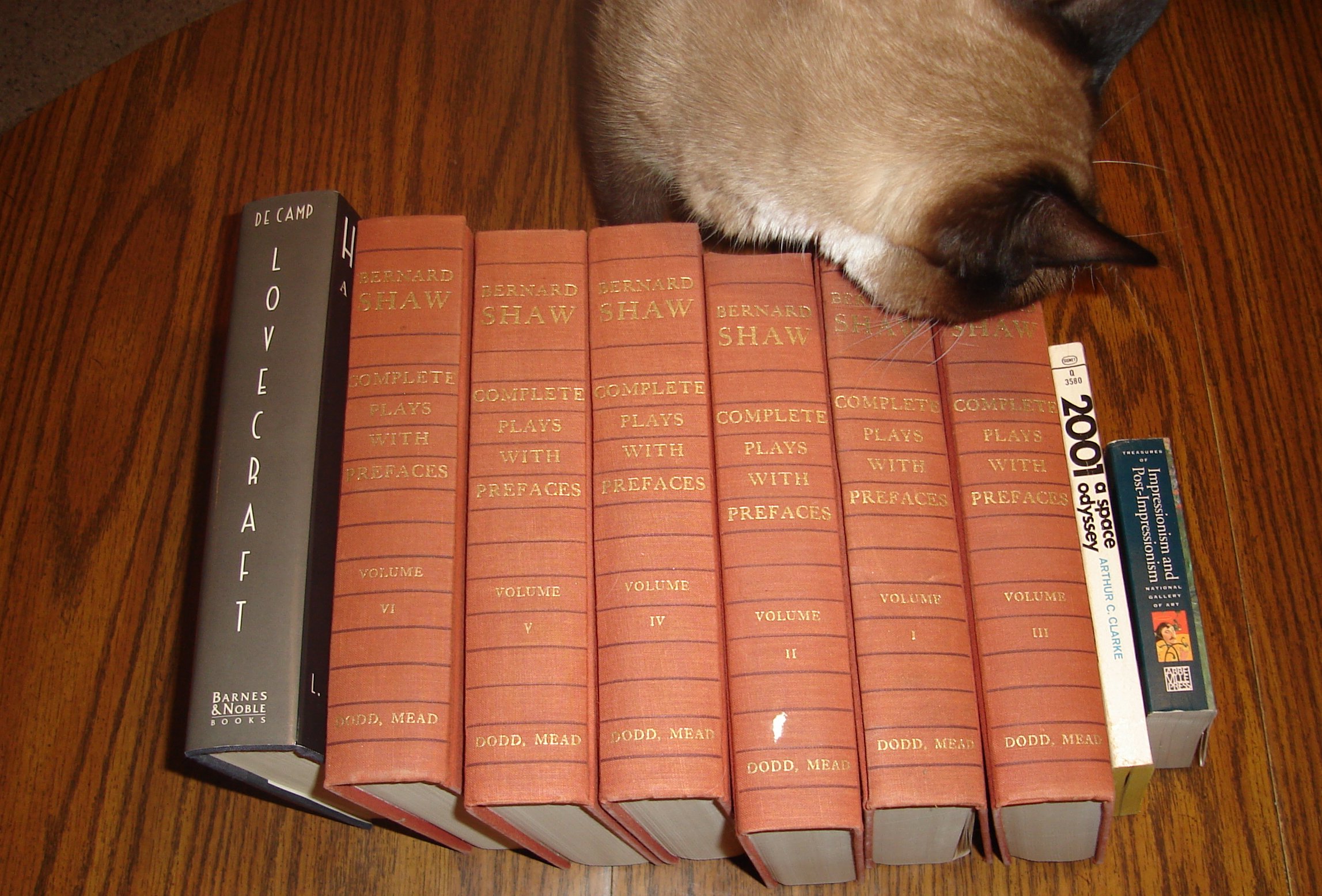
I don’t expect we’ll race back to Kirkwood anytime soon for the pickings. Apparently, the communitariat is too busy protesting its neighbors to read anything worth reading.
Buy My Books!
Like the other MacLean books I’ve read this year (Puppet on a Chain and Santorini), this book represents more “modern” MacLean (that is, up to date when he wrote them; in this case, the late 1970s). Unfortunately, like the other modern books, this one is a little thin relative to the action in, say, The Guns of Navarrone or Where Eagles Dare.
This book details two MacLeanesque heroes who help out a rogue oil billionaire whose revolutionary oil platform, parked in the Gulf of Mexico, is under threat from a bad man employed by the traditional oil cartel. Weapons are fired. However, there really aren’t any plot twists to keep it going. It reads like a television or movie script.
Still, a bad MacLean book is average suspense, so it’s not as though it’s a bad book; it’s just not the best in the MacLean oeuvre.
Buy My Books!
I bought this book this weekend for a quarter, a super bargain since it’s a two-fer: It’s the first printing of the Signet movie tie-in edition (with the book review from the New Yorker cut out and tucked in as a bookmark), and I bought the next two books in the series last weekend, so I needed to get this book, too. I guess there’s a fourth in the series, but I might hold off buying that that until I see how the first three go. After all, he did ruin the Rama series.
The book, written in conjunction sort of with the screenplay for the Kubrick film, fills in a lot of the gaps of just what the heck was going on. It adds plenty of detail to the monkeys scene and to the ending to make sense of what only served as stunning images in the movie.
The plot revolves around the appearance of the monoliths, strange stones that man has found which have an age of 3 million years. When one is found near a moon base, it blasts a radio signal to Saturn (Jupiter in the movie). A ship is sent to it, and Hal the computer kills everyone on board. Even that is explained better in the book. And it’s all tied together.
I’ve seen the movie once and I saw 2010 a couple of times when it was on Showtime and I was stuck in rural Missouri in the 1980s, so I’ll be a little familiar with the continuing storyline.
Although I don’t know how much I’ll appreciate Clarke and his reputation after I am done. I mean, Childhood’s End was okay, this book was okay, Rendezvous with Rama was great until Clarke ruined it in the 1980s with its sequels. But that this fellow is held up with Asimov, Heinlein, and Niven as one of the greats in the field. Meh.
Buy My Books!
This year, I’ve read pulp novels from the Killmaster, the Enforcer, and Matt Helm series, so why not try one from the granddaddy, Don Pendleton’s The Executioner? It has the most books published about a single character, some 200 or 300 of them. So I found one at a book fair, cheap, and checked it out.
The other two series offered more depth. Sugar’s “The Enforcer” has weird sci-fi elements and Objectivist speeches; the Killmaster gets the chicks; and Matt Helm channels Dean Martin, whether intentionally or not. The Executioner just runs around and kills Mafia.
In this book, he goes to Philadelphia to take out a branch of the Family. He blows up a compound that used to be a bordello and then works his way into the home of the don. He kills a “specialist” that’s come to take care of the problem and then sets elements of the mob against each other while having a hand in, I dunno, 60 deaths? 70?
On a side note, The Executioner (one of the main inspirations for Marvel Comic’s The Punisher, by the way) was a Vietnam veteran. Many characters from the pulp of the era and television of the next decade involved Vietnam veteran characters who were not suicidal nutbars or whatnot; instead, they were tough, efficient crime fighters of one sort or another. Where are the veterans as honorable crimefighters these days in popular culture?
This book reads like a television script (and the book says they’re a major motion picture series coming!) with about that much depth of character (I know, it’s pulp, but this guy isn’t much more than a name holding various guns). I guess that’s what you get with a series written by dozens, but this is only #15, when Don Pendleton himself was writing them.
Of all the series I’ve sampled this year, this is the least likely for a return visit; that’s not to say that it’s bad pulp, but it’s the worst of the pulp I’ve read this year.
Buy My Books!
Now that Business 2.0 is going belly up (no word if they’ll transfer our subscription to Fortune or Sports Illustrated or will just forget about us), I’m tied with Charles Hill for number of magazines to which we have subscribed that have ceased publication this year.
One would think that magazines will purge us from their mailing lists for subscription come-ons designed to look like overdue invoices since we’re obviously a kiss of death.
Or perhaps one, me, would hope.
Buy My Books!
Green Bay Packers tied for first place in the NFC North!
Buy My Books!
This book rounds out the Brighton Beach trilogy, and although it’s been decades since I read Brighton Beach Memoirs, I read Biloxi Blues just this May. Ergo, I am sort of up on the characters and storyline. Bottom line? This play was probably the weakest of the bunch and only made its way onto stage and onto the television screen because Neil Simon was all that. As a stand alone drama, it’s a little lacking. You have to be invested in the characters already from the previous works to really care, and the piece doesn’t offer an overarching goal/conflict that needs to be resolved; instead, you’ve got a subplot in the chance Stan and Eugene have to make it as comedy writers, a subplot about the grandmother offstage moving to Florida, and a subplot about the breakdown of the Jerome parents’ marriage. Even lumped together, it doesn’t stick.
On a side note, I find that the actor who played Eugene Jerome in the movie Brighton Beach Memoirs, Jonathan Silverman, reprised the role for the Broadway debut of the play; however, in the made-for-television treatment (as opposed to the other two plays’ movie treatment), Silverman plays Stan Jerome, the older brother. He’s lost the part of Eugene to Corey Parker, who played Epstein in the film Biloxi Blues; as you know, Matthew Broderick played Eugene Jerome in both the Broadway and film versions of Biloxi Blues. Both Silverman and Broderick played Eugene Jerome on Broadway in Brighton Beach Memoirs; so when you’re watching the movies in order, you get some cast switching in odd ways. Kind of like when Lee Van Cleef was two different characters in For a Few Dollars More and The Good, The Bad, and The Ugly.
So it’s good to read the play if you need to close out the trilogy, but if it’s your only insight into the Jerome mythos, you might want to pass.
Buy My Books!
Ogden Nash didn’t take poetry too seriously; the verses are light things with rhymes and runon lines used to comedic effect. I don’t know what else to say about it; they were fun to read aloud and amusing, which is what Nash was no doubt going for. He tortures spellings to get rhymes and tacks on couplets with the punchline to long enumerations, but I liked them well enough to read more.
Which is a good thing, since I bought four volumes at once.
Buy My Books!
I saw this play staged in 1993 or 1994 in Milwaukee at the Milwaukee Rep or one of the subsidiary theatre groups that shares the space down on Wells; at the time, I thought it was the best drama I’d ever seen on stage. I still do, but unfortunately I’m not going to the theatre as much as I did when I was a poor college student making $6.60 an hour and paying tuition. I don’t know how that happened. So my experience hasn’t gotten much broader since the middle 1990s.
This book tells the story of a successful artist, Jonathan Waxman, who visits the home of his collegiate flame in England on the eve before the opening of his first European show. There, he finds a painting from his student period that captures something of his innocence before he became famous and rich and a self-made producer of commodity art. Or maybe it’s his meeting Patty again, a woman whom he dumped unceremoniously because she was not Jewish and who’s now married to an English archeologist whom she does not love.
The play is told in a series of scenes told non-chronologically and in as varied of places as the English house where Patty and her husband live; Jonathan’s boyhood home; the college where they went to school; and the opening itself. When the Milwaukee Rep staged it, I didn’t get the correct sense of the scenes between Jonathan and his German interviewer were at the opening, so I lost a bit from it.
But I got a bit out of reading it that I wouldn’t have if I hadn’t seen it first; perhaps that’s the way to do these plays, unlike movies. Watch them live first and read the book after to see what you’ve missed.
At any rate, I liked the play and I liked the book.
Buy My Books!
This book is a chapbook; that is, a small collection of poetry published probably at Kinko’s and often sold for a nominal fee. Back in 1994 and 1995, I did a couple of my own, although I forked out for the double-sided printing and the saddle stapling instead of the single-sided tape bound print job evidenced in this book.
Not too long after this book’s publication, I met Pam on the open mike circuit in St. Louis, so this represents I suppose the first time I bought a used book from someone I know and reviewed it herein. Ergo, I am going to offer a sunnier, more encouraging review than I’d give to someone I never knew. Be forewarned.
Puleo has a good sense of rhythm and sense for how words sound; I could read these aloud without stumbling or trying to determine the cadence in stride. She’s also fair enough with her eye for imagery.
However, this book shows her as an underachiever. She relies on too much repetition that provides little effect and enjambs a lot of lines that could have been better served with line breaks and punctuation.
She’s somewhere above Rod McKuen. Maybe tied with Sylvia Plath.
As a bonus, here’s a book review I wrote about her in 1995:
Bonus Book Report: St. Louis Jazz by Pam Puleo (1995)
This review first appeared in the Fall 1995 edition of the St. Louis Artesian, a free little pickup literary magazine I published 1994-1996. Puleo gave me a copy of the book, so I reviewed it because, frankly, the hardest part of putting out the magazine was coming up with enough literary stuff to fill it.
Pam Puleo titled her new chapbook St. Louis Jazz, and the title fits her style. Puleo’s well-developed voice binds her poetry like a slender thread woven throughout her works. The voice of wisdom, of been-there, done-that, somehow blends into a softer shade of poetry, into a velvet purple by her continued, although muted romanticism.
Puleo packs many songs into this volume, most describing the search for love in a world that is neither cold nor hot, but only room temperature. The poet’s brief epiphanies and occasional insights we can share as she grows older, grows wiser, but never grows hard not bitter.
Buy My Books!